In summary:
- When a bus ramp fails, your confidence depends on proactive strategies, not just reactive complaints.
- Mastering a ‘confidence toolkit’ of communication, positioning, and legal awareness is key to managing travel anxiety.
- Understanding the nuances of the law (like the Paulley case) empowers you to advocate for your rights effectively in the moment.
- Your journey includes navigating to the stop and accessing destinations; the entire accessibility ecosystem matters.
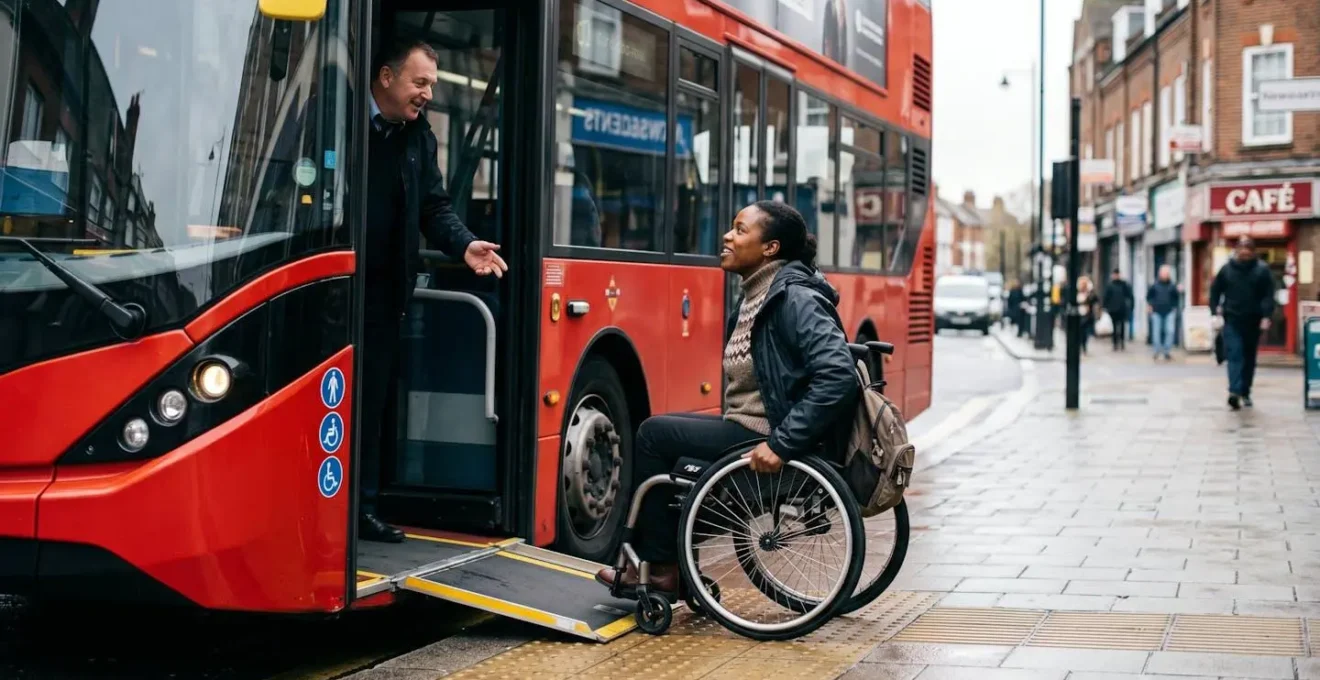
The sight of a bus approaching can bring a mix of hope and anxiety for any wheelchair user. Will the ramp work? Will the designated space be free? Will the driver be helpful? This anxiety is often rooted in past experiences or the fear of a single point of failure: the mechanical ramp. Standard advice often tells you to know your rights and complain later, but this does little to reduce the stress of being left on the pavement.
This approach is reactive. It focuses on what to do after the problem has already derailed your journey. But what if the key to confident travel wasn’t just about knowing the rules, but about mastering a proactive system? What if you could build a ‘confidence toolkit’ that prepares you for potential issues, helps you manage them in real-time, and turns anxiety into a feeling of control?
This guide moves beyond the single issue of a broken ramp. We will explore the entire accessibility ecosystem of a bus journey. We’ll decode the nuanced interactions with other passengers, master the safest way to travel once on board, understand the critical differences between services, and build a powerful strategy for self-advocacy. This is about shifting your mindset from hoping for the best to being prepared for the worst, ensuring you can travel with the confidence you deserve.
This article provides a comprehensive framework for navigating UK bus travel. Below is a summary of the key areas we will cover to build your confidence and knowledge.
Summary: Your Complete Guide to Navigating UK Bus Access Challenges
- Why Can Bus Drivers Ask Pushchair Users to Vacate the Wheelchair Space?
- How to Position Your Wheelchair Correctly for the Safest Bus Journey?
- London Buses vs Regional Services: Which Offers Better Wheelchair Access?
- The Broken Ramp Complaint That Forces Bus Companies to Improve
- When Is the Best Time to Travel by Bus to Avoid Wheelchair Space Conflicts?
- How to Use Tactile Paving to Cross Busy UK Junctions Without Sighted Assistance?
- Why Must UK Shops and Restaurants Make Adjustments for Customers with Reduced Mobility?
- Why Do Tactile Paving Colours Differ at UK Train Stations and Crossings?
Why Can Bus Drivers Ask Pushchair Users to Vacate the Wheelchair Space?
One of the most common sources of conflict and anxiety is finding the designated wheelchair space occupied, often by a pushchair. The legal position is nuanced and was significantly clarified by a landmark Supreme Court case. While a bus driver cannot physically force a passenger to move, they have a legal duty to do more than simply make a single, polite request. The policy of ‘first come, first served’ does not apply when it prevents a wheelchair user from boarding.
This principle was established in the case of FirstGroup Plc v Paulley. When Doug Paulley, a wheelchair user, was denied access because a passenger with a pushchair refused to move, the court ruled that the bus company’s policy was inadequate. The judgment clarified that drivers must take all reasonable steps to make the space available. This includes assessing the situation, rephrasing the request as a requirement of travel, and even stopping the bus for a period to apply pressure and demonstrate the seriousness of the issue. The Court stopped short of requiring drivers to physically remove passengers, but it firmly shifted the responsibility onto operators to enforce a more robust policy. Understanding this gives you the grounds to insist that the driver does more than just give up after the first “no”.
Case Study: The FirstGroup Plc v Paulley (2017) Ruling
The Supreme Court’s decision in this case fundamentally changed bus accessibility policy in the UK. The Court found that simply requesting a non-wheelchair user to move was not enough to fulfil the duty to make reasonable adjustments under the Equality Act. As a result of the landmark Paulley v FirstGroup judgment, drivers are now expected to use more assertive tactics, such as explaining that the space is legally designated for wheelchair users or pausing the service, to encourage compliance. This case provides the legal backbone for a wheelchair user to insist on the driver taking further action if their initial request is ignored.
This legal precedent is a powerful part of your ‘confidence toolkit’. Knowing the driver has a duty to take further steps allows you to advocate for yourself calmly and assertively in a difficult situation.
How to Position Your Wheelchair Correctly for the Safest Bus Journey?
Successfully boarding the bus is only the first step. Ensuring your safety during the journey is paramount, and this depends on correct positioning within the designated space. UK regulations are very specific about this to maximise safety during acceleration, braking, and turning. The primary rule is that you must be positioned facing the rear of the vehicle. This allows the padded backrest to absorb any force from sudden stops, protecting you from injury.
This rear-facing requirement is not just a recommendation; it is mandated by law. The UK Public Service Vehicles Accessibility Regulations 2000 (PSVAR) specify that wheelchair spaces must be designed to accommodate a user in this position. Once you have reversed into the space and your wheelchair is flush against the backrest, the next critical action is to apply your brakes firmly. Do not rely on the bus’s smooth ride; an emergency stop can happen at any time, and engaged brakes are your primary restraint system. Finally, locate the dedicated ‘stop’ button for the wheelchair space before the bus moves off, so you can signal your intent to alight without needing to move.
This simple, repeatable sequence of actions—reverse in, back up to the rest, apply brakes—is a core part of your personal safety protocol. It’s a non-negotiable routine that gives you control over your own safety once on board.
Your Action Plan: Safe On-Board Positioning
- Board the bus, using the ramp, and ask for driver assistance if you need it.
- Manoeuvre into the designated space and reverse so your chair is against the padded backrest, facing the rear of the bus.
- Once in position, apply your wheelchair’s brakes and ensure they are fully engaged.
- Locate the dedicated wheelchair ‘stop’ bell and make a mental note of its position.
- Before you travel, know your chair’s dimensions. The standard UK reference size is 700mm wide by 1200mm long.
London Buses vs Regional Services: Which Offers Better Wheelchair Access?
Not all bus services in the UK are created equal. While national laws like PSVAR set a baseline for accessibility, the consistency and quality of implementation can vary dramatically between London and regional services. For wheelchair users, Transport for London (TfL) operates what is often considered the gold standard. The entire fleet of over 9,000 buses is low-floor and wheelchair accessible, and data shows that 95% of bus stops in London are now wheelchair accessible, often featuring raised kerbs for level boarding.
This level of consistency is harder to find outside the capital. While regional operators like Stagecoach, Arriva, and First Bus are also bound by PSVAR, the reality on the ground can be very different. Fleet upgrades may be less consistent, driver training can vary between depots, and crucially, the bus stop infrastructure in many rural and regional areas often lacks the investment seen in London. This can mean encountering non-raised kerbs, which makes ramp deployment difficult or impossible, even if the bus itself is compliant. Furthermore, policies like free travel for wheelchair users, which is standard in London, are not universal across regional operators.
The table below highlights the key differences, providing the situational awareness needed to manage expectations and plan your journey effectively depending on your location.
| Feature | London TfL Buses | Regional Services (Stagecoach/Arriva/First Bus) |
|---|---|---|
| Fleet Accessibility | 100% low-floor accessible buses across 9,000+ vehicles with 700+ routes | Varies by region; legally required to meet PSVAR 2000 standards but implementation inconsistent |
| Wheelchair Space Size | 2000mm minimum since 2018 (vs 1300mm legal minimum) | Typically 1300mm (legal minimum) |
| Fare for Wheelchair Users | Free travel for all wheelchair and mobility scooter users at all times | Varies by operator; generally no blanket free travel policy |
| Bus Stop Infrastructure | 95% of stops wheelchair accessible with raised kerbs | Highly variable; rural and regional areas often lack raised kerbs and accessible shelters |
| Driver Training | Standardized large-scale TfL training programmes with consistent accessibility protocols | Varies significantly by operator; training quality inconsistent across franchises |
| Complaints System | Unified TfL system with clear escalation path | Fragmented across multiple operators; more complex to navigate |
The Broken Ramp Complaint That Forces Bus Companies to Improve
When you are left stranded by a broken ramp or a driver who refuses to assist, the feeling of powerlessness can be immense. However, a formal complaint is more than just an expression of frustration; it is a powerful tool for change. Bus companies are legally obligated to make ‘reasonable adjustments’ under the Equality Act 2010, and a broken ramp is a clear failure to do so. As legal experts submitted to the UK Parliament, the issue is not a lack of rights, but a lack of awareness on how to enforce them.
The majority of complaints are in relation to lack of ramp assistance… The issue is that other than raising a complaint, the commuters rarely know their rights to raise these as a legal case.
– Ringrose Law, Written evidence to UK Parliament Transport Committee
Turning your experience into a formal, evidence-based complaint is the most effective form of proactive advocacy. A well-documented complaint that references the correct legislation is difficult for an operator to ignore. It creates a paper trail and contributes to a body of evidence that can be used by regulators like the Traffic Commissioner to identify failing operators. Don’t underestimate your power; your complaint can be the catalyst that forces a company to fix its equipment, retrain its staff, and improve its service for everyone. The key is to be methodical and gather as much information as possible at the time of the incident.
Your Checklist: Filing an Effective Accessibility Complaint
- Document the incident: Immediately record the date, time, bus route number, bus registration number (if possible), and the exact location. Take photos or video as evidence.
- Request CCTV evidence: Formally submit a Subject Access Request to the bus operator to obtain CCTV footage of the incident, citing your rights under data protection law.
- File a formal complaint: Use the operator’s official procedure, and in your complaint explicitly reference their failure under the Equality Act 2010 (Section 20) and the Public Service Vehicles Accessibility Regulations 2000.
- Escalate if necessary: If you receive an unsatisfactory response, escalate your complaint to the relevant watchdog: London TravelWatch (for London), the Traffic Commissioner, or Bus Users UK.
- Consider legal action: As a final resort, you can file a claim in the County Court for discrimination. You have 6 months minus one day from the date of the incident to do so.
When Is the Best Time to Travel by Bus to Avoid Wheelchair Space Conflicts?
A key piece of situational awareness for any wheelchair user is understanding the built-in limitations of the system. The most significant of these is that most UK buses, including all in the TfL fleet, have only one designated wheelchair space. While this space is a legal requirement, its singular nature is the primary cause of potential conflicts, whether with other wheelchair users, pushchairs, or passengers with excess luggage.
As per official guidelines, Transport for London regulations specify that all its buses have room for one person using a wheelchair, with standard dimensions up to 70cm wide by 120cm long. This “one space” rule means that the most effective strategy for ensuring a stress-free journey is to travel at times when demand for that space is lowest. This is the essence of proactive journey planning.
Avoiding peak hours is the single most impactful choice you can make. This typically means travelling between 10:00 AM and 3:00 PM on weekdays. School run times (around 8:00-9:00 AM and 3:00-4:30 PM) are particularly prone to high numbers of pushchairs, increasing the likelihood of the space being occupied. By planning your journeys for mid-morning or early afternoon, you dramatically increase the probability of finding the wheelchair space empty and ready for you, minimising the chance of conflict or delay.
This simple shift in timing can transform the travel experience from a gamble into a predictable and calm routine, reducing anxiety and putting you in control of your journey.
How to Use Tactile Paving to Cross Busy UK Junctions Without Sighted Assistance?
Your ‘confidence toolkit’ for public transport extends beyond the bus itself. The journey to and from the bus stop is an integral part of the experience, and mastering the accessibility features of the urban environment is crucial. Tactile paving is a key component of this accessibility ecosystem, providing vital information for visually impaired pedestrians, but its signals are useful for everyone navigating a complex junction. Understanding its language enhances your situational awareness. There are two main types: ‘blister’ paving (domed surfaces) warns of a hazard like a kerb edge, while ‘corduroy’ paving (ribbed bars) provides directional guidance across a crossing.
At controlled crossings, these tactile surfaces are combined with audible and other tactile signals to create a multi-sensory system. When you press the button, you can often find a rotating cone on the underside of the control box. This cone spins when the ‘green man’ is illuminated, providing a tactile signal for deafblind users. This is accompanied by an audible bleep, which often gets faster to indicate that time to cross is running out. By combining these cues—the feel of the paving underfoot, the spinning cone, and the audible signal—you can navigate busy junctions with much greater confidence, even without perfect sight.
Your Plan: Crossing a Junction Using Multi-Sensory Cues
- Locate the crossing point by finding the tactile ‘blister’ paving, which indicates the edge of the pavement.
- Find the control box and press the button. Feel for the rotating cone underneath it.
- Wait for the signals: Listen for the steady bleeping to start and feel for the cone to begin spinning. This is your signal to cross.
- Follow the path: If present, use the ‘corduroy’ tactile paving to guide your direction straight across the road.
- Be aware of the changing signal: Listen for the bleeping to speed up, which warns you that the crossing time is ending.
Knowing how to interpret this system means you are less reliant on visual cues alone, adding another layer of resilience to your complete journey from door to destination.
Why Must UK Shops and Restaurants Make Adjustments for Customers with Reduced Mobility?
The principles of the Equality Act 2010 do not end at the bus door. Your journey’s destination, be it a shop, café, or restaurant, is also legally required to be accessible. The obligation for service providers to make ‘reasonable adjustments’ is a cornerstone of UK disability law. This isn’t just about social responsibility; it’s a legal duty and a massive economic opportunity that businesses ignore at their peril. The collective spending power of disabled people and their families, often termed the ‘Purple Pound’, is a significant economic force.
Indeed, research into the ‘Purple Pound’ demonstrates that this market is valued at an estimated £274 billion annually in the UK. Businesses that fail to make reasonable adjustments are not only breaking the law but are also turning away a huge and loyal customer base. For a wheelchair user, a ‘reasonable adjustment’ can be as simple as a portable ramp to overcome a single step, staff willing to bring items from an inaccessible shelf, or ensuring there is a clear path between tables. Knowing that these are not favours, but legal requirements, empowers you as a consumer.
You have the right to expect these adjustments, and if they are not provided, you have grounds for a complaint. This knowledge is part of your toolkit for navigating the entire community, not just the transport network. It ensures that your accessible journey on the bus leads to an equally accessible and welcoming experience at your destination.
Your Checklist: What Constitutes a ‘Reasonable Adjustment’ in a Venue?
- Physical Access: Is there a ramp for steps? Are doorways at least 800mm wide? Are thresholds level?
- Interior Navigation: Are pathways between displays or tables clear and at least 900mm wide?
- Communication: Are staff trained to assist? Are large-print menus or table service available if needed?
- Facilities: Is there an accessible toilet with adequate turning space and a RADAR key system or free access?
- Information: Does the venue’s website provide clear information about its accessibility features in advance?
Using this checklist allows you to quickly assess a venue and know when to ask for an adjustment you are legally entitled to.
Key takeaways
- Proactive self-advocacy, based on knowledge, is more powerful than reactive complaining.
- Your journey is a complete ‘accessibility ecosystem’, from tactile paving at junctions to the adjustments made at your destination.
- The Paulley case is a vital tool, proving drivers have a duty to take robust action to clear the wheelchair space.
Why Do Tactile Paving Colours Differ at UK Train Stations and Crossings?
To fully master the accessibility ecosystem, it helps to understand the ‘why’ behind its design, including its inconsistencies. The tactile paving system, a Japanese invention from the 1960s, was designed with a dual purpose: to be felt underfoot and to be seen by those with partial sight, using high-contrast colours. In the UK, this has evolved into a national standard where colour provides an extra layer of information. Typically, red tactile paving is used at controlled crossings (those with traffic lights or a pelican crossing), while buff-coloured paving is used at uncontrolled crossings or to mark the edge of train station platforms.
However, anyone who travels regularly will notice that this colour-coding is not always consistent. The effectiveness of the system can be undermined by several factors. Incorrect installation by contractors, natural weathering that fades the colours, and regional variations in practice can all lead to confusion. A red tactile surface might be used where a buff one is specified, or vice-versa.
While frustrating, understanding this potential for inconsistency is, in itself, a part of advanced situational awareness. It means you learn to trust the texture (blister for hazard, corduroy for direction) as the primary source of information, while treating the colour as a secondary, and sometimes unreliable, clue. It’s a perfect example of how the ideal design of an accessible system can be compromised in the real world, and how knowledgeable users can adapt by understanding both the rule and its common exceptions. This deeper knowledge builds resilience, ensuring you can navigate safely even when the system isn’t perfect.
By shifting from a mindset of anxiety to one of proactive, informed advocacy, you reclaim control. This ‘confidence toolkit’—understanding the law, mastering your safety procedures, and reading the entire accessibility ecosystem—empowers you to not just travel, but to travel with the assurance and independence you are entitled to. Start building your confidence today by planning a short, local bus journey to put these principles into practice.