In summary:
- Effective assistive aids are not about cost, but about matching the right tool to a specific, recurring daily challenge.
- Proactively identifying task “bottlenecks” before they cause exhaustion is key to maintaining independence and energy.
- Overcoming the psychological hurdle of using aids is crucial; reframing them as “energy-saving tools” rather than symbols of decline is effective.
- For UK residents, resources like the Disabled Facilities Grant (DFG) can help fund larger home adaptations like accessible kitchen storage.
- The goal is to use technology to conserve physical energy for the activities you love, not just to complete necessary chores.
The stubborn lid on a jar of jam. The tiny button on a favourite shirt. These small, everyday challenges can become significant sources of frustration when grip strength begins to wane. For many seniors in the UK, this gradual change feels like an unavoidable loss of independence. The common response is often a patchwork of solutions—a gadget bought on a whim, a task avoided, or a reluctant request for help. This approach focuses on the symptoms of a problem, not the strategy to solve it.
While the market is flooded with catalogues of assistive devices, simply acquiring more “stuff” rarely leads to a meaningful improvement in quality of life. The discussion often circles around the features of the aids themselves, overlooking the more critical questions: Which specific struggles drain the most energy? When is the right time to introduce an aid to prevent exhaustion, not just react to it? And how do we overcome the feeling that using a device makes us “look old”?
But what if the key to maintaining independence wasn’t in the device, but in the decision-making process? This guide proposes a different perspective. We will shift the focus from a reactive collection of gadgets to a proactive strategy of “energy conservation.” By viewing assistive aids as smart tools to manage your daily energy expenditure, you can preserve your stamina for the activities that bring you joy, whether it’s gardening, playing with grandchildren, or pursuing a hobby.
This article will provide a practical framework for this strategic approach. We will explore how to identify which tasks would most benefit from an aid, compare different types of solutions for common issues like dressing and kitchen access, and address the psychological barriers to adoption. We will also cover the practicalities of funding and installation for larger adaptations within the UK context, empowering you to make informed choices that genuinely enhance your daily life.
This guide is structured to walk you through a strategic process for selecting and implementing assistive technology. The following sections break down key decisions, from identifying needs to understanding specific solutions for the home.
Summary: A Strategic Guide to Assistive Devices for Hand Weakness
- Why Does a £5 Jar Opener Restore More Independence Than Expensive Gadgets?
- How to Identify Which Daily Struggles Would Benefit Most from Technical Aids?
- Button Hook vs Voice-Activated Dressing Aid: Which Helps Arthritis Sufferers More?
- The “It Makes Me Look Old” Mistake That Stops Seniors Using Life-Changing Aids
- When Should You Introduce Dressing Aids Before Mornings Become Exhausting?
- When Should You Install Soft-Close Pull-Downs Before Grip Strength Declines Further?
- Full-Length Bed Rail vs Grab Handle: Which Helps More for Getting Out of Bed?
- How Far Down Should Pull-Down Baskets Reach for Safe Wheelchair Access?
Why Does a £5 Jar Opener Restore More Independence Than Expensive Gadgets?
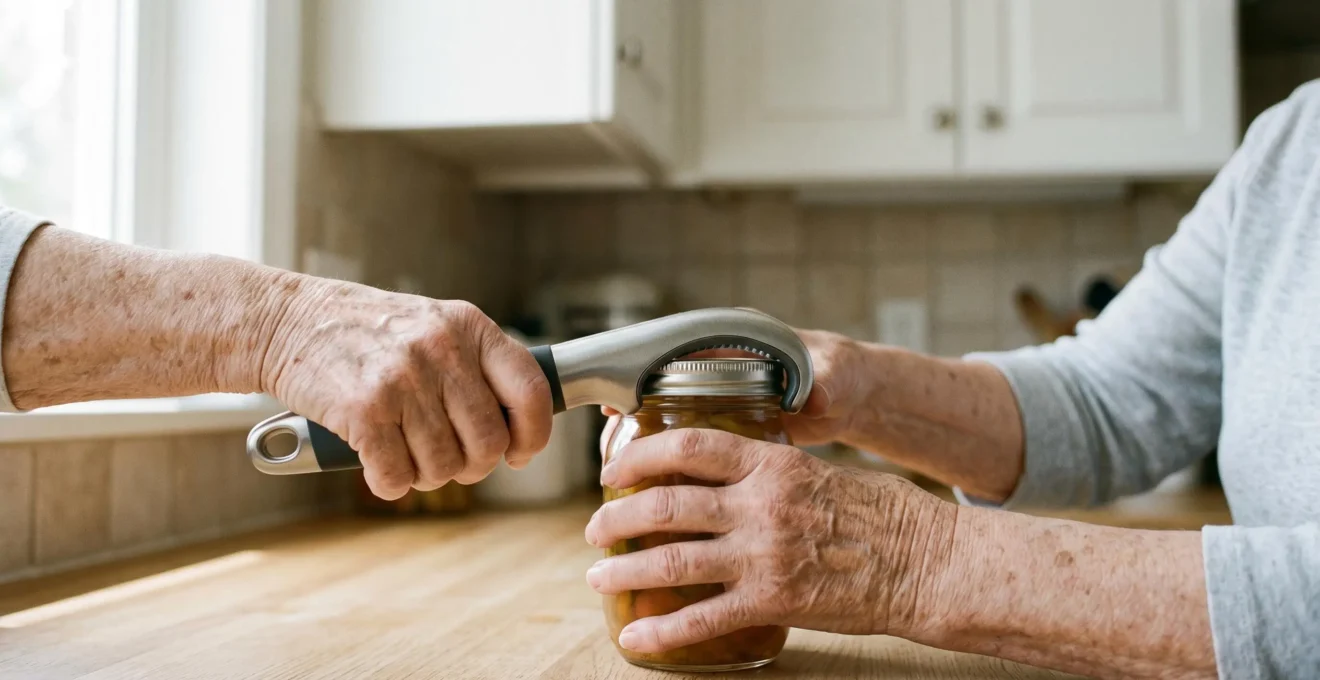
Independence is not measured in pounds sterling. A high-tech, voice-activated system might seem impressive, but if it solves a problem you only face once a month, its impact is minimal. Conversely, a simple, £5 silicone jar opener that enables you to make your own breakfast every single morning without assistance delivers a profound, daily dose of self-sufficiency. The value of an assistive device lies in its ability to solve a frequent, high-friction problem, thereby conserving your physical and mental energy for more rewarding activities.
This principle is about focusing on impact over innovation. It’s a shift from asking “What’s the newest gadget?” to “What is the simplest tool that resolves my most common frustration?” Often, the most effective solutions are low-tech, intuitive, and designed to do one thing exceptionally well. Research consistently shows the outsized impact of these simple interventions; one study highlighted that providing such devices can lead to a 50% reduction in disability rates among older adults. By addressing the small, recurring “energy leaks” in your day, you free up significant reserves.
The challenge of reduced grip strength is a practical, mechanical issue. As Dr. Kenneth Lam, a researcher from the National Health and Aging Trends Study, points out, “It’s a technical problem which, unlike so much of aging, is actually solvable.” This empowering perspective reframes the use of aids not as a concession to age, but as a smart, tactical decision. The goal isn’t to surround yourself with medical equipment; it’s to strategically deploy simple tools that eliminate daily bottlenecks, making life easier and more enjoyable.
Therefore, the success of a device is not in its price tag or complexity, but in its frequency of use and the degree of independence it restores. A well-chosen kitchen tool that allows you to cook your favourite meal is infinitely more valuable than a costly gadget that sits in a drawer.
How to Identify Which Daily Struggles Would Benefit Most from Technical Aids?
Before you can select the right tool, you must first accurately diagnose the problem. A systematic self-assessment is the most effective way to pinpoint the specific tasks that are becoming difficult, frustrating, or energy-draining. This isn’t about listing every minor inconvenience; it’s about identifying the recurring bottlenecks in your daily routine. An occupational therapist (OT) often performs this kind of evaluation, but you can conduct a basic version yourself to gain powerful insights.
The goal is to move from a vague feeling of “things are getting harder” to a concrete list of challenges. Think of yourself as a detective in your own home, observing activities room by room. Which specific actions require the most effort or cause the most discomfort? Is it twisting a tap, buttoning a cuff, or reaching a plate from a high shelf? Keeping a simple diary for one week can be incredibly revealing, creating a data-driven list of priorities rather than relying on memory.
This methodical approach, as visually represented by a professional assessment, ensures that you are solving the right problems. It prevents impulse buys of gadgets that don’t match your actual needs and focuses your investment of time and money on solutions that will deliver the greatest return in terms of daily independence and energy conservation. The checklist below provides a structured way to begin this process.
Your Action Plan: A DIY Home Assessment for Aid Identification
- Kitchen Assessment: For one week, note every time you struggle to open a jar, turn a knob, grip a utensil, or reach a high cupboard. Is it a grip, twist, or reach problem?
- Bathroom & Dressing Assessment: Document difficulties with taps, buttons, zippers, or putting on socks and shoes. Note if balance is also a factor during these tasks.
- Mobility & Household Assessment: Track how often you have trouble rising from a chair, carrying items, or retrieving something you’ve dropped. This helps separate grip issues from broader mobility challenges.
- Task Avoidance Log: Write down any task you avoided doing because it seemed too difficult or tiring. This often reveals the most significant areas for intervention.
- Prioritise Your List: Review your notes and rank the challenges. The tasks that appear most frequently or cause the most frustration are your top priorities for finding an assistive solution.
Button Hook vs Voice-Activated Dressing Aid: Which Helps Arthritis Sufferers More?
For the over 10 million people in the UK living with arthritis, getting dressed can be a daily battle. The choice of an assistive aid, however, is not a simple case of “good” versus “bad.” The most helpful device depends entirely on the specific symptoms and the individual’s goals. A low-tech button hook and a high-tech voice-activated dressing system both aim to help, but they solve very different problems, making solution matching a critical step.
A button hook is a prime example of a targeted, low-tech solution. It is designed specifically to address the loss of fine motor skills and pincer grip, common in conditions like rheumatoid arthritis. It allows the user to continue wearing their existing wardrobe and maintain a sense of normalcy and control over their clothing choices. It is inexpensive, requires no setup, and directly solves the mechanical problem of manipulating small buttons.
A voice-activated dressing aid, on the other hand, is a high-tech solution that addresses much broader issues. It’s not just about finger dexterity; it’s for individuals with significant mobility limitations, severe fatigue, or a reduced range of motion where the entire act of dressing is exhausting. This type of device is an energy conservation tool on a larger scale. While more expensive and requiring a learning curve, it can be life-changing for someone whose primary goal is to simply get dressed without depleting their energy for the rest of the day.
The following table breaks down the key differences, helping you match the solution to the specific symptom you or a loved one is experiencing. Understanding this distinction is key to investing in an aid that truly assists rather than one that adds complexity.
| Factor | Button Hook (Low-Tech) | Voice-Activated Dressing Aid (High-Tech) |
|---|---|---|
| Primary Symptom Addressed | Loss of fine motor skills and pincer grip (common in rheumatoid arthritis) | Broader mobility limitations, severe fatigue, and reduced range of motion |
| Cost Range | £3-£8 (widely available in UK mainstream stores) | £50-£200+ (specialized medical equipment suppliers) |
| Learning Curve | Immediate use, no setup required | Requires setup, voice training, and adaptation period |
| Best For | Early-stage arthritis, maintaining clothing choice independence | Advanced arthritis with significant energy conservation needs |
| UK-Specific Benefit | No VAT when purchased as disability aid from registered suppliers | Eligible for VAT Relief on complex aids (0% VAT vs 20% standard rate) |
The “It Makes Me Look Old” Mistake That Stops Seniors Using Life-Changing Aids
Perhaps the single greatest barrier to adopting assistive technology is not cost or availability, but stigma. The thought, “This will make me look old and frail,” prevents many people from using simple tools that could dramatically improve their quality of life. This psychological hurdle is powerful, but it can be overcome by reframing the purpose of these devices: they are not symbols of decline, but tools of empowerment and proactive enablement.
One of the most effective strategies to dismantle this stigma is to normalize the use of well-designed aids. Many modern devices are created with “universal design” principles, meaning they are designed for everyone’s comfort and ease of use, not just for people with a disability. The popular OXO Good Grips range of kitchen utensils is a perfect example; their thick, soft-handled peelers and can openers are celebrated by chefs and home cooks of all ages for their superior ergonomics, not because they are “disability aids.” Highlighting these mainstream examples can help shift perception.
Case Study: The UK Disabled Living Centres ‘Try-Before-You-Commit’ Strategy
To combat the stigma of “medical shopping,” UK-based Disabled Living Centres provide a non-commercial, pressure-free environment. Visitors can explore and physically test a wide array of assistive devices in realistic, home-like settings. By trying a dressing aid in a mock bedroom or a kitchen gadget in a model kitchen, seniors can experience the benefits firsthand without the pressure to purchase. This hands-on approach normalizes the technology, reframing it as a practical lifestyle tool rather than a piece of medical equipment, which has been shown to significantly increase adoption rates among those who were initially resistant.
For family members, opening this conversation requires tact and empathy. Instead of focusing on the limitation, focus on the benefit. Frame the device as a way to conserve energy for more enjoyable activities. For example, using a sock aid might save enough energy in the morning to make an afternoon of gardening possible. The following points can help guide a positive and productive conversation:
- Frame as Energy Conservation: “This tool could save your energy in the morning so you have more stamina for your gardening later.”
- Emphasise Maintained Activities: “With this device, you can continue preparing your own meals independently, just the way you like.”
- Normalize with Universal Design: “Lots of people use these ergonomic tools because they’re just more comfortable for everyone.”
- Highlight Aesthetic Options: “Modern aids come in all sorts of stylish designs now; we can find one that matches your kitchen.”
- Offer a Trial Period: “Let’s just try it for a week. If you don’t find it helpful, we can return it, no pressure at all.”
When Should You Introduce Dressing Aids Before Mornings Become Exhausting?
The ideal time to introduce a dressing aid is not when getting dressed has become an impossible task, but when it starts to become a consistently tiring one. This is the concept of the “adoption threshold”: the point at which the daily effort of a task begins to noticeably impact your energy or mood for the rest of the day. By introducing a simple aid *before* you cross this threshold, you shift from a reactive mindset of “I can’t do this anymore” to a proactive one of “How can I make this easier to keep doing it indefinitely?”
Research indicates that for most adults, noticeable decline in grip strength typically begins after age 60, though it’s a gradual process. The key is to pay attention to the early warning signs. Are you starting to avoid certain shoes because bending down is a strain? Do you find yourself resting after the “effort” of putting on a coat? These are signals that a task is beginning to cost more energy than it should. Introducing a long-handled shoehorn or a dressing stick at this stage isn’t an admission of defeat; it’s a strategic move to preserve your valuable energy reserves.
Using an aid proactively maintains dignity and control. It prevents the morning routine from becoming a source of dread and exhaustion, allowing you to start the day with more stamina and in a better frame of mind. The senior pictured above isn’t “giving in”; they are smartly using a well-designed tool to maintain their independence with grace. This is the essence of proactive enablement.
Waiting until a task is completely unmanageable often leads to frustration, a higher risk of falls, and a greater psychological barrier to accepting help. The moment you find yourself consistently thinking, “This is becoming a real chore,” is the perfect moment to ask, “Is there a simple tool that could make this effortless again?”
When Should You Install Soft-Close Pull-Downs Before Grip Strength Declines Further?
While small gadgets solve immediate problems, larger home adaptations like pull-down kitchen shelves address long-term safety and accessibility. These systems bring high cupboards down to a manageable level, eliminating the need for risky stretching or climbing on step-stools. The right time to consider such an installation is when you first notice that reaching for everyday items like plates or glasses has become a conscious effort or a cause for concern about balance. Installing them proactively, before a near-miss or fall occurs, is a crucial investment in future safety.
For many in the UK, the cost of such adaptations can be a significant barrier. However, financial support is available. The Disabled Facilities Grant (DFG) is a council-run grant designed to help with the costs of making changes to your home so you can continue to live there safely and independently. This can cover a wide range of adaptations, including widening doors, installing ramps, and modifying kitchen or bathroom facilities to make them more accessible. In England, you can get up to £30,000, and the grant is means-tested for adults.
The process begins not with a builder, but with your local council. Requesting a free Care Needs Assessment is the essential first step, regardless of your income or savings. This assessment, often carried out by an occupational therapist (OT), will determine which adaptations are necessary and appropriate for your situation. It’s crucial not to start any work before your grant is approved, as this can invalidate your application.
Understanding the availability of this support can change the calculation entirely. What might seem like an unaffordable luxury becomes a feasible safety measure. The UK government continues to support this initiative, confirming significant funding to help people adapt their homes. Thinking about these larger projects proactively, and knowing that financial pathways like the DFG exist, allows for long-term planning to ensure your home remains a safe and comfortable environment as your needs change.
- Request a Needs Assessment: Contact your local council to ask for a free assessment from an occupational therapist. This is the official starting point.
- Get the OT’s Recommendation: The OT will visit your home and recommend specific adaptations, such as pull-down shelving, to meet your needs.
- Apply for the DFG: With the OT’s report, you can then apply for the Disabled Facilities Grant through your local council’s housing department.
- Wait for Approval: The council has up to six months to give you a decision. You must not start the installation before you get official approval.
- Complete the Work: Once approved, the work must be completed within 12 months.
Full-Length Bed Rail vs Grab Handle: Which Helps More for Getting Out of Bed?
Transitioning safely in and out of bed is a cornerstone of daily mobility and independence. When this action becomes difficult due to reduced core or grip strength, bed aids are often considered. However, a full-length bed rail and a smaller grab handle (or bed assist rail) serve fundamentally different purposes. Choosing the correct one is a critical safety decision that requires a clear understanding of function, not just form. One is a passive safety net, while the other is an active mobility tool.
A full-length bed rail is primarily a passive safety device. Its main function is to prevent a person from accidentally rolling or falling out of bed during sleep. It is most appropriate for individuals who are at high risk of falls while sleeping, perhaps due to cognitive conditions, restlessness, or medication side effects. However, it’s important to be aware of the potential risks, such as entrapment, which is why the Medicines and Healthcare products Regulatory Agency (MHRA) in the UK has specific guidance on their safe use.
In contrast, a grab handle or bed assist rail is an active mobility aid. It is designed to be purposefully held to provide leverage and support for the user to pull themselves from a lying to a sitting position, and then to push up into a standing position. This type of aid is ideal for someone who has the cognitive ability and upper body strength to use it but needs that extra support to overcome reduced leg or core strength. They are commonly recommended by OTs as a first-line solution for improving bed mobility.
The choice is not about which is “better,” but which one matches the specific need: fall prevention during sleep versus active assistance for transfers. The table below outlines the key considerations for each, providing a clear framework for this important decision.
| Factor | Full-Length Bed Rail | Grab Handle (Bed Assist) |
|---|---|---|
| Primary Function | Passive safety device—prevents falls during sleep | Active mobility aid—assists with sitting up and standing motion |
| Best For | Preventing nighttime rolling/falling from bed; suitable for those at risk during sleep | Providing leverage to transition from lying to sitting to standing; for those with reduced core/leg strength |
| Safety Consideration | Risk of entrapment between rail and mattress (MHRA guidance applies) | Lower entrapment risk; must be properly secured to bed frame |
| Installation | Fastens between mattress and box spring; requires compatible bed frame | Slides under mattress or bolts to frame; generally easier installation |
| NHS/OT Recommendation | May recommend alternatives like height-adjustable beds for high-risk patients | Commonly recommended as first-line aid for mobility assistance |
| Availability via UK Services | May be loaned through local authority equipment services after OT assessment | Widely available; may qualify for local authority loan or DFG contribution |
Key takeaways
- The best assistive tool is not the most expensive, but the one that solves a frequent, daily problem.
- Proactively assess which tasks drain your energy; introduce aids before these tasks become exhausting to conserve stamina for enjoyable activities.
- Overcome the stigma of using aids by reframing them as smart, ergonomic tools for empowerment, not symbols of decline.
How Far Down Should Pull-Down Baskets Reach for Safe Wheelchair Access?
For wheelchair users, a standard kitchen is often a landscape of inaccessible spaces. Pull-down shelving units are a transformative adaptation, but their effectiveness hinges on correct installation. It’s not enough for the basket to simply lower; it must descend to a height that allows for safe and comfortable access without straining. The key is to adhere to established accessibility standards to ensure the adaptation is genuinely useful.
In the United Kingdom, guidance for accessible design is laid out in building regulations. Specifically, the UK Building Regulations Approved Document M (Volume 1) specifies that the most comfortable reach zone for a seated person is generally between 750mm and 1200mm from the floor. For a pull-down basket, this means the lowest point of the basket in its fully extended position should fall within this range, ideally at the lower end (around 750-800mm) to accommodate users of different heights and arm lengths.
Beyond vertical height, other spatial considerations are critical for true accessibility. There must be sufficient clear floor space in front of the unit to allow a wheelchair to approach and turn. A minimum 1500mm diameter turning circle is the standard requirement. Furthermore, the force required to operate the pull-down mechanism is a vital factor for users with reduced grip strength. The mechanism should be smooth and light, requiring less than 5kg of force to operate, ensuring the user can manage it independently.
Installing these systems correctly from the outset prevents a costly adaptation from becoming another source of frustration. When planning such an installation, whether privately or through a Disabled Facilities Grant, these measurements are not just suggestions—they are the blueprint for creating a truly functional and empowering kitchen space. The following checklist summarizes the critical installation points to review with a contractor or OT.
- Basket Bottom Height: Ensure the lowest part of the basket, when fully lowered, is between 750mm and 800mm from the finished floor level.
- Clear Floor Space: Maintain a clear space of at least 1500mm x 1500mm in front of the cabinet for wheelchair manoeuvring.
- Knee Clearance: If a front approach under a counter is needed, ensure there is at least 800-900mm of clear space for knees.
- Operating Force: Test the mechanism. It should be easy to pull down and lock into place with minimal effort.
- Final Adjustment: The best systems allow for minor height adjustments after installation to perfectly tailor the final position to the primary user.
By shifting your perspective from simply acquiring gadgets to strategically managing your energy, you can transform assistive technology from a reactive measure into a proactive tool for a fuller, more independent life. The next logical step is to begin your own “task-first assessment” today, identifying one or two daily friction points where a simple, targeted solution could make all the difference.