The single most important factor for medical alert engraving is not listing every condition, but providing immediate, actionable intelligence for the first 60 seconds of an emergency.
- Information is prioritised based on what can kill you or change a paramedic’s immediate treatment plan (e.g., allergies, anticoagulants).
- A simple, engraved bracelet is often more effective than a high-tech NFC/QR code version because it requires zero technology or time to read.
Recommendation: Audit your current medical information using a paramedic’s “what-if” framework: If you were found unconscious, what single piece of data would a first responder need to know to save your life? Engrave that first.
In an emergency, every second counts. As the sirens approach, a team of first responders is already running through scenarios. When they arrive, their focus is singular: stabilise the patient. For many UK seniors, a medical alert bracelet, often bearing the Rod of Asclepius symbol, is their voice when they cannot speak. But what should that voice say? The common advice is to list your name, conditions, and an emergency contact. While not wrong, this approach often misses the critical point.
Thinking like a patient is natural. You want to provide a complete picture of your health. But for your bracelet to be truly effective, you must learn to think like a paramedic. What information is not just useful, but life-altering in that initial, chaotic minute? It’s not about your GP’s name or your full medical history. It’s about the “deal-breakers”—the facts that will dictate whether a paramedic pushes a certain drug, starts a specific procedure, or immediately suspects a particular cause for your collapse. You do not need a prescription to wear one, but you do need a strategy for what it says.
This guide moves beyond generic lists. It’s a look inside the first responder’s mind, prioritising the information we need to make the right decisions, fast. We will deconstruct the what, why, and when of medical alert information, ensuring your bracelet is not just a piece of jewellery, but a life-saving tool optimised for a real-world emergency.
To help you navigate this critical topic, this article breaks down the essential considerations from a first responder’s perspective. You’ll find a structured guide to making your medical ID as effective as possible in an emergency.
Contents: A Paramedic’s Guide to Medical IDs
- Why Do Paramedics Check for Medical Bracelets Before Administering Certain Drugs?
- Engraved Bracelet vs NFC Smart ID: Which Do UK Paramedics Actually Check?
- MedicAlert vs Amazon Medical Bracelet: Is the Subscription Service Worth the Cost?
- The Penicillin Allergy Bracelet That Nearly Killed a Patient with Outdated Information
- When Should You Update Your Medical Alert Bracelet After a New Diagnosis?
- Why Does a Sudden 20-Point Drop in Blood Pressure Need Urgent Attention?
- Why Does Your Home Pendant Alarm Not Work Once You Leave the House?
- Can You Get a Panic Button That Works Outside Your Home in the UK?
Why Do Paramedics Check for Medical Bracelets Before Administering Certain Drugs?
When a paramedic arrives, they are facing a patient and a puzzle. An unconscious or confused individual cannot provide a history. In this critical information vacuum, a medical alert bracelet isn’t just helpful; it’s a primary diagnostic tool. We are trained to look for them. In fact, a survey revealed that more than 95% of first responders look for medical IDs during emergencies. We check the wrists and neck during our initial patient assessment for this exact reason.
The information engraved on that small piece of metal can fundamentally alter our treatment plan. The most crucial reason is to prevent iatrogenic harm—injury caused by medical treatment. For example, if a patient is in a traffic accident and is bleeding, our standard protocols might involve certain procedures. However, if their bracelet says “ON ANTICOAGULANTS” or lists a specific blood thinner like Apixaban, our entire approach changes. Giving a standard clotting agent without this knowledge could be ineffective or even harmful.
Similarly, a bracelet listing “Penicillin Allergy” prevents the administration of a common and effective group of antibiotics that could otherwise trigger life-threatening anaphylaxis. It’s about knowing what NOT to do just as much as knowing what to do. Information like “Diabetes,” “Epilepsy,” or “Adrenal Insufficiency” provides immediate clues to the cause of a collapse, guiding us toward administering glucose, protecting against a seizure, or providing an essential steroid, all within the first few minutes.
This immediate access to “actionable intel” is the core function of a medical ID. It bypasses guesswork and directs us toward safe, effective, and rapid care when the patient cannot advocate for themselves.
Engraved Bracelet vs NFC Smart ID: Which Do UK Paramedics Actually Check?
In the “First 60 Seconds” of an emergency, simplicity is king. The environment can be chaotic, dark, or weather-beaten. Our gloves are on, our hands might be busy, and our attention is split between the patient and the surroundings. This is the operational reality that dictates our preference for medical ID formats. While NFC and QR code bracelets are technologically advanced, they introduce barriers that are significant in an emergency context.
An NFC or QR code system requires a paramedic to:
- Have a compatible, charged smartphone with them.
- Have a reliable data signal.
- Take the time to scan the code, navigate a webpage or app, and potentially enter a password.
This process can take minutes. In an emergency, we don’t have minutes; we have seconds. The traditional engraved bracelet, by contrast, requires only one thing: a pair of eyes. The information is instantly accessible, with zero dependencies on technology, battery life, or internet connectivity. It is the most reliable and efficient method of communicating critical information in a crisis.
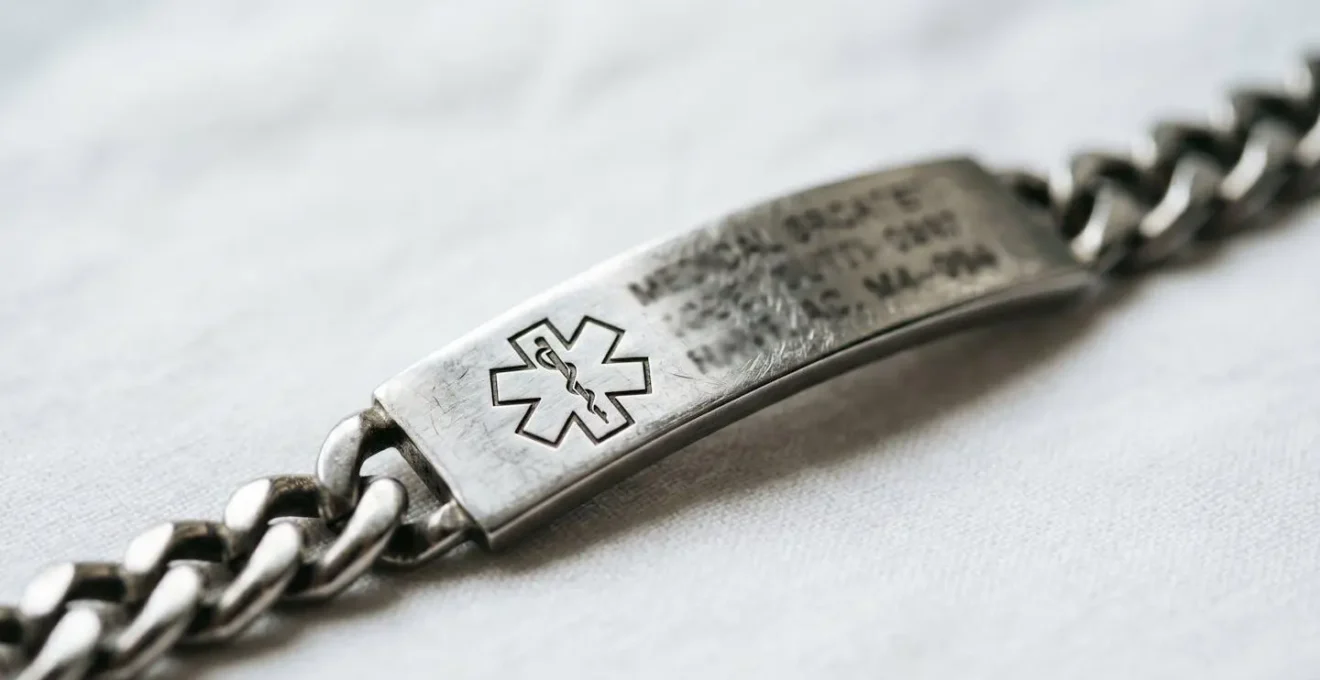
As the image above illustrates, the strength of a traditional ID is its straightforward, fail-safe design. It cannot fail to load, lose signal, or require a software update. While a smart ID can hold more information, the most vital data—the “deal-breakers”—should be immediately visible. A hybrid approach can work, where the most critical information is engraved, and a QR code offers secondary details for the hospital, but for pre-hospital care, engraving is the gold standard.
Therefore, when choosing a bracelet, prioritise the instant readability that a clear, concise engraving provides. This is the format that is most aligned with the realities of emergency response.
MedicAlert vs Amazon Medical Bracelet: Is the Subscription Service Worth the Cost?
The market for medical IDs ranges from simple, inexpensive bracelets found on Amazon to comprehensive services like MedicAlert, which require an annual subscription. For a UK senior with multiple health conditions, the choice isn’t just about cost; it’s about the depth of information and the support structure you need in an emergency. A basic engraved bracelet from a retailer provides the essential “First 60 Seconds” information we’ve discussed. It’s a vital, low-cost safety measure.
However, a subscription service like MedicAlert offers a fundamentally different level of support. The bracelet or pendant contains a unique ID number and a 24/7 emergency phone line. When a paramedic calls that number, they are connected to a trained operator who can verbally relay a wealth of pre-registered information. This goes far beyond what can be engraved on a small plate. It’s your full dossier, available on demand.
Case Study: The MedicAlert 24/7 Emergency Response Service
MedicAlert’s subscription service provides a 24/7 US-based Emergency Response Team that acts as a liaison between first responders and members. When paramedics call the hotline after finding a MedicAlert ID, trained specialists relay comprehensive medical information including conditions, allergies, medications, implanted devices, and emergency contacts. The service also directly notifies family members during emergencies and maintains a secure digital health record accessible nationwide, providing continuity of care that basic engraved bracelets cannot offer.
Is it worth it? If you have a complex medical history, multiple medications, implanted devices (like a pacemaker or stent), or rare conditions, the answer is often yes. It allows the most critical data to be engraved for immediate access, while the full, detailed history is just a phone call away for the responding crew or A&E department. This can include your NHS number, detailed medication dosages, and specialist contact details. This service acts as a bridge, providing deep context once the initial 60-second assessment is complete. The organisation’s long history, having protected over 4 million people since 1956, speaks to its established role in emergency care.
Ultimately, a basic bracelet is far better than nothing, but for those with complex needs, a subscription service provides a level of detail and support that can be invaluable in a serious emergency.
The Penicillin Allergy Bracelet That Nearly Killed a Patient with Outdated Information
A medical alert bracelet is a powerful tool, but it has a critical vulnerability: if the information is wrong, it can be more dangerous than wearing no bracelet at all. Consider this real-world scenario that haunts emergency services: A patient arrives at A&E with a severe infection. They are unconscious, but wearing a bracelet that clearly states “NO PENICILLIN.” Following this directive, doctors administer a different, potentially less effective or more toxic, “second-line” antibiotic. Later, a family member arrives and clarifies that the patient’s penicillin allergy test was re-evaluated years ago and came back negative. The patient was no longer allergic.
In this case, the outdated information led to a delay in administering the most appropriate treatment, potentially worsening the patient’s outcome. The bracelet, intended as a safety net, became a single point of failure in their care. This is not a hypothetical risk. As our health changes—with new diagnoses, changes in medication, or resolved allergies—our medical ID must change in lockstep. An old, inaccurate bracelet provides a false sense of security to the wearer and dangerously misleading information to responders.
This underscores the absolute necessity of maintaining the accuracy of your engraved information. It is not a “set it and forget it” device. It is a living document that must reflect your current medical status. Any change that would affect a paramedic’s actions in an emergency must trigger an immediate update.
Your Action Plan: Medical ID Information Update Protocol
- Update immediately after any new diagnosis that would change a paramedic’s actions in the first 60 seconds of treatment (anticoagulants, epilepsy, adrenal insufficiency).
- Schedule updates to align with annual GP reviews and specialist consultations to ensure all information is current.
- Upon hospital discharge, obtain the final Discharge Summary and confirm all new medications and diagnoses before ordering updated engraving.
- Use interim solutions like waterproof tags or temporary medical ID straps while waiting for a permanent re-engraving.
- Cross-reference your medical ID information with your digital health records (like the NHS App) to ensure consistency.
Treating your medical ID with this level of diligence ensures it remains a reliable and life-saving asset in your healthcare toolkit.
When Should You Update Your Medical Alert Bracelet After a New Diagnosis?
The short answer is: immediately. The moment a new diagnosis or medication would change a paramedic’s actions, your bracelet is officially out of date. The guiding principle is to consider the “actionable intel” a first responder needs. Does this new information fall into that category? If you are diagnosed with atrial fibrillation and prescribed an anticoagulant like warfarin, your risk profile in a trauma situation (like a fall) has just changed dramatically. This is high-priority information that must be on your bracelet.
Conversely, a diagnosis of mild arthritis, while important to you, is unlikely to alter a paramedic’s immediate life-saving interventions for a heart attack or stroke. Use this filter: “If I were unconscious, would knowing this save my life or prevent serious harm in the next 10 minutes?” This helps distinguish between your complete medical history and your emergency medical summary.
As Advanced EMT Zachary DiGiusto explains, the information needs to serve a direct purpose in the field. His perspective highlights what responders are looking for:
As an Advanced EMT, I need to know information that can help me form a field diagnosis and understand why you might be unconscious, or how to best assess you, or how to manage you.
– Zachary DiGiusto, NRAEMT, Lauren’s Hope First Responders Survey on Medical IDs
The decision to update should be triggered by specific events:
- A new, critical diagnosis: Epilepsy, Diabetes, Adrenal Insufficiency, severe allergies.
- A new, critical medication: Blood thinners (NOACs, Warfarin), long-term steroid use, MAOI antidepressants.
- An implanted device: Pacemaker, ICD, stent, shunt.
- A change in emergency contact: Ensure your ICE number is always current.
The overwhelming consensus from the field backs this up. According to a comprehensive survey, over 95% of first responders agree that wearing medical alert jewelry can improve patient outcome in an emergency. That effectiveness, however, is directly tied to its accuracy.
Make a habit of reviewing your bracelet’s information after every significant GP or specialist appointment. This vigilance is a small price to pay for ensuring your silent advocate speaks the truth when you need it most.
Why Does a Sudden 20-Point Drop in Blood Pressure Need Urgent Attention?
While a medical bracelet won’t show your real-time blood pressure, it can provide the context for why a sudden drop is so dangerous. A 20-point drop in systolic blood pressure (the top number), especially if you become dizzy or faint, is a red flag for a condition called orthostatic hypotension. For a paramedic, however, a sudden drop could also signal something more sinister, like internal bleeding or the onset of shock after a fall. If your bracelet indicates you’re on anticoagulants or have a history of heart conditions, this information, combined with a low BP reading, paints a much clearer and more urgent picture.
A significant drop in blood pressure means your vital organs, especially the brain and heart, are not receiving enough oxygen-rich blood. This can lead to fainting, which causes falls and injuries, or progress to life-threatening shock. For a senior, who may have less physiological reserve, this is a critical event. The presence of a medical condition that affects blood volume or vessel tone, such as diabetes or heart disease, can make these drops more frequent and severe.
This is why some seniors, especially those with conditions causing such fluctuations, may also use a personal alarm system. The alarm allows them to call for help immediately after a fall or during an episode of dizziness, while the bracelet provides the “why” for the responding crew. It connects the event (a fall) to a potential cause (hypotension) and a contributing factor (a medical condition or medication listed on the bracelet).
The quiet concern for one’s health, especially with conditions that can change in an instant, is a reality for many. Your medical ID serves as the bridge between your known medical history and the unknown variables of an emergency. It provides the crucial context that allows us to interpret vital signs not just as numbers, but as indicators of a specific, treatable problem.
Therefore, while you won’t engrave “prone to BP drops,” engraving the underlying condition (e.g., “Heart Condition,” “Addison’s Disease”) gives paramedics the vital clue needed to understand the significance of a 20-point drop.
Why Does Your Home Pendant Alarm Not Work Once You Leave the House?
Many seniors in the UK rely on home pendant alarms for peace of mind. These systems are excellent safety nets, providing a direct link to a monitoring centre or family members at the press of a button. However, a common and dangerous misconception is that they work everywhere. They do not. The simple reason is technology: a standard home pendant alarm is a two-part system. The button you wear (the pendant) is a short-range radio transmitter. It communicates only with a base unit that is plugged into your telephone line or a cellular module inside your home.
The pendant’s range is typically limited to the confines of your house and perhaps the immediate garden, often up to a few hundred feet from the base unit. Once you walk to the corner shop, visit a neighbour, or go to the post office, you are out of range. If you fall or have a medical emergency outside of this small bubble, pressing the button will do nothing. The base unit is too far away to receive its signal.
This limitation creates a false sense of security for active seniors who still lead independent lives outside the home. The system that protects you so well indoors becomes a useless accessory the moment you step beyond its technological tether. Understanding this distinction is crucial for ensuring you have the right protection for your lifestyle.
The following table, based on an analysis of different alert systems, clarifies the fundamental differences between an in-home system and a mobile solution.
| Feature | In-Home Pendant System | Mobile GPS Alert System |
|---|---|---|
| Coverage Area | Home and immediate vicinity only (up to 1,000 feet from base) | Nationwide coverage anywhere with cellular signal |
| Technology | Connects to landline or home cellular base unit | Built-in cellular connection and GPS tracking |
| Use Case | Protection within home where most falls occur | Protection at home and while traveling, shopping, or exercising |
| Setup Requirements | Base unit must be installed and connected | Fully portable, no installation needed |
| Limitations | Does not work beyond base station range (garden/local shops inaccessible) | Requires cellular coverage; GPS may take time to acquire signal when first leaving home |
If your life extends beyond your front door, you need a safety solution that travels with you. This is where mobile GPS-enabled panic buttons become not just a convenience, but a necessity.
Key Takeaways
- Prioritise for the First 60 Seconds: Engrave information that a paramedic must know immediately to prevent harm or make a critical treatment decision.
- Simplicity is Speed: Traditional engraving is faster and more reliable for first responders than QR codes or NFC technology in an emergency setting.
- Outdated is Dangerous: A medical ID with inaccurate information is a liability. Audit and update your bracelet after any significant change in your health status.
Can You Get a Panic Button That Works Outside Your Home in the UK?
Yes, absolutely. The technology has evolved significantly beyond the home-based systems. Mobile panic buttons, often called mobile medical alerts or GPS pendants, are designed specifically for this purpose. These devices are self-contained units that do not rely on a base station at home. They have their own built-in SIM card and a GPS receiver, allowing them to function anywhere in the UK that has a mobile phone signal.
When you press the button, the device does two things simultaneously: it opens a two-way voice call with a 24/7 monitoring centre through its built-in speaker and microphone, and it transmits your GPS coordinates. This allows the operator to speak with you, assess the situation, and dispatch the appropriate emergency services (ambulance, police, or fire) to your exact location, whether you’re in a park, a supermarket, or on a country walk. The speed of this connection is a critical performance metric, with testing by independent caregivers showing that some systems connect to help in under 10 seconds. For instance, comprehensive testing of medical alert bracelets showed that some leading providers like Medical Guardian averaged just 8 seconds to connect.
Many of these modern devices also include automatic fall detection. Using accelerometers, they can sense a sudden impact and a lack of subsequent movement, triggering an automatic call to the monitoring centre even if you are unable to press the button yourself. When choosing a mobile system, it’s vital to assess features that are relevant to outdoor use:
- GPS Accuracy: Does it work well in both urban canyons and open rural areas?
- Waterproof Rating: A rating of IP67 or higher is essential for reliability in the UK’s unpredictable weather.
- Battery Life: Look for a device that can last at least 24-48 hours on a single charge to cover a full day out and about.
- Monitoring Centre Accreditation: Ensure the service is accredited and has direct links with UK emergency services.
The logical next step for an active senior is to review their current safety net. If it’s limited to your home, it’s time to explore a mobile GPS solution to ensure your protection is as boundless as your lifestyle.