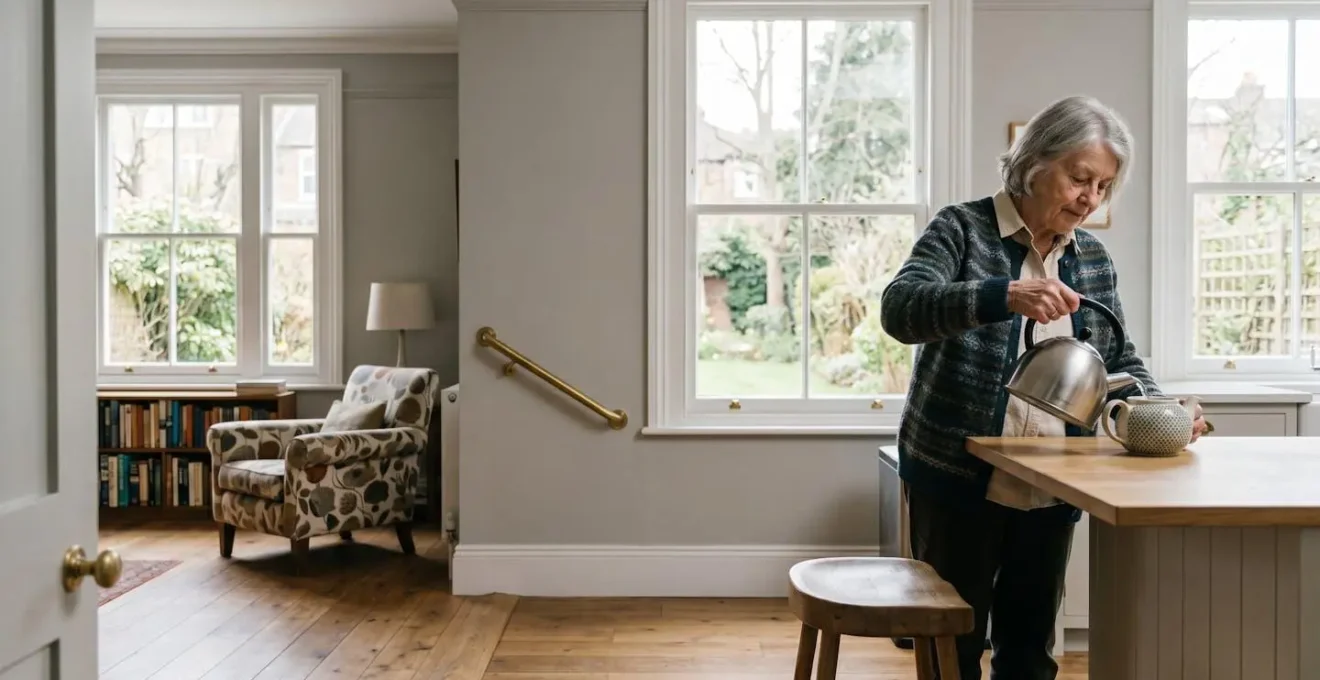
Successfully ageing in place in the UK depends less on one-off installations and more on a dynamic strategy balancing three key pillars: proactive home adaptation, robust social support, and shrewd financial planning.
- Physical adaptations are essential, but their success hinges on anticipating future needs rather than just reacting to current mobility issues.
- Social isolation can undermine a perfectly adapted home, making a deliberate “social scaffolding” as critical as any physical support.
- Financial foresight, including understanding alternatives to equity release, creates the necessary runway to fund care without prematurely losing the home.
Recommendation: Begin by conducting a holistic audit of your home, social network, and finances, viewing them as interconnected parts of a single long-term independence plan.
The ambition to “age in place” is a deeply held value for many seniors across the UK. It represents autonomy, comfort, and a connection to a lifetime of memories. The common advice often revolves around tangible, immediate fixes: install grab rails, consider a stairlift, or get a personal alarm. While these are important safety measures, they represent only a fraction of the story. They address the ‘what’ but critically miss the ‘how’ and ‘why’ of long-term success. As a gerontologist, I see too many families focus on the hardware of adaptation, only to be blindsided by the less visible challenges of social isolation or financial missteps.
The reality is that thriving at home for decades is not a static, one-time project. It’s a dynamic process that requires a more comprehensive and realistic approach. The key to unlocking genuine, lasting independence lies in moving beyond a simple checklist of equipment. It requires building a resilient strategy based on three interconnected pillars: proactive adaptation of your physical environment, the deliberate construction of social resilience, and the application of careful financial foresight. This isn’t just about surviving at home; it’s about creating an ecosystem where you can genuinely thrive, maintaining quality of life, purpose, and connection.
This guide moves beyond the platitudes to provide a gerontological perspective on what it truly takes. We will explore how to future-proof your home, navigate the complex interplay between independence and support, and avoid the common traps that can derail even the best-laid plans. By understanding these deeper dynamics, you and your family can build a robust and realistic roadmap for successful ageing in place.
To navigate this complex but crucial topic, this article is structured to address the most pressing questions families face. The following summary outlines the key areas we will explore, moving from the foundational ‘why’ to the practical ‘how’ of creating a sustainable plan for ageing in place.
Summary: A Gerontologist’s Guide to Long-Term Ageing in Place
- Why Do Some Seniors Thrive at Home While Others Need Care Homes Despite Similar Health?
- Where Should You Start When Adapting Your Home for Reduced Mobility?
- How to Future-Proof Your Home for Ageing in Place Over the Next 20 Years?
- How to Identify Hidden Fall Hazards in Your Home Before Calling an Occupational Therapist?
- The Loneliness Trap That Forces Well-Adapted Seniors into Care Homes
- Ageing Entirely at Home vs Regular Respite Care: Which Preserves Independence Longer?
- The Equity Release Mistake That Leaves Families Unable to Fund Care Costs
- When Should You Reassess Your Ageing in Place Plan After a Major Health Event?
Why Do Some Seniors Thrive at Home While Others Need Care Homes Despite Similar Health?
One of the most perplexing questions for families is why a senior with manageable health conditions might end up in residential care, while another with a similar profile continues to live independently. The answer rarely lies in medical charts alone. While physical health is a factor, the crucial difference is often the strength of the support ecosystem and the individual’s psychological well-being. A perfectly adapted house is of little use if the person living in it feels isolated, unsupported, or unable to manage the daily tasks of life. The scale of this issue is significant; in the UK, an estimated 2 million people aged 65+ have unmet needs for care and support, a gap that often precipitates a crisis.
Success in ageing in place hinges on what I call “social scaffolding”—a robust, deliberate network of formal and informal support. This includes everything from family members who check in regularly, to neighbours who can help with small tasks, to community groups that provide purpose and social interaction. When this scaffolding is weak or non-existent, even minor health setbacks can become insurmountable challenges. The home environment itself can shift from a sanctuary to a source of stress. As researchers on the ENABLE-AGE Project noted, the experience of home is not universally positive.
Ageing in place may bring social and psychological benefits, there can also be a significant downside on an everyday level. Home in old age can be a place of negative experiences, such as isolation and loneliness.
– ENABLE-AGE Project Research Team, Ageing in Place in the United Kingdom
Therefore, those who thrive are often not the ‘healthiest’, but the most resilient and connected. They or their families have proactively built this social scaffolding. They have systems in place for shopping, transport, social engagement, and emergency help. In contrast, those who are forced to move often experience a collapse not just of their health, but of their entire support system, proving that the foundation of ageing in place is as much social as it is physical.
Where Should You Start When Adapting Your Home for Reduced Mobility?
Faced with the prospect of home adaptations, the sheer number of options can be overwhelming. The instinct is often to look at major installations like stairlifts, but the most effective starting point is almost always smaller, more strategic, and begins with professional assessment. Before spending a single penny, your first call should be to your local council’s adult social services department to request a free needs assessment, often carried out by an occupational therapist (OT). This expert evaluation is the foundation of any successful adaptation plan, as it focuses on your specific daily challenges rather than just selling products.
This assessment is also the gateway to financial support. Many are unaware that under UK law, equipment and minor adaptations costing less than £1,000 must be provided free of charge by the council if the assessment deems them necessary. This can cover crucial items like grab rails, raised toilet seats, or bath boards. For larger, more expensive projects like a walk-in shower or widening doorways, the assessment is the first step towards applying for a Disabled Facilities Grant (DFG). This grant, which is means-tested, can provide significant funding to make essential changes possible.
From a practical standpoint, the “one room at a time” strategy is highly effective. Focus your initial efforts on the area that presents the highest risk and offers the greatest return on investment for safety and independence. For most people, this is the bathroom. A fall in the bathroom can be catastrophic, and simple changes here can have a disproportionately large impact. A few logical first steps include:
- Request a free assessment: Contact your local council’s adult social services or a Home Improvement Agency (HIA) via Foundations, the national body.
- Check DFG eligibility: Use free online tools like ‘Adapt My Home’ to get an initial idea of your eligibility for a Disabled Facilities Grant.
- Prioritise the bathroom: A walk-in shower, comfort-height toilet, and strategically placed grab rails often provide the most significant safety improvement.
- Think function first: Ask “How can I achieve this task safely?” rather than “What product do I need?”. This opens up a wider range of often cheaper solutions.
By starting with assessment and prioritising high-impact areas, you create a logical, cost-effective plan that addresses genuine needs rather than perceived ones.
How to Future-Proof Your Home for Ageing in Place Over the Next 20 Years?
Future-proofing a home for ageing is about moving from a reactive to a proactive mindset. It’s not about preparing for the mobility you have today; it’s about anticipating the needs you might have in five, ten, or even twenty years. This concept, which I call “Dynamic Adaptation,” involves making design choices that are not only functional but also flexible and aesthetically pleasing, avoiding a clinical or institutional feel. The goal is to integrate accessibility so seamlessly that it enhances the home for everyone, regardless of age or ability. This approach has a proven, tangible impact; evidence from Foundations, the national body for home improvement agencies, found that proactively adapting your home can delay a move into residential care by four years.
A key principle of future-proofing is universal design. Instead of installing temporary, often unsightly, aids, consider permanent changes that improve daily life now. For example, rather than a bulky plastic ramp, you might regrade the garden path to create a step-free entrance. Instead of just adding grab rails, you could install stylish, reinforced towel rails in the bathroom that are designed to support weight. Good lighting is another critical, often overlooked, element. Improving task lighting in the kitchen and ensuring high contrast between floors, walls, and doorways can dramatically reduce fall risks for ageing eyes long before mobility becomes a major issue.
As the image above illustrates, successful future-proofing lies in the details: the tactile feel of a well-placed support, the ease of using a light switch, the security of a non-slip surface. It’s about reducing the small, daily points of “environmental friction” that can accumulate over time and wear a person down. Key areas to focus on for long-term impact include creating a ground-floor living space (bedroom and full bathroom), installing lever-style door handles instead of knobs, and choosing flooring that is non-slip and has minimal thresholds between rooms. These changes may seem minor, but they create a home that remains supportive and safe through decades of changing needs.
How to Identify Hidden Fall Hazards in Your Home Before Calling an Occupational Therapist?
While an occupational therapist’s assessment is invaluable, performing your own preliminary safety audit can empower you to spot and fix many “hidden” hazards. The most dangerous risks are often not the obvious ones, like a trailing wire, but the subtle, everyday patterns and environmental flaws that increase the likelihood of a fall over time. The key is to stop looking for objects and start analysing behaviours and the environment through the lens of an older person. Your goal is to identify sources of environmental friction—small difficulties that force over-reaching, unsteadiness, or poor visibility.
One of the most effective methods is to physically walk the paths you use most frequently every day, such as from the bed to the bathroom or from your favourite chair to the kitchen. As you do, pay hyper-attention to every moment you instinctively reach out to steady yourself on a wall or piece of furniture. These are your real risk points, indicating where a grab rail or better lighting is actually needed, not just where it looks logical. Lighting is another critical, often misjudged factor. A room that seems bright during the day can become a minefield of shadows and low contrast at twilight, a particular danger for ageing eyes that struggle with changing light levels and differentiating colours.
Beyond the physical environment, it’s vital to consider personal factors. Medication is a significant contributor to falls. A “brown bag review,” where you take all your current medications to your local NHS pharmacist, can identify any drugs or combinations that might be causing dizziness or postural hypotension (a sudden drop in blood pressure on standing). Similarly, don’t just look for trip hazards; look for task-based risks. If you have to use a small stool to reach your favourite mugs in a high cupboard, the cupboard itself is the hazard. The solution isn’t to be “more careful” but to reorganise the kitchen so that frequently used items are easily accessible between waist and shoulder height.
Your Action Plan: A DIY Home Safety Audit for Fall Prevention
- Trace Your Daily Paths: Walk your most-used routes (e.g., bed to kitchen). Note every time you steady yourself or need to switch on a light; these are your true risk points that reveal where support is needed.
- Conduct a Lighting Test: Assess lighting at different times (morning, twilight, night). Look for areas of poor colour contrast between floors and walls, which can create “invisible” hazards for ageing eyes.
- Request a Medication Review: Ask your local NHS pharmacist for a ‘brown bag review’ to check if any medications, especially for blood pressure, could be causing dizziness or instability.
- Analyse Task-Based Risks: Instead of looking for hazards, ask “What makes this daily task difficult?”. Difficulty reaching into wardrobes or high cupboards signals a risk of over-reaching and losing balance.
- Verify Existing Support: If you already have grab rails, check if they are actually located where you need them during real daily tasks, not just in standard positions.
The Loneliness Trap That Forces Well-Adapted Seniors into Care Homes
A home can be perfectly adapted, with every possible safety feature in place, yet still become a gilded cage. The “loneliness trap” is one of the most powerful and insidious factors that can force a senior into residential care, even when their physical health and home environment are stable. Social isolation is not merely a feeling of sadness; it’s a significant health risk that erodes a person’s physical and cognitive resilience. When the social scaffolding around an individual collapses, their ability to cope with the small challenges of daily life diminishes, and the home ceases to be a place of comfort. A shocking 940,000 older people in the UK are often lonely, a figure that highlights a silent epidemic running parallel to physical health concerns.
This isolation can be triggered by many factors: the loss of a spouse, friends moving away or passing on, the cessation of driving, or a decline in mobility that makes leaving the house difficult. Without purpose or meaningful daily interaction, motivation wanes. A person may stop cooking proper meals, neglect personal hygiene, or fail to manage their medication correctly, not because they are physically unable, but because they lack the will and social impetus. This downward spiral is often misinterpreted by concerned families as a sign that the person can “no longer cope at home,” when the root cause is a profound lack of social connection, not a lack of physical capacity.
Combating this requires proactively building and maintaining a robust social scaffolding. This is not about passive “social activities” but about fostering genuine, meaningful connections and a sense of purpose. It could involve joining a local club, volunteering, participating in a community garden, or using technology to connect with family. The solution is deeply personal, but the principle is universal: humans need a reason to get up in the morning. As Age UK warns, the consequences of failing to address this are dire, creating a future public health crisis.
If we don’t tackle loneliness, by 2034 there will be 1.2 million people over 65 in England who will often feel lonely, with far reaching consequences.
Ageing Entirely at Home vs Regular Respite Care: Which Preserves Independence Longer?
The concept of using a care home to *preserve* independence at home sounds like a contradiction, but this is the “Independence Paradox” that many families fail to consider. The default goal is often to remain at home 100% of the time, viewing any stay in a care facility as a failure. However, the strategic, planned use of respite care can be one of the most powerful tools for prolonging one’s ability to age in place successfully. It addresses two critical failure points in many long-term plans: carer burnout and the fear of a crisis-driven, permanent move.
First, if a spouse or adult child is providing significant informal care, their well-being is paramount to the plan’s success. Without regular breaks, carer burnout is almost inevitable, leading to a breakdown in the support system that forces a permanent move for the person receiving care. Planned respite provides essential relief, allowing the carer to rest and recharge, thereby sustaining their ability to provide support over the long haul. Second, respite care can act as a “soft introduction” to a care environment, demystifying it and reducing the fear and stigma associated with a potential future move. It allows the senior to experience the social aspects, activities, and professional support available, all while knowing they will be returning home.
Case Study: Respite Care as a Proactive Transition Tool
Recent UK data shows a growing trend of older adults using short-term respite care not as a last resort, but as a strategic way to ‘test drive’ a care environment. The most common duration is around two weeks. This approach allows an individual and their family to assess a home’s suitability, meet staff, and experience the social life without the pressure of a permanent decision. For the primary family carer, this period provides critical relief from the demands of 24/7 support, preventing burnout. This strategy reframes respite from a sign of failure into a proactive tool, giving everyone confidence and reducing the trauma of a potential future move if it becomes necessary, ultimately helping to sustain the ageing-in-place arrangement for longer.
While the goal remains to stay at home, viewing respite not as an emergency stop-gap but as a scheduled part of a long-term strategy can dramatically increase the chances of success. It provides a safety valve for the entire support system, ensuring that when a higher level of care is temporarily needed, it doesn’t automatically trigger the end of a person’s life at home. It is a pragmatic compromise that, paradoxically, can be the key to maintaining independence for years longer than an “all or nothing” approach.
The Equity Release Mistake That Leaves Families Unable to Fund Care Costs
One of the most significant threats to a long-term ageing-in-place plan is a financial misstep made years earlier. For many homeowners, property is their largest asset, and the temptation to unlock this capital via equity release can be strong. However, doing so without a clear understanding of future care costs can be a catastrophic mistake. The primary error is taking a large, tax-free lump sum early on for lifestyle purchases—like a new car or extensive holidays—without creating a dedicated “financial runway” for the high cost of domiciliary (at-home) care later in life.
The costs of professional care at home are substantial and often underestimated. For 2024/25, official UK government data shows an average hourly cost of £23.56, with the Homecare Association stating that legally compliant, quality care actually costs closer to £32.14 per hour. A few hours of care per day can quickly amount to thousands of pounds per month. If a significant portion of home equity has already been spent, and the remaining amount is being eroded by the compound interest of the equity release loan, families can find themselves in a desperate situation: unable to afford the care needed to stay at home, but with insufficient equity left to fund a move into a quality care home.
Before considering commercial equity release, it is crucial to explore all other options, particularly those designed specifically for care funding. One of the most important and often-overlooked alternatives is a Deferred Payment Agreement (DPA) from the local authority. This scheme is designed to prevent people from having to sell their homes immediately to pay for care.
Alternative Strategy: The Deferred Payment Agreement (DPA)
A DPA is a scheme offered by local councils in the UK. If you are assessed as needing to move into a care home, the council can pay your care home fees on your behalf. They secure this loan against your property, and the debt is repaid from the sale of the property after your death, or if you choose to sell it earlier. This serves as a vital financial bridge, allowing you to access care without the immediate trauma of selling the family home. It avoids the high compound interest rates of many commercial equity release products and preserves more of the property’s value for the family, ensuring that financial decisions are made thoughtfully rather than in a crisis.
Financial foresight means planning for the most expensive scenario—the need for intensive daily care—and protecting your assets to meet that need. It requires resisting the allure of a quick cash lump sum in favour of a sustainable long-term strategy that ensures your home can support you, both physically and financially, for as long as possible.
Key Takeaways
- True success in ageing in place is a dynamic process, not a one-time fix, resting on adapting your home, building social support, and smart financial planning.
- Social isolation is a major risk factor that can undermine a physically safe home; proactive “social scaffolding” is as crucial as grab rails.
- Financial planning for care is essential. Understand alternatives like Deferred Payment Agreements before considering commercial equity release to avoid depleting your main asset too early.
When Should You Reassess Your Ageing in Place Plan After a Major Health Event?
A successful ageing-in-place plan is not a document you create once and file away; it’s a living strategy that must be responsive to change. The single most critical trigger for a comprehensive reassessment is a major health event, such as a fall, a stroke, a new diagnosis, or any incident requiring hospitalisation. These events often mark a significant shift in a person’s physical or cognitive baseline, rendering the old plan obsolete. The statistics on hospital usage underline this escalating risk with age; NHS data for 2024 shows that A&E attendances per 100,000 people jump from 49,917 for those aged 75-79 to a staggering 93,931 for those over 90. Each visit is a potential turning point that demands a plan review.
The reassessment should begin immediately, even before hospital discharge. The goal is to ensure a safe transition home and to adapt the plan to the “new normal.” This isn’t just about adding a new piece of equipment; it’s a holistic review of all three pillars: physical adaptation, social scaffolding, and financial resources. Does the home environment now present new risks? Is the previous level of social support still adequate? Will the new care needs impact the financial runway? Answering these questions quickly and honestly is vital to preventing a rapid decline or a preventable readmission to the hospital, which often leads to a permanent move to residential care.
The period immediately following hospital discharge is the most vulnerable. It’s essential to have a clear, actionable plan to manage this transition. The following steps provide a framework for reassessing and adjusting your ageing-in-place strategy in the crucial days and weeks after a health event.
- Request an OT Assessment: Insist on an occupational therapy assessment before hospital discharge if the home setup needs reviewing for the new level of mobility.
- Identify Urgent Adaptations: The NHS may provide essential equipment (like a hospital bed or commode) to facilitate a safe return home. Clarify what will be provided.
- Contact Social Care: Within 72 hours of the discharge notice, contact your local council’s adult social care department to arrange any necessary interim care support, such as help with washing or dressing.
- Review Medications: A change in health often means a change in medication. Review the new prescriptions with a local pharmacist to understand side effects that could affect mobility or cognition, like dizziness.
- Hold a Family Meeting: Within the first week of being home, bring together key family members and the individual to assess how the updated plan is working and identify any gaps in support.
Ultimately, a successful strategy for ageing in place requires a shift in perspective. It means viewing your home, your social network, and your finances as an integrated system that must be actively managed. To start this process effectively, the first step is always a thorough and honest assessment of your current situation and future needs. Begin evaluating the solutions and support systems available in your local area today to build a truly resilient plan for the future.