In summary:
- Effective home physiotherapy is not about perfect mimicry, but understanding the principles to adapt exercises safely to your UK home.
- Consistency is key; missing just two days can cause a significant physiological setback due to muscle de-training.
- Timing your exercises within a ‘therapeutic window’ after taking pain medication improves performance and safety.
- Gentle stretching and ‘soft gymnastics’ often improve balance and joint health more effectively than traditional high-impact exercises for seniors.
Being sent home from the hospital or a physiotherapy clinic with a sheet of exercises can feel both empowering and daunting. You’re in the comfort of your own home, but suddenly you’re the one in charge of this crucial part of your recovery. For many seniors across the UK, especially after procedures like a knee replacement, this is a familiar scenario. The motivation is there, but so are the questions: “Am I doing this right? Is this pain normal? How can I possibly do this exercise in my small living room?”
The common advice is to “just be consistent” or “watch videos online.” While well-intentioned, this advice often misses the mark. It fails to address the gap between a sterile clinical environment and the reality of a home filled with furniture, trip hazards, and no expert eye to correct your form. The internet, meanwhile, can be a minefield of conflicting, and sometimes dangerous, advice.
This guide takes a different approach. We’re moving beyond simple instructions to give you the physiotherapist’s mindset. The real key to success isn’t just following a protocol; it’s understanding the core principles of recovery. It’s about learning how to listen to your body’s feedback, how to intelligently adapt movements to your space, and how to build a routine that is both safe and effective. We will explore why consistency is so critical, how to transform your living room into a safe exercise space, and when to perform your exercises for maximum benefit. You’ll learn the difference between expert guidance and generic online content, and discover gentle exercises that pack a powerful punch for balance and mobility.
This article will break down these complex topics into manageable, actionable steps. It is structured to build your confidence and knowledge, empowering you to become an active, informed partner in your own rehabilitation journey. Explore the sections below to gain the insights you need to succeed.
Summary: A Practical Guide to Independent Home Physiotherapy
- Why Does Missing 2 Days of Exercises Set Back Your Recovery by a Week?
- How to Modify Hospital Exercises for a Small UK Living Room?
- Physiotherapist Visits vs YouTube Exercises: Which Improves Outcomes for Knee Replacements?
- The Resistance Band Mistake That Causes Shoulder Injuries in Home Physiotherapy
- When Should You Schedule Home Exercises Relative to Pain Medication?
- How to Perform a 5-Minute Daily Health Check Without Medical Training?
- Why Does Gentle Stretching Improve Balance Better Than Walking for Over-70s?
- What Is Soft Gymnastics and How Does It Differ from Regular Exercise Classes?
Why Does Missing 2 Days of Exercises Set Back Your Recovery by a Week?
It’s a frustratingly common experience: you’re making steady progress, miss a couple of days of your physio exercises due to a busy schedule or feeling unwell, and suddenly it feels like you’ve lost a whole week of hard work. This isn’t just in your head; it’s a physiological reality. The key is to understand the difference between “de-loading” and “de-training.” Missing one day might be a strategic de-load, allowing muscles to repair. Missing two or more days, however, initiates de-training.
When you perform your exercises consistently, your body builds not just muscle strength, but also crucial neural pathways. Your brain gets better and faster at telling the correct muscles to fire in the right sequence. When you stop, even for 48-72 hours, these signals start to weaken. Your muscles, particularly the small stabilising ones essential for recovery, begin a process of atrophy (shrinking), and the fluid, coordinated movement you were building becomes less efficient. It’s like forgetting a dance; the steps are still vaguely there, but the rhythm and flow are gone.
Furthermore, consistent, gentle movement helps to manage inflammation and promote the circulation of synovial fluid, which lubricates your joints. When you stop, inflammation can build up, and joints can feel stiffer, making it physically harder and more painful to restart. This combination of weakened muscle activation, neurological disconnect, and increased stiffness is why getting back on track feels disproportionately difficult. It’s not a failure of willpower; it’s a biological reset you are fighting against. This is why your physio is so insistent on daily practice—it’s about maintaining momentum to prevent the slide into de-training.
How to Modify Hospital Exercises for a Small UK Living Room?
The pristine, spacious gym at the hospital is a world away from the average UK living room, with its cosy furniture, beloved ornaments, and potential trip hazards. The key to success is not to despair but to practice “environmental intelligence”—learning to see your home not as an obstacle, but as a set of therapeutic tools. You don’t need fancy equipment to replicate the benefits of your prescribed exercises.
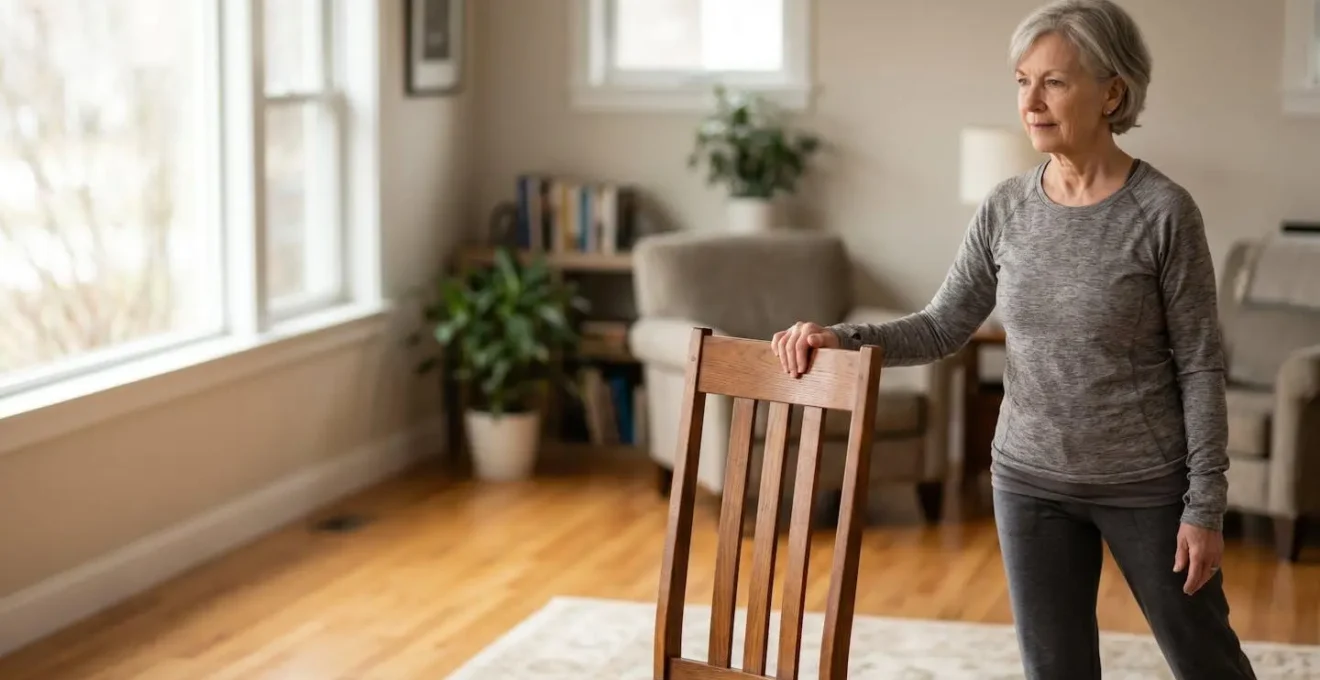
Your goal is to modify the *principle* of the exercise, not necessarily its exact form. If an exercise required a plinth to sit on, a sturdy, non-wheeled dining chair is your best friend. If you were using parallel bars for support, placing that same chair in front of you or standing in a clear doorway where you can touch both sides provides the same stability. The back of a solid sofa can be used for balance support during standing leg exercises. The most important step is creating a dedicated safe zone.
Before every session, take two minutes to clear a space of at least six by six feet. This means moving rugs, tucking away electrical cords, and shifting the coffee table. This small ritual not only prevents falls but also mentally prepares you for your session. By using everyday objects as anchors and supports, you can effectively translate your hospital protocol into a safe, practical, and repeatable home routine. The focus shifts from missing the clinic equipment to creatively using what you have to achieve the same therapeutic outcome.
Physiotherapist Visits vs YouTube Exercises: Which Improves Outcomes for Knee Replacements?
In the digital age, it’s tempting to supplement or even replace formal physiotherapy with the vast library of exercises available on platforms like YouTube. While visual guides can seem helpful, research consistently shows that for complex recoveries like a total knee replacement, there is no substitute for professional guidance. The difference in outcomes lies in one crucial factor: personalised feedback and progression.
A physiotherapist does more than just show you an exercise; they assess your specific movement patterns, identify weaknesses, and provide real-time tactile and verbal cues to ensure you are activating the correct muscles. It’s the difference between simply bending your knee and learning to fire your quadriceps correctly to support the joint. This nuanced approach is impossible for a generic video to replicate. In fact, a systematic review published in BMC Musculoskeletal Disorders found that patients receiving physiotherapy exercise showed improved physical function compared to those without. The guidance ensures you are performing movements that are therapeutic, not just going through the motions.
Case Study: The CORKA Trial on Personalised Rehabilitation
The CORKA randomised controlled trial provided crucial insights. It compared traditional outpatient physiotherapy with home-based rehabilitation for patients after knee surgery. While it found home-based therapy could be effective, its success was heavily dependent on the “individualized approaches alongside collaborative relationships” between therapist and patient. This highlights that the location is less important than the quality and personalisation of the guidance. For isolated individuals, the study noted that a structured home therapy program provided important social and motivational benefits, reinforcing that a good physio relationship is about more than just mechanics.
YouTube can be a useful tool for a quick reminder of an exercise you’ve already mastered with your physio, but it’s a poor replacement for primary instruction. It can’t tell you if you’re compensating with your hip, if your form is risking injury, or when it’s time to progress to a more challenging movement. Professional physiotherapy, whether in-person or via a structured telehealth program, remains the gold standard for achieving the best possible outcomes.
The Resistance Band Mistake That Causes Shoulder Injuries in Home Physiotherapy
Resistance bands are fantastic, affordable tools for home physiotherapy, but they are also a common source of injury when used incorrectly. For shoulder rehabilitation in particular, one mistake stands out above all others: using too much resistance, too soon. It’s a natural impulse to want to feel a strong “burn,” assuming that more resistance equals faster progress. With the delicate rotator cuff muscles, this is a recipe for disaster.
The primary mistake is choosing a heavy band that forces you to recruit larger, stronger muscles (like your upper traps or back) to complete the movement. This is called compensation. When you do this, the small, specific rotator cuff muscles you’re trying to strengthen are bypassed. Worse, this poor form can lead to shoulder impingement, where the tendons get pinched and inflamed, setting your recovery back weeks or even months. Other critical errors include failing to warm up properly, using poor form like arching the back or shrugging the shoulders, and letting the band snap back instead of controlling the return phase of the movement.
The golden rule of resistance band training for shoulders is to start with the lightest band available. The focus should be on perfect form and feeling the exercise in the precise target area. You should be able to complete 15-20 repetitions with flawless technique before even considering a heavier band. The goal is muscle activation and endurance, not a powerlifting-style struggle. Mastering control with light resistance builds the strong, stable foundation your shoulder needs to heal properly.
When Should You Schedule Home Exercises Relative to Pain Medication?
Navigating the relationship between pain, medication, and exercise is one of the most challenging aspects of home rehabilitation. Do you exercise when the pain is lowest, or push through it? The most effective strategy is to work within what physiotherapists call the “therapeutic window.” This is the period after your pain medication has taken effect, but before it has completely masked all sensation.
Exercising with high levels of pain is counterproductive. Your body’s natural guarding reflex will cause you to tense up, alter your movements, and compensate, which can lead to strain or injury. On the other extreme, exercising when you are so pain-free that you can’t feel anything is also dangerous, as you might push past your body’s safe limits without the warning signal of discomfort. The expert view is clear on this delicate balance.
The goal is not to be completely pain-free (which risks over-exertion), but to be in a ‘therapeutic window’ where pain is dulled enough to allow for correct movement patterns, but enough sensation remains to act as a safety guide.
– Progressive Physical Therapy, Rehabilitation Exercise Timing and Pain Management
Understanding Rehabilitation Phases and Timing
Rehabilitation is a journey with a clear timeline. In the Early Phase (1-2 weeks post-op), the focus is on pain control and gentle motion, making medication timing critical. As you enter the Middle Phase (2-6 weeks), strengthening exercises are introduced as pain subsides. By the Advanced Phase (6-12 weeks), the focus shifts to progressive loading. Throughout these stages, coordinating your exercise with your medication is essential. It’s not about avoiding pain, but managing it to a level (typically below a 4/10) where you can perform exercises with good form, facilitating healing rather than hindering it.
Typically, this means scheduling your physio session about 30-60 minutes after taking your prescribed pain relief. This allows the medication to peak, dulling the sharp, prohibitive pain and reducing it to a more manageable background ache. This dull ache is useful feedback, reminding you to move with control. By timing it right, you create the perfect conditions for a safe, productive, and ultimately more successful rehabilitation session.
How to Perform a 5-Minute Daily Health Check Without Medical Training?
When you’re managing a condition at home, you become the frontline observer of your own health. You don’t need a medical degree to perform a valuable daily check-in; you just need consistency and a focus on changes from your baseline. This 5-minute routine helps you spot potential issues early, provides valuable information for your GP or physio, and keeps you actively engaged in your own wellbeing. The goal is simple: notice what’s different today compared to yesterday.
Start by establishing your “normal.” What does your joint look and feel like on a good day? How much effort does it take to get out of your favourite armchair? This becomes your baseline. Each morning, before you get too busy, run through a quick mental and physical checklist. Are you stiffer than usual? Is there any new swelling or redness? How is your balance today? This isn’t about diagnosis; it’s about data collection. A small change might be nothing, but a pattern of changes over several days is a clear signal to seek advice.
This daily practice of self-observation is incredibly empowering. It moves you from being a passive recipient of care to an active participant. By tracking these simple metrics, you can provide your healthcare team with precise, objective information (“My morning stiffness has gone from a 3/10 to a 7/10 over the past four days”) instead of vague complaints. This leads to better advice, more effective treatment, and greater control over your health journey.
Your 5-Minute Daily Self-Assessment Checklist
- Asymmetry check: Stand in front of a mirror and visually compare both sides of your body (e.g., both knees, both ankles). Look for any new swelling, redness, or visible differences you didn’t see yesterday.
- Stiffness rating: On a scale of 1 (no stiffness) to 10 (completely rigid), how stiff do you feel this morning? Jot down the number to track trends over time.
- Functional effort test: Perform one key daily task, such as rising from a dining chair without using your hands. How much effort did it require today compared to your baseline? Easy, moderate, or difficult?
- Balance test: Standing near a sturdy surface for support, time how long you can comfortably stand on one leg. Aim for at least 10 seconds per side, noting if it feels more wobbly than usual.
- Heel-to-toe walk: In a clear hallway, try to walk 10-15 feet in a straight line, placing the heel of your front foot directly against the toes of your back foot with each step. Note any significant loss of balance.
Why Does Gentle Stretching Improve Balance Better Than Walking for Over-70s?
It sounds counterintuitive. Surely walking, the very definition of being upright and mobile, would be the best exercise for improving balance. While walking is fantastic for cardiovascular health and dynamic balance (balance while in motion), it’s less effective at preventing the specific types of falls most common in seniors. The surprising truth is that gentle, mindful stretching often provides a more direct benefit to your stability. The reason lies in a concept called proprioception.
Proprioception is your body’s sixth sense—its ability to know where its parts are in space without you having to look. It’s the complex network of signals between muscles, joints, and the brain that allows you to stand, turn, and reach without toppling over. As we age, this sense can dull. The majority of falls among older adults don’t happen during a brisk walk; they happen during transitional movements like standing up from a chair, turning quickly in the kitchen, or reaching for something on a high shelf. This is where statistics paint a stark picture, as studies on elderly mobility reveal that around one third of people over 65 experience a fall every year.
Gentle stretching exercises directly target and retrain this proprioceptive system. As one expert source explains, the mechanism is very specific:
Walking improves dynamic balance (balance while moving). However, most falls in seniors occur during transitions (standing up, turning, reaching). Stretches that involve reaching or shifting weight directly train the specific muscle-firing patterns needed for these high-risk transitional movements.
– Bella Vista Health Center, Simple Home Exercises For Seniors
When you perform a slow, controlled stretch that involves a weight shift or a reach, you are consciously re-mapping those brain-body connections. You are actively teaching your nervous system to recognise and control your centre of gravity during those exact vulnerable moments. That is why activities like Tai Chi, chair yoga, and specific balance stretches are so powerfully effective at fall prevention.
Key Takeaways
- Consistency Over Intensity: Missing more than one day of physio initiates ‘de-training’, a physiological setback that is harder to overcome than just lost time.
- Adapt, Don’t Abandon: Use sturdy furniture like dining chairs and sofas to safely replicate the principles of hospital exercises in a small home environment.
- Pain as a Guide, Not a Barrier: Time your exercises 30-60 minutes after taking pain medication to work in a ‘therapeutic window’ where pain is managed but feedback is still possible.
What Is Soft Gymnastics and How Does It Differ from Regular Exercise Classes?
As you progress in your recovery, you might hear the term “soft gymnastics” or “gentle exercise.” These classes are often recommended for seniors, but how do they differ from a standard fitness class? The distinction is fundamental: regular exercise often focuses on building large muscle groups and cardiovascular endurance, whereas soft gymnastics prioritizes joint health, mobility, and the activation of small, stabilising muscles.
Think of it as working from the inside out. Instead of focusing on the ‘big movers’ like the quads or biceps, soft gymnastics uses slow, controlled, and often smaller movements to improve the function of the joints themselves. This approach is explained by its core philosophy:
While regular exercise focuses on muscles, soft gymnastics prioritizes the joints themselves. Movements are designed to promote synovial fluid production (joint lubrication), improve mobility, and activate the small, stabilizing muscles around the joint.
– Comfort a Life, Best Home Modifications for Seniors to Enhance Safety and Comfort
This makes it an ideal form of exercise for anyone dealing with arthritis, recovering from joint replacement surgery, or experiencing stiffness and reduced mobility. The movements are low-impact and easily adaptable, meaning they put minimal stress on the body while delivering significant benefits in flexibility, balance, and the reduction of aches and pains. It’s about coaxing the body into better movement rather than forcing it.
Case in Point: The Power of Chair Yoga
Chair yoga is a perfect example of soft gymnastics in practice. It allows individuals with limited mobility or balance concerns to perform a huge range of movements entirely from a safe, seated position. It builds flexibility, core strength, and endurance without any of the risks associated with floor-based or standing exercises. Crucially, it incorporates mindfulness and breathing techniques that help manage pain and reduce stress—benefits that a standard high-energy aerobics class may not offer. For seniors who find traditional exercise intimidating, chair yoga proves that a gentle approach can yield powerful results for both body and mind.
Your home physiotherapy journey is a marathon, not a sprint. By embracing these principles—understanding the ‘why’ behind your exercises, adapting your environment, timing your efforts, and choosing the right kind of movement for your body—you transform yourself from a passive patient into the confident leader of your own recovery team. Start today by implementing one of these strategies and take the next step towards a stronger, more mobile future.