Most avoidable A&E visits for seniors are not sudden events, but the final stage of a predictable physiological cascade that an informed carer can interrupt.
- Subtle changes like mild dehydration or a 20-point blood pressure drop are critical, data-backed predictors of an impending crisis.
- Using structured communication tools like SBAR when calling NHS 111 transforms a plea for help into a request for a specific, non-A&E intervention.
Recommendation: Start tracking daily vitals and symptoms today; this data is your most powerful tool for advocating for proactive home-based care.
For any carer, there is a moment of quiet dread: a subtle change in a loved one’s condition that flickers on the edge of your perception. Is this new confusion just a ‘bad day’, or is it the start of something serious? Is this lethargy just tiredness, or the beginning of a slide that ends in a call to 999 and a stressful A&E admission? The standard advice—”watch for changes,” “call your GP”—is well-intentioned but often feels inadequate in these high-stakes moments. It leaves you feeling like a passive observer, waiting for a crisis to declare itself.
But what if you could shift from reactive worry to proactive prediction? This is the perspective of an acute medicine consultant. It is not about guesswork; it is about understanding that most avoidable hospitalisations are the result of a predictable physiological cascade. A small, manageable issue like mild dehydration triggers a sequence of events—kidney strain, confusion, a fall—that escalates towards an emergency. The key is not just to spot the final, dramatic event, but to recognise and act on the first, subtle domino before it falls.
This guide provides a consultant’s framework to empower you, the carer, to do just that. We will move beyond generic lists of symptoms and equip you with the tools to quantify changes, understand their clinical significance, and strategically navigate the UK’s healthcare system to secure the right care, at the right time, in the right place—which is often at home. We will decode the earliest warning signs, show you how to present your concerns with the clarity of a medical professional, and outline a weekly routine that builds resilience and prevents crises before they begin. You are the most important member of your loved one’s care team; this is how you make your role count.
This article provides a detailed framework to help you identify critical warning signs and navigate the NHS to prevent unnecessary hospital trips. The following sections break down key areas of concern and provide actionable strategies.
Summary: What Early Warning Signs Predict an Avoidable Hospital Admission Within 48 Hours?
- Why Does Mild Dehydration Escalate to Hospital Admission in Frail Seniors?
- How to Use NHS 111 to Get Urgent Home Care Instead of an Ambulance?
- Hospital at Home vs A&E Admission: Can Your Relative Be Treated at Home Instead?
- The “Wait and See” Mistake That Turns UTIs into Sepsis Admissions
- When Should You Complete a ReSPECT Form to Avoid Unwanted Hospital Admissions?
- Why Do Seniors Who Track Daily Symptoms Have 40% Fewer Hospital Visits?
- Why Does a Sudden 20-Point Drop in Blood Pressure Need Urgent Attention?
- How to Create a Weekly Health Routine That Keeps You Out of A&E?
Why Does Mild Dehydration Escalate to Hospital Admission in Frail Seniors?
Dehydration is not a minor issue in frail older adults; it is an accelerant for clinical deterioration. The thirst mechanism diminishes with age, and for individuals with cognitive or mobility challenges, maintaining adequate fluid intake is a constant battle. This seemingly simple problem is a primary trigger for a cascade of complications that frequently ends in an A&E visit. The data is stark: 37% of seniors admitted to hospital were dehydrated on arrival, a figure that highlights its prevalence as a precursor to crisis.
The physiological cascade begins when even mild dehydration starts to concentrate the blood, forcing the heart to work harder and reducing blood flow to vital organs. The kidneys are particularly vulnerable. When under-perfused, they struggle to filter waste products, leading to a rapid buildup of toxins. This is not a theoretical risk. A UK study found that 47.7% of elderly patients with dehydration on admission also presented with acute kidney injury. This single complication is a powerful driver of hospital admission, as it can cause profound confusion (delirium), electrolyte imbalances, and further systemic failure.
For a carer, the predictive signs to watch for are not just a dry mouth. Look for a decrease in urine output, darker-coloured urine, new or worsening confusion, unexplained fatigue, and dizziness upon standing. These are not “just signs of old age”; they are early indicators that the body’s systems are under stress. Intervening at this stage with a focused hydration plan can halt the cascade and prevent a hospital admission that, just 48 hours later, might seem unavoidable.
How to Use NHS 111 to Get Urgent Home Care Instead of an Ambulance?
When you recognise the signs of deterioration, the next step is crucial. For many, the default is to wait for the situation to become a clear 999 call, but this often leads to an unnecessary A&E visit. The NHS itself recognises this issue, with NHS England estimating that up to 40% of A&E attendances are avoidable or could be better managed in a community setting. NHS 111 is designed to be the gateway to these alternative pathways, but its effectiveness depends entirely on the quality of the information you provide. A vague call reporting “confusion” is likely to result in a cautious, risk-averse dispatch of an ambulance.
To secure a more appropriate response, such as an urgent visit from a community response team or a virtual ward referral, you must shift from being a worried relative to a clinical reporter. You need to provide clear, objective data. This is where the SBAR (Situation, Background, Assessment, Recommendation) framework is invaluable. This is the same tool medical professionals use to communicate effectively and succinctly.
By structuring your call this way, you are not just describing a problem; you are presenting a case. You are giving the call handler the clinical evidence they need to justify a non-ambulance response. You are demonstrating that the situation is being managed, that you are a competent and reliable reporter, and that your request for a specific home-based intervention is well-founded. This strategic communication is your most powerful tool for accessing urgent home care and avoiding the A&E waiting room.
- Situation: State the immediate concern clearly (‘My mother has a suspected UTI with fever’).
- Background: Provide relevant history (‘She has a history of UTIs leading to sepsis and previous hospitalizations’).
- Assessment: Share objective observations (‘Her temperature is 38.1°C, she is more confused than her normal baseline, and her mobility has reduced today’).
- Recommendation: Make a specific request (‘I request an urgent home assessment by a community response team to prevent an A&E visit’).
Hospital at Home vs A&E Admission: Can Your Relative Be Treated at Home Instead?
The very idea of a hospital admission for a frail older person can be terrifying, not just because of the underlying illness, but because of the known risks of the hospital environment itself: delirium, deconditioning, and hospital-acquired infections. The good news is that healthcare is evolving. The “Hospital at Home” or “virtual ward” model is an increasingly common alternative, designed to provide hospital-level care within the patient’s own residence. Research strongly supports this shift, with one UK healthcare study predicting that 20% of admissions could potentially be avoided with effective community-based interventions like these.
As you can see, this model involves healthcare professionals, such as specialist paramedics or community nurses, coming to the patient. They can perform assessments, take blood tests, administer intravenous antibiotics or fluids, and set up remote monitoring. This is not a lesser form of care; for many common conditions like chest infections, cellulitis, or exacerbations of COPD, it is often a superior and safer option. It avoids the stress and disorientation of A&E and allows the person to recover in a familiar, comfortable setting, which is itself therapeutic.
However, accessing this service often requires advocacy. When you call NHS 111 or speak to a GP, you should be prepared to ask the question directly: “Is this a condition that could be managed by the Hospital at Home team?” By presenting clear, tracked data about your relative’s condition, you demonstrate that you are a capable partner in their care, making it more likely that clinicians will feel confident in managing the person at home with your support. You are not just requesting a service; you are presenting a case for why home-based care is the most clinically appropriate option.
The “Wait and See” Mistake That Turns UTIs into Sepsis Admissions
A Urinary Tract Infection (UTI) is one of the most common triggers for a sudden and severe decline in older adults. In a younger person, the symptoms are clear and localised: pain, frequency, urgency. In the elderly, these classic signs are often absent. Instead, the infection presents “non-specifically” as new-onset confusion, agitation, reduced mobility, or a general state of being ‘unwell’. This is where the “wait and see” approach becomes incredibly dangerous. The carer may see confusion but not connect it to an infection, delaying treatment by a critical 24-48 hours.
This delay allows the bacteria to proliferate and potentially enter the bloodstream, a condition known as urosepsis. This is a life-threatening medical emergency. The timeline is frighteningly short; clinical evidence shows that progression from UTI to sepsis can occur within 48-72 hours, and in highly vulnerable individuals, this can accelerate to just a matter of hours once systemic signs appear. This is why a new, unexplained confusion in an older person should always be treated as a potential UTI until proven otherwise. As study authors Hsiao et al. noted in the Annals of Translational Medicine, the presentation of sepsis in the elderly can be both subtle and severe.
Older persons, especially those older than 80 years of age, frequently display non-specific signs and symptoms of sepsis, while later presentation may be very severe with rapid progression to septic shock.
– Hsiao et al., study authors, Annals of Translational Medicine study on uroseptic shock risk factors
As a carer, your role is to be the early warning system. If you observe a sudden change in mental state, especially if accompanied by a low-grade fever or increased lethargy, you must act. Contact the GP or NHS 111 immediately, state your suspicion clearly (“I am concerned about a potential UTI presenting as new confusion”), and provide objective data like a temperature reading. Do not accept “let’s see how they are tomorrow.” The window to prevent a UTI from becoming a sepsis admission is short, and your prompt, informed action is what closes it.
When Should You Complete a ReSPECT Form to Avoid Unwanted Hospital Admissions?
Amid a medical crisis, difficult decisions about treatment and hospitalisation have to be made rapidly. Often, the person at the centre of the crisis is too unwell to express their wishes, leaving families and clinicians to guess what they would have wanted. This is particularly true regarding the question of hospital admission itself. For some people with advanced frailty or life-limiting illnesses, a potentially distressing and ultimately futile hospital stay is the last thing they would want. The ReSPECT (Recommended Summary Plan for Emergency Care and Treatment) process is designed to prevent this exact scenario.
A ReSPECT form is not just a “Do Not Resuscitate” order. It is a comprehensive document that records a person’s preferences for a wide range of emergency situations. It is created through a conversation between the person (or their family if they lack capacity), and their healthcare team. It allows them to state their priorities and preferences, including whether they would prefer to be treated at home or in a hospice rather than be admitted to hospital if their condition deteriorates. This process is now widely adopted in the UK, with Wikipedia noting that as of 2026, the ReSPECT process is used in around 70% of counties in England.
Case Study: ReSPECT Forms Guiding Emergency Care in UK Care Homes
A qualitative study in UK care homes found that the presence of a completed ReSPECT form fundamentally changed how emergency situations were handled. Paramedics and out-of-hours doctors took the documented wishes seriously, leading to more person-centred decisions. One staff member reported that with a ReSPECT form, “outside professionals consult that much more and take their wishes into account,” resulting in decisions to provide comfort care at the home rather than pursue an unwanted hospital admission. The form acts as the patient’s voice when they cannot speak for themselves.
The time to have this conversation and complete a ReSPECT form is not in the middle of a crisis, but during a period of stability. If the person you care for has strong feelings about avoiding hospitalisation, or has an advanced condition where the burdens of hospital treatment might outweigh the benefits, you should ask their GP about initiating the ReSPECT process. This document becomes a powerful tool of advocacy, ensuring their voice is heard and their wishes are respected, even in the most challenging circumstances.
Why Do Seniors Who Track Daily Symptoms Have 40% Fewer Hospital Visits?
A core principle in preventative medicine is that consistent monitoring can dramatically reduce crises, with some clinical models suggesting it could lower avoidable hospital visits by up to 40%. The reason is simple: tracking transforms vague feelings into actionable data. It moves you from saying “mum seems a bit off today” to “her resting heart rate is 15 beats higher than her weekly average, and her fluid intake is 500ml below target.” This is the language of clinical significance, and it is the key to unlocking proactive care.
This process of tracking establishes what clinicians call a “baseline delta”—the difference between a person’s normal state and their current state. For a frail senior, their ‘normal’ might be quite different from a textbook healthy person. By recording key metrics daily—blood pressure, heart rate, temperature, fluid intake, general mood, mobility—you create a personalised map of their health. It is the deviation from this unique baseline, not from a generic standard, that serves as the earliest and most reliable warning sign of a developing problem.
This data-driven approach is your most powerful tool for advocacy. When you present this information to a GP or an NHS 111 call handler, you are providing evidence, not anecdotes. It allows them to see the trend and appreciate the significance of a change that might otherwise be dismissed. The stakes for missing these early signs are incredibly high. For instance, a UK prospective cohort study found that 79% of seniors who died in hospital were dehydrated at admission. This tragic outcome is often the end point of a slow deterioration that could have been detected and reversed weeks earlier with simple, diligent tracking. Your notebook or spreadsheet is not just a record; it is a shield.
Why Does a Sudden 20-Point Drop in Blood Pressure Need Urgent Attention?
Blood pressure is a vital sign that provides a direct window into the state of the circulatory system. While high blood pressure is a well-known chronic risk, a sudden *drop* in blood pressure can be a much more acute and immediate danger signal in a frail older person. A drop of 20mmHg in the systolic (top number) or 10mmHg in the diastolic (bottom number) reading, particularly when moving from a lying to a standing position (known as orthostatic hypotension), is a red flag. It indicates the body is struggling to adapt and maintain adequate blood flow to the brain, which can lead to dizziness, falls, and fainting.
This drop is often not an isolated event but a symptom of an underlying problem. It can be one of the earliest signs of dehydration, bleeding, or a serious infection that is starting to affect the entire body. Clinicians in emergency departments use these vital signs as key predictors of short-term outcomes. As Dr. Gelareh Gabayan highlighted in a study published in the Annals of Emergency Medicine, these numbers are not to be ignored.
Patients age 65 or older with acute or chronic cognitive impairment or mental status changes, and abnormal vital signs (a systolic blood pressure below 120 and heart rate above 90) had a greater likelihood of experiencing death or an ICU admission within 7 days.
– Dr. Gelareh Gabayan, Annals of Emergency Medicine study on geriatric ER outcomes
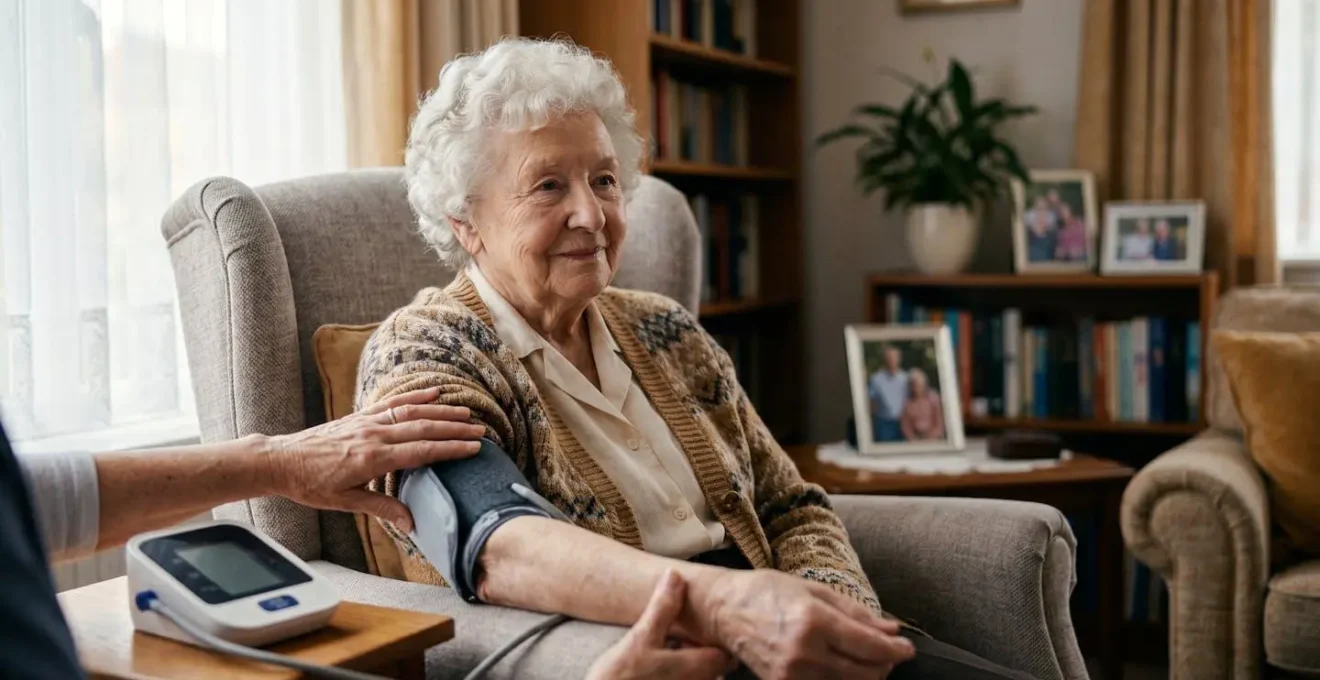
For a carer, this means a blood pressure monitor is as essential as a thermometer. A single low reading might not be a cause for alarm, but a sustained drop, or a significant drop on standing, combined with any other symptom like confusion or dizziness, requires immediate action. This is precisely the kind of objective data that warrants an urgent call to your GP or NHS 111. You can even perform a basic orthostatic blood pressure test at home.
Your action plan: Orthostatic Hypotension Home Test Procedure
- Have the patient lie down flat for 5 minutes; measure and record blood pressure and heart rate.
- Assist the patient to stand up slowly; measure blood pressure and heart rate at 1 minute after standing.
- Keep patient standing safely (with support); measure blood pressure and heart rate again at 3 minutes after standing.
- A sustained drop of 20mmHg systolic or 10mmHg diastolic between lying and standing positions indicates a positive test.
- If the test is positive or the patient experiences dizziness/unsteadiness, contact your GP or NHS 111 immediately and report the specific findings.
Key Takeaways
- The shift from observer to advocate begins with data: track vitals to establish a personal baseline against which you can measure change.
- Communicate with NHS 111 using the SBAR framework to request specific home-based interventions, not just report a problem.
- A ReSPECT form is a critical document that ensures patient wishes regarding hospitalisation are known and respected during an emergency.
How to Create a Weekly Health Routine That Keeps You Out of A&E?
Preventing avoidable hospital admissions is not about a single action but about creating a system of proactive, preventative care. A structured weekly routine transforms caregiving from a series of reactive tasks into a deliberate strategy for maintaining health and stability. By assigning a theme to each day, you ensure that all key areas of health and safety are addressed consistently, without feeling overwhelmed. This approach builds a rich picture of the person’s health over time and creates a rhythm of vigilance.
This systematic approach ensures that nothing is forgotten. It combines proactive monitoring (Triage Tuesday) with environmental safety checks (Wellness Wednesday) and crucial logistical planning (Medication Monday, Food Friday). This routine is the engine of data-driven advocacy; the vital signs recorded on Tuesday provide the objective evidence you need to make a compelling case to a GP on Thursday. It builds a detailed, longitudinal record of health that makes it easier to spot subtle deviations from the baseline. Below is a sample routine that you can adapt to your specific needs.
| Day Theme | Key Activities | Health Focus Area | Documentation |
|---|---|---|---|
| Medication Monday | Review blister packs, check medication supply, order repeat prescriptions | Medication adherence and safety | Update medication log, note any missed doses |
| Triage Tuesday | Check vital signs (BP, temperature, pulse, oxygen saturation), update health dashboard | Baseline monitoring and deviation detection | Record all vitals in weekly tracking chart |
| Wellness Wednesday | Falls hazard hunt (check lighting, rugs, pathways), test personal alarm system | Environmental safety | Note any hazards identified and remedied |
| Food Friday | Meal planning for nutrition and hydration, check fridge for expired food, prepare hydration plan | Nutrition and fluid intake | Log daily fluid intake target, plan meals |
| Social Sunday | Check-in on mood and mental state, plan social engagement activities, family contact | Mental health and isolation prevention | Note mood score (1-5), social interactions planned |
A crucial part of this routine is preparing for the possibility that an emergency might still happen. A well-prepared “Grab Bag” ensures that if paramedics do arrive, they have all the critical information they need in one place, saving precious time and enabling better decision-making from the outset. This bag should be kept in an accessible place, ready to go at a moment’s notice.
- Current ReSPECT form or advance care planning document.
- Complete medication list with dosages and frequencies.
- Printed copy of baseline health data (usual BP, weight, etc.).
- GP and next of kin contact details.
- Summary of key medical history and allergies.
Your role as a carer is pivotal. Implementing even one of these strategies today can prevent a crisis tomorrow. Begin by establishing a weekly health check-in; this single routine is the foundation of proactive, preventative care that keeps your loved one safe at home, where they want to be.