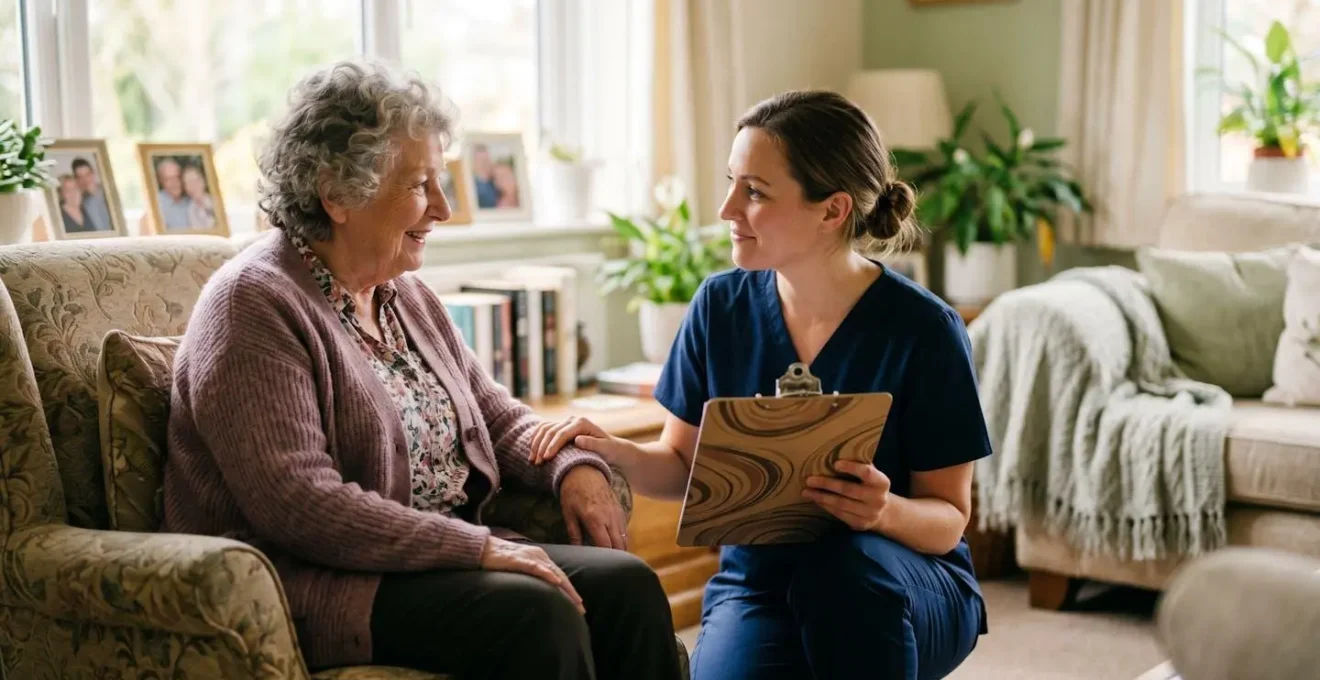
A good COPD care plan is not a document that gathers dust; it is a live, data-driven tool that empowers you to secure the right NHS support for your relative.
- Generic, task-based plans often fail to capture the complexity and unpredictability of conditions like COPD, leaving patients underserved.
- Effective communication with district nurses relies on providing specific, factual observations (e.g., “rescue inhaler use is up 50% this week”) rather than general worries.
Recommendation: Start treating the care plan as your central log for collecting simple, daily evidence. This transforms your role from an anxious relative into a credible partner in your parent’s care.
As a district nursing team leader, I often meet families who feel worried and powerless. You see your parent struggling with their Chronic Obstructive Pulmonary Disease (COPD), you know their breathing is worse, but you feel your concerns aren’t fully translating into changes in their care. You might have a folder labelled “Care Plan,” but it feels like a static list of medications and appointments, not a tool that actively helps.
The common advice is to ensure the plan is “person-centred” and to “communicate well” with the nursing team. While true, this is unhelpful without understanding how the NHS system is designed to respond. The system runs on evidence, on specific triggers, and on a clear understanding of clinical need. A generic plan that only lists tasks will never unlock the proactive, responsive support a person with a complex, fluctuating condition like COPD requires.
The real key is to transform that care plan from a passive document into a dynamic clinical tool. It’s about learning to capture your unique, daily observations in a way that provides clear, actionable evidence for the healthcare professionals involved. It’s about speaking the language of clinical relevance.
This guide will walk you through exactly what a robust COPD care plan should contain from a clinical standpoint. We will explore how to articulate your relative’s needs effectively, understand the different levels of NHS support available, and use simple tools to make you an indispensable partner in managing their health at home.
Summary: A Practical Guide to Your Relative’s COPD Care Plan
- Why Does a Generic Care Plan Fail Patients with Multiple Long-Term Conditions?
- How to Communicate Your Relative’s Preferences to District Nurses Effectively?
- NHS Continuing Healthcare vs Standard District Nursing: Which Level Does Your Relative Need?
- The Outdated Care Plan Mistake That Leaves Patients Underserved
- When Should You Request a Care Plan Review After Hospital Discharge?
- The Handover Failure That Puts Patients at Risk Between Care Shifts
- How to Use a Simple Daily Living Checklist to Spot Autonomy Changes Early?
- How to Get District Nurses to Visit Your Housebound Parent Regularly?
Why Does a Generic Care Plan Fail Patients with Multiple Long-Term Conditions?
A generic care plan typically lists tasks: ‘administer medication at 8 am,’ ‘check blood pressure.’ For a patient with multiple long-term conditions like COPD, often alongside heart failure or diabetes, this is fundamentally inadequate. Such conditions are not a stable set of tasks; they are a complex interplay of fluctuating symptoms, competing treatment demands, and unpredictable events. A plan that doesn’t capture this complexity, intensity, and unpredictability will always fail to provide the right level of care.
The NHS structures its higher levels of support, like Continuing Healthcare (CHC), around assessing this very complexity. To determine eligibility, assessors look at a dozen key areas, or “care domains.” A generic plan that just says “breathless” doesn’t provide the necessary evidence. A good plan details the *nature* of the breathlessness: Does it happen at rest? Does it cause anxiety? How does it limit mobility? This is the level of detail that demonstrates a “primary health need” beyond the scope of routine care.
Without this detail, your relative’s needs are invisible to the system. This is a key reason why, according to Nuffield Trust analysis, only 21% of people assessed for standard NHS Continuing Healthcare between January and March 2024 were found eligible. Their care plans didn’t provide the evidence to cross the threshold. A robust plan acts as the evidence log, documenting needs across all relevant domains, not just listing the obvious nursing tasks.
Your Audit Checklist: Does the Current Plan Reflect True Complexity?
- Breathing: Does it document oxygen requirements, specific triggers for breathlessness, and what an ‘exacerbation’ looks like for them?
- Nutrition: Does it note any dietary needs related to their conditions (e.g., fluid restrictions) and how breathlessness impacts their ability to eat?
- Drug Therapies: Does it just list medications, or does it map them out, highlighting potential conflicts from different specialists and noting side effects?
- Mobility: Does it specify how far they can walk, what aids they use, and what their risk of falls or muscle deconditioning is?
- Psychological Needs: Does it document the anxiety, low mood, or fear that often accompanies severe breathlessness and its impact on their wellbeing?
How to Communicate Your Relative’s Preferences to District Nurses Effectively?
District nurses operate under immense time pressure. An effective care plan must communicate essential information quickly and credibly. Vague statements like “Mum seems more anxious today” are hard to act on. The goal is to translate subjective feelings into objective, factual data. This shift in communication changes your role from a worried family member to a vital source of clinical evidence.
Instead of saying “He’s not himself,” try “His rescue inhaler use has increased from 3 times a day to 6 times a day this week.” Instead of “She’s struggling,” try “She can no longer walk to the bathroom without having to stop to catch her breath, whereas she could last Tuesday.” This is the language that nurses are trained to recognise and respond to. It provides a baseline and demonstrates a clear change in condition, which is a powerful trigger for a clinical review.
A powerful, simple tool is a one-page profile, sometimes called a ‘This Is Me’ document. This isn’t just about listing likes and dislikes (‘likes classical music’). It’s for critical personal context that impacts care. For example: ‘I get anxious when I cannot see my blue inhaler on my bedside table,’ or ‘I need 30 minutes to rest after washing and dressing before I can think about breakfast.’ A 2022 study on personalised care planning found that when families co-created these profiles, nurses reported a significantly improved ability to deliver person-centred care during time-pressured visits. It’s about giving them the essential ‘user manual’ for your relative.
NHS Continuing Healthcare vs Standard District Nursing: Which Level Does Your Relative Need?
Understanding the different tiers of NHS support available at home is crucial, as it determines the scope and funding of your relative’s care. The two main levels are standard district nursing services and the more comprehensive NHS Continuing Healthcare (CHC). Confusing the two is a common source of frustration for families who feel their needs aren’t being met. As of March 2024, only around 52,096 people in England were eligible for CHC, highlighting that it is for those with the most significant needs.
Standard district nursing is task-oriented and intermittent. A nurse will visit to perform specific clinical tasks like giving an injection, changing a dressing, or monitoring a stable condition. The service is funded by the NHS, but the family may need to pay for any additional social care (like help with washing or meals) and accommodation costs.
NHS Continuing Healthcare, in contrast, is for individuals assessed as having a ‘primary health need.’ This is determined not by a specific diagnosis, but by the complexity, intensity, and unpredictability of their overall condition. If eligible, the NHS funds 100% of the care package, including personal care and accommodation if required. For a COPD patient, this could mean moving from monthly nurse visits to a comprehensive, ongoing package of care to manage severe, unpredictable exacerbations and anxiety.
The following table, based on information from the House of Commons Library, breaks down the key distinctions you need to be aware of. Understanding this framework is essential for assessing whether the current level of care is appropriate and for building a case if you believe a higher level of support is needed, as explained in a briefing paper on NHS Continuing Healthcare.
| Criteria | Standard District Nursing | NHS Continuing Healthcare (CHC) |
|---|---|---|
| Eligibility Basis | Specific nursing tasks required intermittently | Assessed ‘primary health need’ based on complexity, intensity, and unpredictability |
| Funding Source | NHS funds nursing visits only | NHS funds 100% of care package including accommodation if in care home |
| Care Pattern | Task-oriented and intermittent (e.g., wound care, injections, monitoring) | Comprehensive, ongoing care package managing totality of needs |
| Assessment Tool | GP or community nurse clinical assessment | CHC Checklist followed by Decision Support Tool (DST) with 12 care domains |
| COPD Example | Stable COPD with predictable medication needs, monthly nurse visits for monitoring | Severe COPD with unpredictable exacerbations, complex medication changes, oxygen dependency, anxiety requiring specialist management |
| Financial Implications | Patient may pay for non-nursing care and accommodation | Entirely NHS-funded regardless of patient assets |
The Outdated Care Plan Mistake That Leaves Patients Underserved
One of the most dangerous mistakes in home care is treating the care plan as a static document. A person’s condition, especially with advanced COPD, changes. A plan written six months ago may be irrelevant and, worse, unsafe today. This is particularly critical when it comes to decisions about emergency treatment and resuscitation. Simply having a “Do Not Attempt Resuscitation” (DNAR) form is an outdated approach. Modern care planning focuses on a more holistic and empowering process.
The gold standard in the NHS is now the ReSPECT process (Recommended Summary Plan for Emergency Care and Treatment). This isn’t just a form; it’s a conversation. It moves beyond a simple ‘yes/no’ on resuscitation to consider a wider range of emergency treatments (like hospital admission or IV antibiotics) in the context of the patient’s personal goals and what is realistically achievable for them.
As the University Hospitals of North Midlands NHS Trust explains in their guidance, the aim is to create a shared understanding between the patient, their family, and healthcare professionals. According to their guide on the ReSPECT process:
ReSPECT has been developed by multiple stakeholders, led by the Resuscitation Council, in order to achieve a process that will be adopted nationally. It focuses on treatments to be considered as well as those that are not wanted or would not work.
– University Hospitals of North Midlands NHS Trust, ReSPECT Process Implementation Guide
A 2022 UK study on ReSPECT implementation found that when these were genuine conversations, patients felt empowered and had peace of mind. However, when professionals simply copied forward old recommendations without discussion—the essence of an outdated plan—patients were left confused and worried. For someone with end-stage COPD, a ReSPECT conversation is vital. It ensures that any emergency response respects their wishes while being grounded in clinical reality, preventing unwanted or futile treatments.
When Should You Request a Care Plan Review After Hospital Discharge?
The period immediately following a hospital stay for a COPD exacerbation is one of the highest-risk times for a patient. They are often deconditioned, on new medications, and adjusting to new equipment. The care plan created in the hospital can quickly become obsolete once they are home. A UK multisite study found that nearly 33% of COPD patients are readmitted within 28 days of discharge. This staggering statistic highlights the urgent need for proactive monitoring and a swift care plan review if things are not going as expected.
You should not wait for the next scheduled GP or nurse visit if you notice problems. You are the person on the ground, and your observations are the most important early warning system. Requesting an urgent review of the care plan is not being demanding; it is a critical safety measure. The key is to know what to look for. These are not just vague feelings of “not doing well”; they are specific system triggers that warrant immediate attention from the district nursing team or GP.
Here are the key red flags that should prompt you to request an urgent care plan review within the first two weeks of discharge:
- New or worsening medication side effects: This includes tremors from increased inhaler doses, confusion, or severe dizziness from new drugs.
- Incorrect equipment use: If your relative is unable to use their new nebuliser or oxygen concentrator correctly despite being shown in hospital.
- Increased breathlessness: A clear, quantifiable increase, such as needing their rescue inhaler more than three additional times per day compared to their baseline before admission.
- Any fall: Even a minor slip can indicate muscle weakness (deconditioning) or medication issues that need addressing.
- Changes in mental state: New or increased confusion, anxiety, or delirium that wasn’t present before the hospital stay.
- Caregiver overwhelm: A crucial but often overlooked factor. If you feel the care demands are unmanageable at home, the plan is not working and needs to be reassessed.
The Handover Failure That Puts Patients at Risk Between Care Shifts
In a home with visiting district nurses, paid carers, and family members all involved, communication is everything. The most dangerous point in any care day is the handover—the moment when responsibility for the patient passes from one person to another. When this fails, vital information is lost. Research by the Agency for Healthcare Research and Quality (AHRQ) estimates that a shocking 70% of deaths caused by medical errors are related to communication breakdowns, with many occurring during handover.
Imagine a district nurse visits in the morning and notices a slight crackle in your father’s breathing. They make a mental note to check again tomorrow. Later that day, a paid carer helps him with lunch and observes he’s more breathless than usual but assumes the nurse is aware. You arrive in the evening and he seems tired, but you put it down to a long day. No single person has the full picture. A potential chest infection is missed because the small clues were never connected.
This is why a central, written clinical handover tool is non-negotiable in a good care plan. It is not just a diary; it is a dedicated communication book that lives in the home. Every single person providing care—nurse, carer, and family member—must write in it at every single visit or interaction. This book becomes the single source of truth.
A good communication book should be structured simply, perhaps with columns for ‘Observations,’ ‘Care Provided,’ and ‘Points for Follow-Up.’ This ensures that the next person arriving can see, at a glance, any changes, concerns, or actions taken during the previous shift. It turns a series of disconnected observations into a coherent timeline of the patient’s condition, making it far easier to spot deterioration early. This simple notebook is one of the most powerful safety tools you can implement.
Key Takeaways
- A care plan’s purpose is to provide the NHS with specific, data-driven evidence of a patient’s needs, not just list tasks.
- Communicate with nurses using factual data (e.g., “breathless after 5 steps”) instead of general feelings (“seems worse today”).
- A central, written communication book for all carers and family to use is the single most important tool for ensuring safe handovers between shifts.
How to Use a Simple Daily Living Checklist to Spot Autonomy Changes Early?
For a progressive condition like COPD, decline doesn’t usually happen overnight. It’s a slow, subtle erosion of autonomy. One week your parent can make a cup of tea without issue; a month later, they have to sit down halfway through. Because these changes are gradual, they are often missed until a crisis occurs. This is where a simple daily living checklist becomes an invaluable tool for proactive case management.
This is not about the generic Activities of Daily Living (ADLs) like ‘can they dress themselves?’ It must be specific to the challenges of COPD. The goal is not to “test” your relative, but to create a consistent, daily record that reveals trends over time. This data is incredibly powerful. Presenting a GP with a chart showing a steady decline over three weeks is far more compelling than saying, “I think he’s getting worse.”
A 2022 UK study highlighted a case where a family caregiver did exactly this. By tracking their mother’s ability to wash without stopping, they created a simple visual graph. This concrete evidence, showing a clear decline, prompted the GP to immediately refer her to a respiratory specialist, whereas previous verbal concerns had not been acted upon. You can use the following checklist to start gathering this vital information today:
- Washing and dressing: Can they complete it without stopping to catch their breath? (Yes/No/With 1 rest break)
- Mobility indoors: Can they walk to the kitchen without becoming breathless? (Yes/No)
- Meal preparation: Can they stand to prepare a simple hot meal or drink? (Yes/No/Partial)
- Communication: Can they speak in full sentences without being interrupted by breathlessness? (Yes/No)
- Emotional state: Rate their anxiety level regarding their breathing today. (Low/Moderate/High)
Tracking these simple metrics for just a few minutes each day builds a powerful dataset. It allows you to spot a negative trend early, provides concrete evidence for care plan reviews, and empowers you to advocate for your parent with undeniable facts.
How to Get District Nurses to Visit Your Housebound Parent Regularly?
One of the most common and heartbreaking frustrations I hear from families is, “We can’t seem to get the district nurses to visit regularly.” With NHS resources stretched thin, routine “checking in” visits are rare. Referrals are triaged based on demonstrated clinical need. To secure regular visits, you must frame your request not as a general need for support, but as a requirement for specific, skilled nursing tasks that only a qualified professional can perform.
This means using strategic vocabulary when speaking to the GP or the district nursing referral hub. It’s about articulating the “why” behind the need for a visit. Instead of “My dad needs looking in on,” you need to present a clear clinical justification. This is where all the evidence you’ve been gathering comes into play. You are not just making a request; you are presenting a case for proactive case management to prevent a crisis, which is a core function of community nursing.
Here is the kind of strategic language that gets a referral accepted and prioritised, because it maps directly to the skills and responsibilities of a community nurse:
- Instead of “Can a nurse check on him?”: Use “Requesting skilled nursing assessment for monitoring early signs of chest infection in a patient with severe COPD.”
- Instead of “He has a lot of pills”: Use “Need support with managing a complex medication regimen with recent changes, requiring professional monitoring for side effects and efficacy.”
- Instead of “His condition is up and down”: Use “Condition shows unpredictable exacerbations requiring skilled nursing observation to distinguish normal fluctuation from deterioration.”
- Instead of “He’s getting very frail”: Use “Requesting referral to the Community Matron for proactive case management of multiple long-term conditions to prevent hospital admission.”
- If appropriate: Use “Requires palliative symptom control for advanced COPD, specifically for breathlessness and anxiety management.”
Using this professional framing demonstrates that you understand the system and have a legitimate need for skilled intervention. It elevates your request from a general worry to a specific clinical imperative that the service is structured to respond to.
By transforming the care plan into a dynamic evidence log and learning to communicate that evidence effectively, you can ensure your parent receives the consistent, high-quality care they need and deserve. The next logical step is to start implementing these strategies today; begin by using the simple daily checklist and prepare to discuss your findings at the next nursing visit or GP appointment.