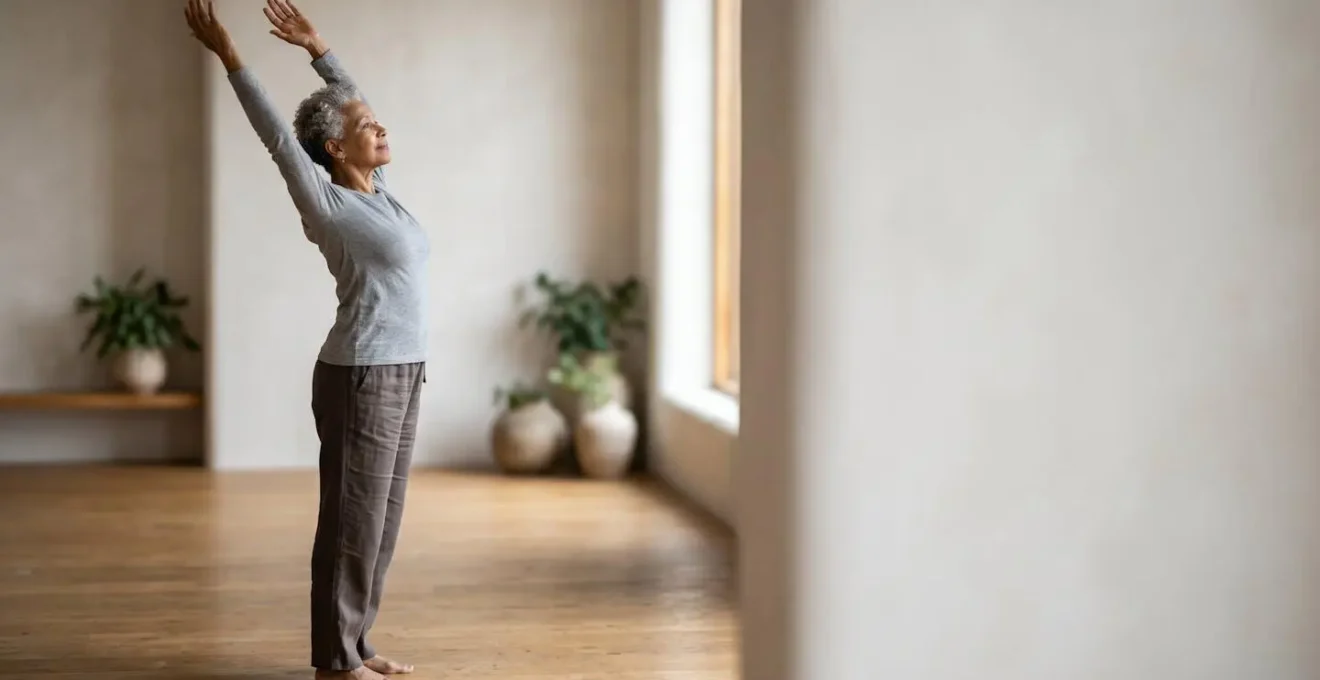
The real value of soft gymnastics for seniors isn’t just gentler movement; it’s about developing “body literacy” to exercise safely and effectively for life.
- It focuses on improving balance and joint awareness (proprioception) rather than just cardiovascular fitness or strength.
- It prioritises individual adaptation and non-competitive personal progress over keeping up with a group pace.
- It builds consistency by teaching you how to modify exercises during discomfort (like an arthritis flare), preventing setbacks.
Recommendation: When choosing a class, look for an instructor who teaches you *how* to listen to your body, not just what movements to do.
If you’ve ever looked at a flyer for a local fitness class and felt a wave of intimidation, you are not alone. The world of exercise can seem dominated by high-energy music, complicated choreography, and an unspoken pressure to “keep up.” Well-meaning advice to “stay active” is everywhere, but it often ignores the real-world concerns many of us have: What if I can’t do the moves? What if I have a bad day with my arthritis? What if I injure myself?
This is where the concept of soft gymnastics, or gentle exercise, offers a profoundly different and more welcoming path. It’s a philosophy of movement built on a foundation of safety, awareness, and personal progress. It moves away from the “no pain, no gain” mentality and instead embraces a more intelligent approach: “no strain, more gain.” The goal isn’t to push you to your limits, but to expand your capabilities safely and sustainably.
But if this approach isn’t about sweating it out or lifting heavy weights, what is it really doing? The secret lies in a shift of focus. Instead of measuring success by how fast you go or how many repetitions you complete, soft gymnastics measures success by how well you understand and respond to your own body’s signals. It’s about developing a skill I call “body literacy.”
This guide is designed to act as your introduction to this empowering approach. We will explore the science behind why gentle, specific movements can be more effective than generic exercise, how to find a class that truly suits your needs, and how to build a resilient, consistent practice that respects your body’s fluctuations. It’s time to discover a way of moving that builds confidence, not fear.
To help you navigate this topic, this article explores the key principles that define gentle, effective exercise for seniors. Below is a summary of the areas we will cover.
Summary: A Senior’s Guide to Safe and Effective Gentle Exercise
- Why Does Gentle Stretching Improve Balance Better Than Walking for Over-70s?
- How to Find a Chair-Based Exercise Class Suitable for Limited Mobility?
- In-Person Soft Gymnastics vs Online Chair Yoga: Which Produces Better Outcomes?
- The Competitive Spirit Mistake That Injures Seniors in Group Exercise Classes
- When Should You Modify Your Exercise Routine During an Arthritis Flare?
- Why Does Missing 2 Days of Exercises Set Back Your Recovery by a Week?
- Why Do 30% of Over-65s in the UK Fall at Home Each Year?
- How to Follow a Complex Physiotherapy Protocol Without a Therapist Present?
Why Does Gentle Stretching Improve Balance Better Than Walking for Over-70s?
It seems counter-intuitive. Surely walking, a dynamic, whole-body activity, would be the ultimate balance trainer. While walking is fantastic for cardiovascular health and general mobility, the reason targeted gentle stretching often yields superior results for balance lies in a concept called proprioception. Think of proprioception as your body’s internal GPS—the sense that tells you where your limbs are in space without you having to look. As we age, this sense can dull, making us less stable and more prone to stumbles.
Walking becomes so automatic that we often do it on “autopilot,” without consciously engaging the nerves and muscles that support balance. Gentle, mindful stretching forces the brain to pay attention. When you slowly stretch your calf or rotate your ankle, you are sending a flood of detailed sensory information from your joints and muscles back to your brain. This strengthens the neural pathways responsible for proprioception. You are, in effect, recalibrating your internal GPS.
Scientific evidence supports this targeted approach. As researchers in one clinical trial noted, specific stretching techniques deliver measurable benefits. A study on older adults found that intermittent stretching of the ankle was more effective than continuous stretching for improving balance. This highlights that it is not just stretching, but the *method* of stretching, that matters.
Therefore, while a daily walk is excellent, complementing it with focused stretching exercises provides a different, vital benefit. It’s not about choosing one over the other; it’s about understanding that walking trains your endurance, while mindful stretching specifically trains the neurological skill of balance.
How to Find a Chair-Based Exercise Class Suitable for Limited Mobility?
Finding the right chair-based class is about more than just locating the nearest community centre. For those with limited mobility, the quality and safety of the instruction are paramount. A great class can be liberating, improving strength and confidence, while a poorly run one can be ineffective or even risky. The key is to become an informed consumer, armed with the right questions to assess a class *before* you commit.
The environment of the class itself offers many clues. A well-designed space for chair-based exercise respects the needs of its participants, prioritising safety and accessibility over aesthetics. The moment you walk in, you can get a sense of whether the class is truly designed for you.
Beyond the physical space, the instructor’s qualifications and approach are the most critical factors. A certified senior fitness instructor will do more than just lead exercises; they will educate you. They will explain the ‘why’ behind each movement and proactively offer modifications. Your goal is to find a teacher, not just a cheerleader. Use the checklist below as your guide to vetting potential classes and instructors.
Your Checklist for Choosing a Safe Chair Exercise Class
- Verify Instructor Qualifications: Ask about their certifications in senior fitness, any physical therapy background, or specialised training in adapting exercises for limited mobility.
- Assess the Class Environment: Look for proper chair spacing for safety, check if the acoustics are adequate for hearing instructions, and gauge if the atmosphere is supportive and non-competitive.
- Request Modification Options: A good instructor should proactively offer exercise variations for different conditions, such as arthritis versus post-surgery recovery, without being asked.
- Evaluate Individual Attention: Observe a class if you can. Does the instructor explain the purpose of each exercise and provide personalised, respectful corrections to ensure proper form?
- Move at Your Own Pace: During a trial class, confirm that the culture encourages controlled movements. The priority should always be quality over speed or quantity.
Finding the right class is a crucial step towards reclaiming mobility and confidence. A little due diligence at the start can make all the difference in achieving a safe, enjoyable, and effective fitness experience.
In-Person Soft Gymnastics vs Online Chair Yoga: Which Produces Better Outcomes?
In the digital age, the choice between attending a local class and following an instructor on a screen has become a central question for many. Both in-person soft gymnastics and online chair yoga promise gentle, accessible movement, but they deliver very different experiences and, consequently, can lead to different outcomes. There is no single “better” option; the ideal choice depends entirely on your personal goals, personality, and current circumstances.
The primary advantage of an in-person class is the immediate, real-world connection it provides. For many, the social aspect is just as beneficial as the physical exercise, providing a powerful antidote to isolation. Furthermore, a live instructor can offer real-time, hands-on feedback, correcting your form to prevent injury and maximise effectiveness in a way a pre-recorded video cannot. This direct oversight significantly lowers the risk of performing movements incorrectly.
On the other hand, online options offer unparalleled flexibility and customisation. You can exercise whenever your energy levels are highest, without worrying about transport or fixed schedules. The pace is entirely your own; you can pause, rewind, and focus on a particular movement as much as you need. This is especially valuable on days when you’re experiencing pain or fatigue. The cost is also often much lower, with many high-quality resources available for free.
This decision requires a clear-eyed look at what you value most. Do you crave social interaction and expert guidance, or do you prioritise flexibility and self-pacing? The following table breaks down the key differences to help you make an informed choice that aligns with your needs.
| Factor | In-Person Classes | Online Chair Yoga |
|---|---|---|
| Social Connection | High – Direct interaction with peers and instructor, combats isolation | Low – Solo practice, limited social engagement |
| Instructor Feedback | Immediate hands-on corrections, visual assessment of form | Delayed or no personalized feedback, requires self-monitoring |
| Scheduling Flexibility | Fixed schedule, requires transportation and commitment to specific times | On-demand access, practice anytime based on energy levels |
| Injury Risk Management | Lower – Real-time correction of improper form | Higher – Depends on self-awareness and body literacy |
| Accountability | External – Social commitment and scheduled appointments | Internal – Requires strong self-discipline |
| Pace Customization | Moderate – Follows group pace with some individual modifications | High – 100% tailored to individual body on any given day |
| Cost | Typically higher – Facility fees, instructor costs | Lower – Many free or low-cost options available |
Ultimately, the best approach might be a hybrid one: attending an in-person class to learn correct form and build community, while supplementing with online sessions for daily consistency.
The Competitive Spirit Mistake That Injures Seniors in Group Exercise Classes
One of the most significant, yet often unspoken, risks in any group exercise setting is not a faulty piece of equipment or a slippery floor; it’s our own internal competitive spirit. Whether we’re comparing ourselves to the person next to us, or to a younger, more able version of ourselves, this instinct to “keep up” or “push through” is a primary driver of injury. It causes us to ignore our body’s warning signals in pursuit of an external benchmark.
True soft gymnastics is fundamentally non-competitive. The goal is to cultivate an internal benchmark of progress. Success isn’t about lifting your leg as high as your neighbour; it’s about noticing a slight improvement in your own range of motion compared to last week. This shift from external comparison to internal awareness is the cornerstone of safe, long-term exercise. It requires us to actively override the competitive urges we’ve been conditioned to follow our whole lives.
Research confirms that this non-competitive mindset yields better physical results. When the focus shifts from performance metrics to personal sensation, progress accelerates.
How a Non-Competitive Approach Improves Balance
A randomized control trial with 36 elderly participants demonstrated that balance training was most effective when participants focused on individual progress. The study emphasized that effectiveness soared when exercises were framed around personal goals like ‘feeling stability improve’ rather than performance metrics like the height of leg lifts. This reframing actively discourages the competitive behaviours that can lead to over-exertion and injury.
Learning to diffuse these competitive urges is a skill. It involves conscious self-talk to reframe the purpose of your activity. Instead of seeing exercise as a performance, you learn to see it as a form of personal healthcare. Here are some phrases to practice:
- “This is my body’s workout, not a public performance.” This reminds you that the purpose is internal health, not external validation.
- “Progress is measured by how I feel, not how I compare.” This shifts the metric of success from an external to an internal one.
- “My younger self had different needs; my current self deserves respect.” This helps to short-circuit unhelpful comparisons to past abilities.
- “Every body in this room has different strengths and challenges.” This normalises variation and dismantles the idea of a performance hierarchy.
When Should You Modify Your Exercise Routine During an Arthritis Flare?
For anyone living with arthritis, the question isn’t *if* a flare will happen, but *when*. One of the most common mistakes is adopting an all-or-nothing approach: either pushing through the pain (which can worsen inflammation) or stopping exercise altogether (which leads to stiffness and deconditioning). The key to managing arthritis and maintaining mobility is to learn how to adapt your routine based on your body’s daily signals. It’s about working *with* your body, not against it.
A simple and effective way to manage this is the “Traffic Light System.” This mental model helps you categorise your symptoms and make an informed decision about how to move on any given day. Instead of a simple “go” or “stop,” it provides a “go with caution” option that is crucial for long-term consistency.
The core principle is that movement itself is a powerful tool against inflammation, but the *type* and *intensity* of that movement must be appropriate. As leading clinicians advise, gentle exercise is key. Tim Allardyce, speaking with Versus Arthritis, notes, “Gentle exercise helps mobility, and that helps reduce inflammation.” The goal during a flare is not to build strength, but to maintain mobility and prevent stiffness without aggravating the joints.
Here is how to apply the Traffic Light System to your exercise routine:
- GREEN (A Good Day): Your pain and stiffness are at a minimum. This is the day to follow your regular routine. You can work through your full range of motion and maintain your current resistance levels. This is your baseline.
- YELLOW (A Mild Flare): You’re feeling more pain and stiffness than usual, but it’s manageable. This is not a day to stop, but a day to modify. Reduce your range of motion by about 30-50%. If you use weights, put them aside. Focus on smooth, fluid movements. Low-impact options like swimming or stationary cycling are excellent choices.
- RED (An Acute Flare): You are in significant pain, and movement is difficult. This is a day for active rest. The goal is to prevent the joint from seizing up. Switch to gentle breathing exercises and isometrics (tensing a muscle without moving the joint). Perform only gentle range-of-motion exercises up to the point of pain, but never into it. Even minimal movement is better than none.
Why Does Missing 2 Days of Exercises Set Back Your Recovery by a Week?
The feeling is all too familiar. You have a few busy days or a period of feeling unwell, your exercise routine slips, and when you return to it, it feels like you’re back at square one. This isn’t just in your head. The old adage “use it or lose it” is especially true for the neuromuscular pathways we build through physiotherapy and consistent exercise. When we stop, even for a short time, these carefully built connections between brain and muscle begin to weaken.
The setback isn’t just about muscle strength; it’s about the consistency of the signal from your brain. Each repetition of an exercise reinforces a specific neural pathway. When you miss a few days, that signal becomes less clear. Your body “forgets” the precise coordination required, leading to less efficient movement and a feeling of increased effort when you restart. This can create a frustrating cycle: the setback is demotivating, which makes it harder to get back on track, leading to longer breaks and further deconditioning.
However, it’s crucial to distinguish between a strategic rest day and an unplanned break. Pushing through an actively inflamed joint can cause more harm than good. As RheumInfo clinical guidance states, “Overuse of an actively inflamed joint may aggravate your arthritis and may increase joint damage.” The solution is not to force yourself through your full routine on a bad day, but to adopt the concept of a “Movement Minimum” or a “Minimum Viable Workout.”
The goal is to prioritise consistency over intensity. Doing just 5 minutes of your most critical exercises is infinitely better than doing nothing at all. This micro-session keeps the neural pathways active and maintains the habit, making it much easier to return to your full routine when you feel better. Consider these options for your minimum viable workout:
- The One Critical Exercise: Perform just the single most important exercise from your protocol.
- Active Range of Motion: Gently move your joints through their comfortable range without any added resistance.
- Breathing + Isometrics: On very difficult days, combine deep breathing with gentle muscle contractions (without movement) to maintain neural activation.
Key takeaways
- Gentle exercise is effective because it prioritises improving body awareness and the neurological skill of balance (proprioception) over raw intensity.
- The safest and most beneficial classes are non-competitive and led by instructors who teach you how to adapt exercises to your body’s daily needs.
- Consistency trumps intensity. A short “minimum viable workout” on a difficult day is far better for long-term progress than skipping exercise entirely.
Why Do 30% of Over-65s in the UK Fall at Home Each Year?
The statistic is sobering and highlights a widespread issue that touches nearly every family in the UK. According to UK falls prevention research, about a third of people over 65, and half of people over 80, fall at least once a year. These are not just minor mishaps; falls are the leading cause of injury-related death in older adults and can be a devastating trigger for a loss of independence. The cost to the healthcare system is enormous, but the cost to individuals and their families in terms of quality of life is immeasurable.
A common misconception is that falls are random, unlucky events. In reality, they are rarely the result of a single cause. More often, a fall is the end point of a “risk cascade”—a progressive accumulation of vulnerabilities that, when combined, overwhelm our ability to stay upright. This is why simply telling someone to “be more careful” is ineffective advice.
Understanding this cascade is the first step toward effective prevention. A major study has shed light on exactly how these factors interact.
The Chain of Fall Risk Factors
A 2022 Health Data Research UK study of over 600,000 older people in Wales revealed the complex nature of fall risk. It found falls typically result from a combination of interacting factors, including: muscular weakness, slowed reaction times, medication side effects causing dizziness, declining vision that reduces obstacle detection, and environmental hazards in the home. The research showed that fall risk is a progressive accumulation of these issues, not an isolated incident.
This is precisely where soft gymnastics and gentle exercise play a critical role. By systematically targeting the modifiable risk factors—improving muscle strength (especially in the legs and core), sharpening reaction times through balance exercises, and increasing body awareness to better navigate one’s environment—we can actively dismantle this risk cascade. Prevention isn’t about eliminating one single risk, but about building enough physical resilience to counteract the combined effect of several.
How to Follow a Complex Physiotherapy Protocol Without a Therapist Present?
Being handed a sheet of physiotherapy exercises can feel both empowering and overwhelming. You have a plan for recovery, but the responsibility for executing it perfectly, day after day, rests entirely on your shoulders. The biggest challenge isn’t the difficulty of the exercises themselves, but the sheer willpower required to remember and consistently perform them without the direct supervision of a therapist.
The secret to successful adherence isn’t about having more discipline; it’s about building a smarter system. Instead of relying on memory or motivation, you can integrate your exercises into your existing daily life by using environmental cues. This means linking a specific exercise to an action or a location that is already part of your routine. By “anchoring” your physiotherapy to an established habit, the existing habit becomes the trigger for the new one, making it nearly automatic.
Your home, which you might see as a place of rest, can be transformed into a supportive environment for your recovery. The goal is to make doing the right thing the easiest and most obvious choice. Instead of a single, long exercise session that’s easy to postpone, you pepper your day with short, 2-minute “exercise snacks” that are impossible to make excuses for.
Here’s how you can create your own system of environmental cues:
- Kitchen Routine Anchoring: Link your ankle exercises to the time you spend waiting for the kettle to boil. Do your standing calf raises while your coffee brews. This transforms dead time into productive recovery time.
- TV Commercial Triggers: Use television advertisement breaks as non-negotiable cues for your seated exercises, like shoulder rolls or neck stretches. A one-hour programme can provide 6-8 automatic exercise opportunities.
- Doorway Transitions: Place a small, simple visual reminder (like a coloured sticker) on a frequently used doorframe. Make it a rule to perform a specific stretch, like a chest stretch, every time you pass through.
- Bathroom Ritual Integration: The two minutes you spend brushing your teeth are a perfect, timed opportunity for balance exercises. You can do seated exercises while waiting for the bath to fill.
By weaving your protocol into the fabric of your day, you remove the burden from your willpower and let your environment do the heavy lifting. This makes consistency feel effortless, rather than a constant struggle.
The first step is always the most important. Armed with this knowledge, you can now begin to search for a class or start integrating these principles at home, not as someone who is intimidated, but as an informed participant ready to take control of your health and mobility.