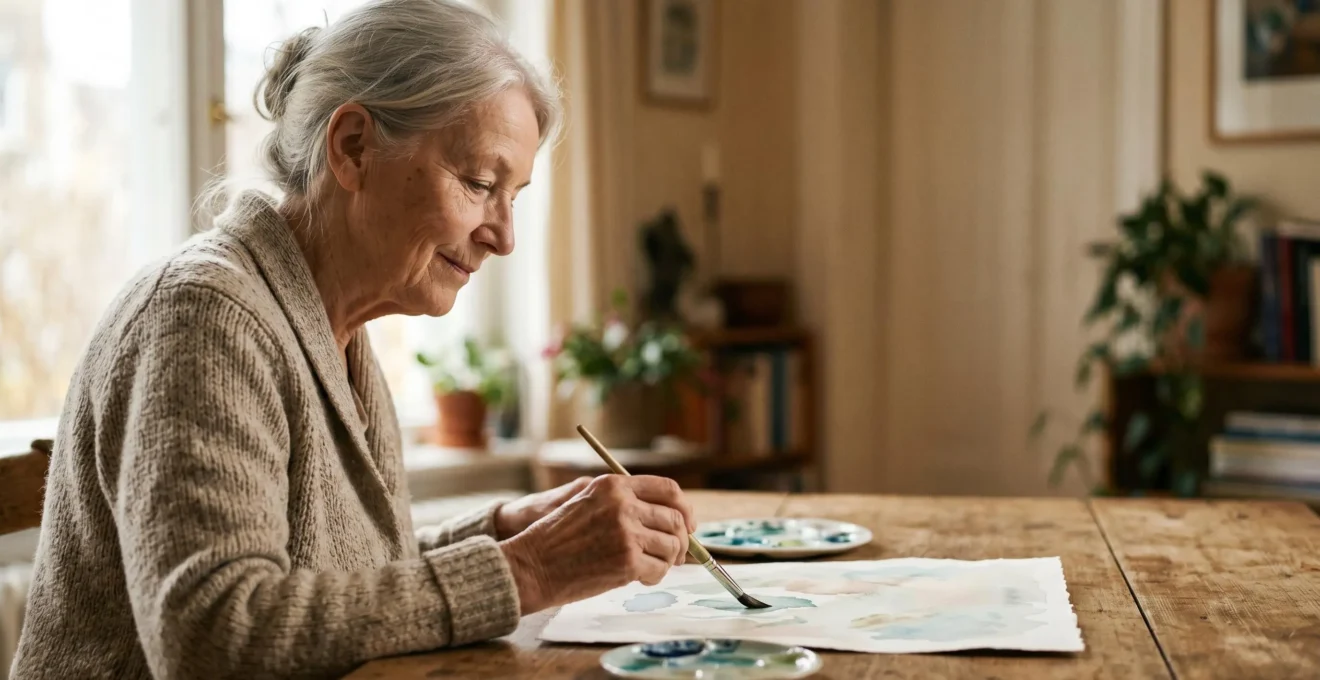
Many people believe you need artistic talent to benefit from art therapy, but this is a fundamental misunderstanding. The truth is that its power to help with depression comes from the creative process, not the finished product. As a registered art therapist, I’ve seen how the simple, guided act of making something—anything—can create measurable positive changes in your brain chemistry and mood, regardless of skill.
The thought of “doing art” can be intimidating, especially if the last time you picked up a paintbrush was in a school classroom decades ago. It’s a common feeling I encounter in my practice: “I can’t even draw a stick figure, how could art therapy possibly help my depression?” This belief, that you must be “good at art” for it to work, is the single biggest barrier that prevents people from accessing a powerful tool for mental wellbeing. We tend to associate art with galleries, talent, and judgment, rather than with process, exploration, and non-verbal communication.
This article is designed to dismantle that myth. We’re not going to talk about creating masterpieces. Instead, we’ll explore the science behind why the simple, tactile act of engaging with materials can be so effective. We will shift the focus away from the intimidating idea of “art” and towards the accessible, therapeutic reality of the creative process itself. This isn’t about what you create; it’s about what the act of creating does for you.
We’ll look at the neurological evidence, the practical steps to access these services in the UK through the NHS, how different formats suit different needs, and how to overcome the psychological hurdles. By the end, you will understand that your perceived lack of talent is not a barrier—it might just be the perfect starting point.
Summary: Art Therapy for Wellbeing Without the Pressure of Talent
- Why Does Creating Art Reduce Cortisol Levels Even in Complete Beginners?
- How to Access Art Therapy on the NHS Without a Mental Health Diagnosis?
- Group Art Workshop vs One-to-One Art Therapy: Which Suits Social Anxiety Better?
- The “I’m Not Good Enough” Mistake That Blocks Art Therapy Benefits
- When Should You Start Art Therapy After Losing a Spouse?
- Why Does Playing Bridge Protect the Brain Better Than Doing Crosswords Alone?
- Diabetes UK vs Local Seniors’ Group: Which Support Network Helps More?
- Which Hobbies Reduce Dementia Risk Most According to UK Research?
Why Does Creating Art Reduce Cortisol Levels Even in Complete Beginners?
The most compelling answer to the “no talent” question lies in our body’s chemistry. The therapeutic benefit of art-making isn’t a vague, feel-good notion; it’s a measurable biological event. When you’re engaged in a creative activity, your brain shifts its focus away from ruminating thoughts and anxieties. This simple act of focused, tactile engagement provides a mental break that has a direct impact on stress hormones.
This isn’t just theory; it’s backed by science. The key takeaway is that the benefit is tied to the process, not the person’s skill level. Research published in the journal Art Therapy demonstrated that just 45 minutes of art-making led to a statistically significant lowering of cortisol levels, and this effect was observed in participants regardless of their prior artistic experience. This means your body doesn’t know or care if you’re a Rembrandt or a beginner; it simply responds to the calming, centering effect of the creative process.
This process, which I call tactile engagement, is crucial. The feeling of clay yielding in your hands, the sensory feedback of a crayon on textured paper, or the smooth flow of paint from a brush—these are grounding experiences. They pull you into the present moment, a state often referred to as “flow,” where worries about the past and future temporarily fade. It is this absorption in the here-and-now that actively lowers the physiological symptoms of stress and depression.
As you can see, the focus is entirely on the hands-on interaction. The goal is not to produce a perfect sculpture, but to experience the sensation of shaping the material. This is the essence of why art therapy is accessible to everyone: the healing mechanism is built into the action itself, not into the aesthetic quality of the result.
How to Access Art Therapy on the NHS Without a Mental Health Diagnosis?
A common assumption is that you need a formal mental health diagnosis and a long, complicated referral to access therapeutic services. However, the UK has a powerful and accessible pathway that is perfectly suited for seniors seeking to improve their wellbeing: Social Prescribing. This NHS initiative connects people to local, community-based support, recognising that health is influenced by more than just medical factors.
Social Prescribing allows your GP to refer you to a “Link Worker.” This person is not a doctor, but a specialist who knows all about the non-clinical services available in your local area, from walking groups to art workshops. Their job is to have a conversation with you about what matters to you and help you find activities that can improve your health and happiness. This is an ideal route for accessing creative programmes, as it focuses on your overall wellbeing rather than a specific diagnosis. As Deb Taylor, a participant in a Social Prescribing programme, noted in an NHS England case study:
To say that art saved my life is an understatement, it has transformed it beyond any recognition of what it used to be.
– Deb Taylor, NHS England Social Prescribing Case Study
While this is a powerful personal experience, it highlights the potential impact. The key is knowing how to navigate the system. The process is straightforward and designed to be user-friendly, putting you in control of your journey towards better mental health through creative engagement.
Your Action Plan: Accessing Creative Wellbeing on the NHS
- Book an appointment with your GP and mention that you’re interested in Social Prescribing for creative wellbeing activities to support your mental health.
- Ask your GP for a referral to a Social Prescribing Link Worker, who will assess your needs and connect you to local community art programmes.
- The Link Worker will identify suitable ‘Arts on Prescription’ or therapeutic art workshops in your area, many provided by charities like Age UK or Mind.
- Attend a taster session at the recommended programme to see if it suits you before committing to regular attendance.
- If formal NHS art therapy isn’t available immediately, search online for ‘[Your Town] Arts on Prescription‘ to find alternative community-based options.
Group Art Workshop vs One-to-One Art Therapy: Which Suits Social Anxiety Better?
Once you decide to explore art therapy, a key question arises: is it better to join a group or see a therapist individually? The answer, especially for someone experiencing social anxiety, depends on your specific needs and comfort level. Both formats have unique benefits, and one can often be a stepping stone to the other. A formal one-to-one session is with a qualified, HCPC-registered art therapist, while a group workshop may be led by a facilitator in a community setting.
For those with severe social anxiety, the thought of a group can be overwhelming. In this case, one-to-one therapy provides a completely safe, confidential space. It allows you to build a trusted relationship—a “therapeutic alliance”—with a therapist at your own pace. Here, the focus is entirely on your internal world, using the art-making process to explore feelings that are too difficult to put into words.
Conversely, a group art workshop offers something one-to-one therapy cannot: a sense of shared experience and community. For many, social anxiety is intensified by the pressure to talk. A key benefit of an art group is that the art-making itself becomes the focus. It is a shared non-verbal activity, which can feel much less intimidating than a traditional talking-based support group. You are together, engaged in a parallel activity, which naturally lowers the barrier to connection. Seeing that others also feel awkward or unsure about their creations can be incredibly validating, normalising the experience and reducing feelings of isolation.
The following comparison can help you decide which path might be a better starting point for you, based on data and common pathways highlighted by UK organisations like the National Academy for Social Prescribing.
| Factor | Group Art Workshop | One-to-One Art Therapy |
|---|---|---|
| Best for | Combating loneliness and isolation | Processing private feelings and trauma |
| NHS Waiting Time (UK) | Faster access via charity-led programmes (often 2-4 weeks) | Longer waiting lists for NHS provision (can be 3+ months) |
| Private Cost (UK) | Often free or low-cost through Social Prescribing | £50-£90 per session privately |
| Social Anxiety Benefit | Shared non-verbal activity less intimidating than talking groups; peer support normalizes experience | Safe one-on-one therapeutic alliance to build confidence before group settings |
| Specialized UK Options | Themed groups: bereaved partners, Men’s Sheds, carer groups | HCPC-registered therapist for clinical-level support |
| Recommended Pathway | Graduation step after building confidence | Starting point for severe social anxiety |
The “I’m Not Good Enough” Mistake That Blocks Art Therapy Benefits
The feeling of “I’m not good enough” or “I’m not creative” is perhaps the most common and powerful obstacle in art therapy. This internal critic, full of judgment about skill and talent, can be so loud that it prevents you from even starting. The mistake is to believe that this voice is telling you the truth. In a therapeutic context, this feeling isn’t a statement of fact; it’s a piece of data. It’s an emotional state that we can work with and explore through the art itself.
The goal of a therapist is to create a space where that voice of judgment can be quieted, not by arguing with it, but by making it irrelevant. The focus shifts entirely away from aesthetics and onto curiosity and sensation. As Dr. Girija Kaimal, a leading researcher in art therapy at Drexel University, has stated:
No matter whether you’re a Rembrandt or can just about manage to draw a stick figure, creating art can help to reduce cortisol levels.
– Girija Kaimal, PhD, Drexel University Art Therapy Research
To bypass this self-judgment, therapists often use simple, non-intimidating “starter” exercises. These are not about drawing or painting a recognisable image; they are about making a mark, engaging with materials, and noticing what happens. The aim is to reconnect with a sense of play and exploration that we often lose in adulthood. Below are four simple exercises that focus on the process-over-product principle. They require no skill and have no “right” or “wrong” outcome.
- The Scribble Technique: Make random scribbles on paper with your eyes closed, then open your eyes and identify shapes or images within the marks, exploring what emerges without judgment.
- Feeling Collage: Cut out images, colours, and textures from magazines that resonate with your current emotional state, arranging them on paper without needing to explain or justify choices.
- Clay Exploration: Simply touch, squeeze, roll, and shape a piece of clay without any goal of creating a recognisable object, focusing purely on the tactile sensory experience.
- Abstract Emotion Painting: Use colours and brush strokes to represent how you’re feeling without attempting to paint a realistic picture, letting the ‘mess’ be part of the therapeutic expression.
When Should You Start Art Therapy After Losing a Spouse?
The loss of a spouse is one of life’s most profound and disorienting experiences. In the midst of grief, words can often fail or feel inadequate. This is where art therapy can offer a unique form of support, providing a non-verbal language to process complex emotions. However, the question of “when” to start is deeply personal, and there is no one-size-fits-all answer. The pressure to “move on” or follow a specific timeline for grieving is unhelpful.
Instead of focusing on a calendar, it is more useful to think in terms of “readiness signals.” Art therapy might be right for you when talking about your feelings feels repetitive or stuck, when your grief feels too big for words, or when you find yourself searching for a way to both honour your partner’s memory and begin to imagine a new future for yourself. It is not about replacing what was lost, but about finding a way to carry the memory forward in a way that feels meaningful and manageable.
Cruse Bereavement Support’s Approach to Creative Grieving
Cruse Bereavement Support, the UK’s leading bereavement charity, integrates creative activities into many of their support programmes. Their approach, which you can explore further on the Cruse website, recognises that there is no fixed timeline. They focus on readiness signals, offering therapeutic art activities when talking feels insufficient. Their specialist bereavement groups often incorporate the creation of “memory objects” or visual narratives, allowing participants to explore and represent their continuing bond with their lost partner in a tangible, symbolic way. This process helps in building a new identity while honouring the past.
This kind of memory work, as shown above, isn’t about artistic skill. It’s about using objects and images to tell a story, to represent a feeling, or to create a tangible connection to a memory. It’s a gentle, respectful way to navigate the landscape of grief, allowing for the expression of love, sadness, and hope all at once.
Why Does Playing Bridge Protect the Brain Better Than Doing Crosswords Alone?
While this article focuses on art therapy, it’s helpful to understand the broader scientific principles that make it effective. One of these is the powerful combination of cognitive and social engagement. Research into brain health for seniors consistently shows that activities combining these two elements offer superior protection against cognitive decline than solitary mental exercises. The classic example is the comparison between playing bridge and doing a crossword puzzle.
A crossword is a fantastic cognitive workout. It challenges your memory, vocabulary, and problem-solving skills. However, it is typically a solitary activity. Bridge, on the other hand, requires all the cognitive skills of a crossword—strategy, memory, logic, probability—but adds a crucial, dynamic layer: social interaction. You must communicate with a partner, interpret the actions of opponents, and adapt your strategy in real-time based on social cues. It’s this combination that makes it a “super-food” for the brain.
This principle directly relates to the benefits of group art therapy. Like bridge, a group art workshop combines a mentally engaging task with a social environment. You are learning, making decisions, and solving small creative problems, all while being in the presence of others. This dual-stimulus is what UK research, such as the English Longitudinal Study of Ageing (ELSA), has identified as a critical protective factor against cognitive decline in seniors. The social element reduces isolation, while the cognitive task keeps neural pathways active and strong.
If you’re interested in activities like Bridge, there are many accessible entry points for seniors in the UK:
- Search for ‘University of the Third Age (U3A)‘ branches in your area, which offer Bridge groups specifically designed for older learners in a supportive social environment.
- Look for ‘Duplicate Bridge clubs near me’ online to find local English Bridge Union affiliated clubs that welcome beginners and provide structured learning.
- Contact your local Age UK branch to ask about card game social groups and cognitive activity programmes for seniors.
- Check your local library or community centre notice boards for informal Bridge groups that meet weekly.
Diabetes UK vs Local Seniors’ Group: Which Support Network Helps More?
When seeking support, it’s crucial to match the network to the need. This question highlights a common dilemma: should you seek out a specialist, condition-specific group or a more general, social-focused one? The answer is that both are valuable, but they serve very different purposes. One is not inherently “better” than the other; they are complementary.
A group like Diabetes UK provides essential, expert-led support. It is the best place for specific medical information, advice on managing your condition, learning about the latest research, and connecting with others who understand the exact clinical challenges you face. This is informational and practical support, and it is vital for managing a long-term health condition effectively.
A local seniors’ group, on the other hand, primarily addresses a different but equally important need: social connection and the fight against loneliness. Its purpose is to provide community, friendship, and shared activities. While health might be a topic of conversation, it is not the central organising principle. This type of group is critical for general mental wellbeing and life satisfaction.
So, where does something like an art therapy group fit in? It occupies a unique and powerful middle ground. It is a “doing” group, not a “talking about illness” group. It offers the social connection of a local seniors’ club but with a structured, therapeutic purpose that can help process the emotional toll that a condition like diabetes can take, without making the condition the sole topic of conversation. It’s a way to find community based on a shared positive activity, rather than a shared diagnosis, which many find liberating and empowering.
Key Takeaways
- The mental health benefits of art therapy are scientifically proven to come from the creative process, making artistic skill or talent completely irrelevant.
- In the UK, you can access art workshops and creative programmes via your GP through NHS Social Prescribing, often without a formal mental health diagnosis.
- Overcoming the “I’m not good enough” feeling is key; starting with simple, non-intimidating exercises like clay work or scribbling can bypass self-judgment.
Which Hobbies Reduce Dementia Risk Most According to UK Research?
Building on the principle of combined cognitive and social engagement, extensive UK-based research has sought to identify which specific hobbies offer the most protection against dementia. The findings are remarkably consistent and point towards activities that integrate three key elements: complex cognitive challenge, sustained physical activity, and social interaction. Hobbies that tick only one or two of these boxes are beneficial, but those that combine all three are the most powerful.
The Triple Protection of Dancing
Major UK longitudinal studies, including the Whitehall II study and the English Longitudinal Study of Ageing (ELSA), have highlighted dancing as an almost perfect activity for dementia prevention. Styles popular with UK seniors, such as ballroom or Scottish country dancing, are particularly effective. They uniquely combine all three protective factors: the cognitive challenge of learning and remembering complex steps, the physical exertion of cardiovascular exercise, and the social engagement of partner work and group participation. This makes dancing a more powerful preventative tool than solitary activities like reading or puzzles, which primarily engage only the cognitive pathway.
This “triple-threat” model provides a clear framework for choosing activities to support long-term brain health. While not everyone is able to dance, the principle can be applied to other hobbies. A group art class, for example, involves cognitive challenge (learning techniques, making compositional choices), fine motor physical activity, and social interaction. The key is to seek out activities that are active and engaging on multiple levels, not passive.
For those looking to proactively engage in these types of hobbies, several UK organisations provide excellent starting points:
- Complex Cognitive Activities: Join the University of the Third Age (U3A) for language classes, musical instrument lessons, or chess clubs designed for older adults.
- Social Engagement: Contact local volunteer centres or the Ramblers Association for group walking activities that combine social interaction with physical exercise.
- Physical Activity: Enrol in senior-specific dance classes at local council leisure centres, which often offer styles like ballroom or line dancing.
- The Ultimate Trifecta – Dancing: Seek out Age UK or community centre dance programmes that offer the triple protection of physical exertion, cognitive challenge, and social interaction.
The journey into art therapy is not about producing a gallery-worthy painting. It is about giving yourself a new language to express what’s inside, a dedicated time to focus on a calming process, and an opportunity to connect with yourself and others in a new way. The evidence shows that the process works, the pathways to access it exist, and the only prerequisite is a willingness to try. Your first step isn’t to become an artist, but simply to give yourself permission to explore. Speak to your GP about a Social Prescribing referral and discover what the creative process holds for you.