Letting go of a beloved hobby like knitting due to arthritis isn’t just a physical loss; it’s a significant threat to your identity and mental well-being.
- Adapting your craft with ergonomic tools and new techniques is an advanced skill, not a defeat.
- Focusing on the meditative process, rather than a perfect result, unlocks the core mental health benefits of knitting.
Recommendation: Start with one small, low-cost adaptation—like a £5 yarn bowl or different needle material—to immediately reduce strain and rediscover the joy of crafting.
The dropped stitch. The sudden ache in your knuckles. The growing weight of a half-finished project that feels more like a burden than a joy. For a passionate knitter, these aren’t just minor annoyances; they are warning signs that a cherished part of your identity is under threat from arthritis. Many will advise you to simply “take more breaks” or, worse, to put the needles down for good. This advice misses the point entirely: knitting is more than a pastime; it’s a source of purpose, a meditative practice, and a tangible link to your creativity.
But what if the solution wasn’t to give up, but to get smarter? What if adapting your craft wasn’t a compromise, but a new, advanced skillset? The true path to continuing the hobby you love isn’t about powering through the pain. It’s about transforming your approach entirely. It involves understanding the biomechanics of your pain, embracing imperfection as a new aesthetic, and building a supportive ecosystem of tools and techniques that work for you.
This guide moves beyond the generic advice. We will explore the deep connection between your hobby and your mental health, provide a framework for choosing the right tools for your specific pain, and reframe the entire challenge. You will learn not just how to manage the physical symptoms, but how to preserve the very essence of what makes you a knitter, ensuring your hands can continue to create for years to come.
To help you navigate this journey of adaptation, this article is structured to guide you from understanding the problem to implementing practical solutions. Explore the sections that resonate most with you.
Summary: How to Continue Knitting Through Arthritis Pain
- Why Does Giving Up Your Favourite Hobby Increase Depression Risk by 40%?
- How to Choose Ergonomic Knitting Needles That Reduce Arthritis Pain?
- Adapting Your Current Hobby vs Finding a New One: Which Preserves Identity Better?
- The Perfectionism Trap That Makes Seniors Abandon Hobbies After One Bad Session
- When Should You Start Adapting Your Hobby Before Your Condition Makes It Impossible?
- Why Does a £5 Jar Opener Restore More Independence Than Expensive Gadgets?
- The Well-Meaning Mistake That Speeds Up Autonomy Loss in Elderly Parents
- What Assistive Devices Help Most with Daily Tasks When Grip Strength Declines?
Why Does Giving Up Your Favourite Hobby Increase Depression Risk by 40%?
Losing a hobby is not a trivial matter; it’s a significant life event with measurable consequences for mental health. The question in the title isn’t just rhetorical. While the 40% figure is a stark illustration, the underlying reality is well-documented. A 2024 study confirmed that depressive symptoms were 20% lower in seniors who regularly engage in hobbies. This is because activities like knitting provide more than just distraction; they structure our time, offer a sense of purpose, and create a state of “flow” where the outside world fades away. This deep immersion is a powerful antidote to anxiety and rumination.
When arthritis forces you to stop, you lose not only the activity but also the identity associated with it. You are a “knitter.” This identity carries with it a sense of skill, creativity, and generosity. Giving it up can feel like a profound loss of self. This is why the fight to adapt is so crucial. Research highlights this protective power, framing knitting not just as a craft but as a vital tool for well-being. As one research team from Taylor & Francis Online powerfully puts it:
Knitting can be perceived as an immunogenic occupation or ‘vaccine’ for knitters with mental illness, enabling them to gain control and improve health and well-being.
– Research team from Taylor & Francis Online, Promoting health through yarncraft: Experiences of an online knitting group living with mental illness
This “vaccine” effect comes from the tangible feeling of control and accomplishment in the face of life’s challenges. Each stitch is a small victory. Preserving this is not an indulgence; it is a fundamental act of self-care and mental health maintenance.
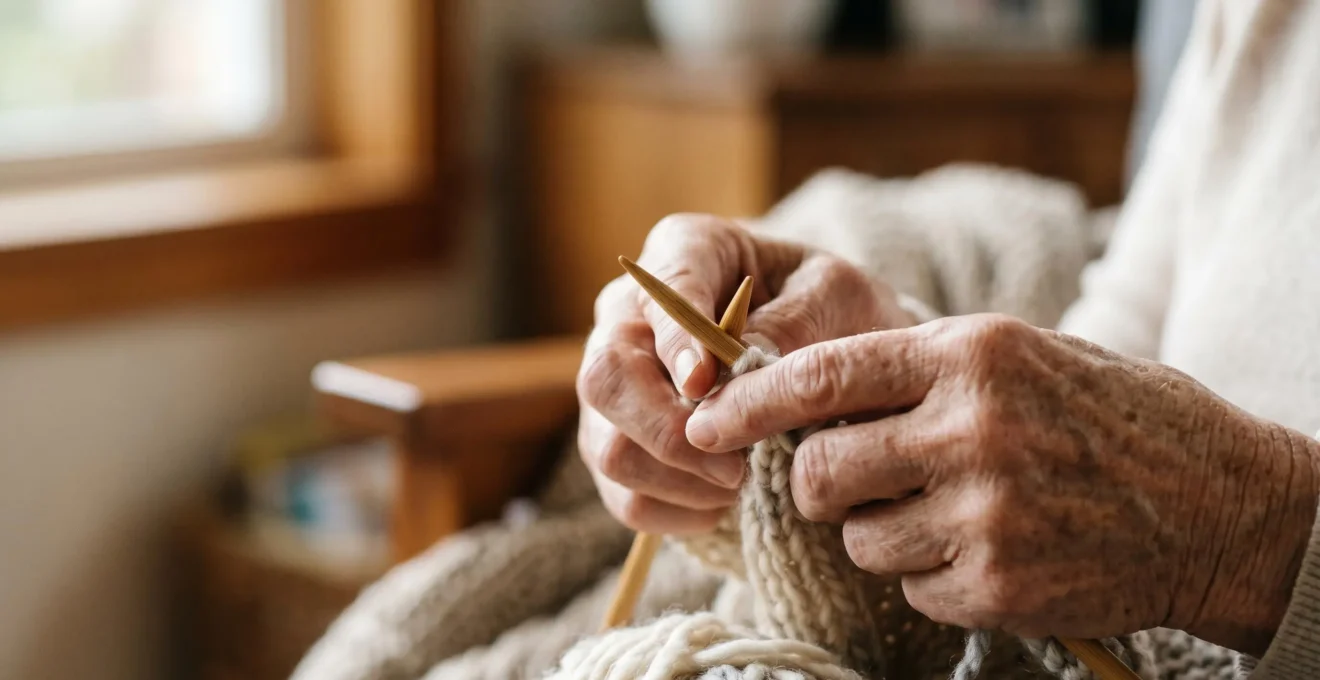
As this image shows, the goal is to protect this state of peaceful immersion. The joy of knitting is found in the process—the rhythmic click of needles, the soft texture of yarn, the quiet focus. The following sections are dedicated to providing you with the tools and mindset to safeguard that experience.
How to Choose Ergonomic Knitting Needles That Reduce Arthritis Pain?
The term “ergonomic” is often used as a marketing buzzword, but true ergonomics is about matching the tool to your specific physical needs. The best ergonomic needle for your friend might be the worst for you. The key is to practice what can be called “biomechanical empathy”—understanding the *why* behind your pain to choose the *what* of your tool. Instead of randomly buying new needles, start by diagnosing the primary source of your discomfort. Is it a sharp pain in your finger joints? A dull ache in your wrist? A feeling of cold stiffness?
Each symptom points to a different solution. For instance, pain from gripping too tightly is a common issue. A standard round needle requires constant, subtle muscle tension to prevent it from rotating. A square or triangular needle, however, provides flat surfaces for your fingers to rest on, reducing this rotational grip tension and allowing for a lighter hold. Similarly, if the weight of a growing project is straining your wrists, the cantilever effect of straight needles is the culprit. Switching to circular needles allows the project’s weight to rest in your lap, not on your joints.
Don’t think of it as abandoning your old, beloved needles. Think of it as curating a new, specialised toolkit that allows you to continue your craft with intelligence and skill. The right tool doesn’t just reduce pain; it restores efficiency and elegance to your movements.
Your Action Plan: Choosing Needles for Your Specific Pain
- For finger joint pain or cramping: Choose square or triangular-shaped needles. The flat surfaces reduce rotational grip tension and provide natural resting positions.
- For wrist strain from project weight: Select long circular needles. The cable distributes the project’s weight to your lap, eliminating wrist cantilever.
- For cold-sensitive joints: Opt for bamboo or wooden needles. These materials warm to your body heat, unlike metal which pulls warmth away from painful joints.
- For reduced grip strength: Use lightweight carbon fibre or bamboo needles. Heavier metal needles require more muscular effort to hold and manoeuvre, leading to faster fatigue.
- For general arthritis pain: Combine strategies. A lightweight, square wooden needle addresses grip, temperature, and weight issues simultaneously.
Adapting Your Current Hobby vs Finding a New One: Which Preserves Identity Better?
When a cherished hobby becomes difficult, well-meaning friends or family might suggest finding a new, less physically demanding one. “Why not take up reading or listening to audiobooks?” they might say. While these are wonderful activities, this advice fundamentally misunderstands what is at stake. The question is not just about filling time; it’s about preserving a core part of your crafting identity. You are not just ‘a person with a hobby’; you are a knitter. That identity is built on years of skill, knowledge, and creative output.
Abandoning knitting for a new hobby can feel like a surrender, an admission that you are no longer the person you once were. Adapting it, however, is an act of defiance and resilience. It is a declaration that you are still a knitter—a smarter, more resourceful one. It involves learning new techniques and methods that can work around your physical limitations, effectively adding a new layer of mastery to your existing skillset. This process of creative problem-solving can be deeply rewarding in itself.
Case Study: Preserving Identity Through Technical Adaptation
A knitter with decades of experience shared her story online after developing arthritis and carpal tunnel syndrome, which made her traditional English-style knitting excruciating. Instead of giving up, she researched alternative methods and taught herself the Portuguese knitting technique. This style, where the yarn is tensioned around the neck or a knitting pin, requires minimal hand and wrist movement. She reported that the switch eliminated her pain entirely. She wasn’t just able to knit again; she was able to knit for hours, pain-free. This demonstrates how a technical adaptation within the same craft can be a far more powerful solution for preserving identity than abandoning the craft altogether.
The goal is to remain in the world you love. By changing your technique instead of changing your hobby, you keep your community, your vocabulary, and your hard-won expertise. You remain a knitter, connected to your past and actively shaping your creative future.
The Perfectionism Trap That Makes Seniors Abandon Hobbies After One Bad Session
You’ve adapted your tools and your technique, but some days, your hands just don’t cooperate. The stitches are uneven, you make a mistake you can’t seem to fix, and the fabric in your hands looks… wrong. It is in this moment that the perfectionism trap springs. The voice in your head compares the current, flawed work to the flawless pieces you created years ago, and concludes, “If I can’t do it perfectly, it’s not worth doing at all.” This is one of the most insidious reasons passionate crafters abandon their hobbies.
The solution is a radical shift in mindset: the goal is no longer the perfect finished object, but the benefit of the process itself. The rhythmic, repetitive motion of knitting is a proven form of mindfulness that calms the nervous system. The focus required is a gentle workout for the brain. The simple act of creating something, anything, is a powerful affirmation of your ability and agency. These benefits are available to you whether the final product is a prize-winning shawl or a lumpy, character-filled scarf.
Embracing the Japanese philosophy of wabi-sabi—finding beauty in imperfection—can be liberating. See the slight irregularities not as mistakes, but as the unique signature of your hands on this particular day. As knitting and mental health advocate Arianna Frasca notes, the value is in the doing, not the done:
It’s okay to frog, pause, or leave something unfinished; it doesn’t impact the mental health benefits of the process.
– Arianna Frasca, knitting and mental health advocate, Knitting for Mental Health
Give yourself permission for a “bad” knitting session. Let the stitches be uneven. Put the project in time-out for a week. The mental health rewards were already banked the moment you sat down and began. Releasing the pressure of perfection is often the most important adaptation of all.
When Should You Start Adapting Your Hobby Before Your Condition Makes It Impossible?
The most common time to seek out adaptations is when the pain becomes unbearable and knitting is already impossible. This reactive approach, however, is often too late. It is born of desperation and can lead to frustration and a sense of defeat. The most effective strategy is to be proactive. The answer to “when should you start adapting?” is simple: the very first time you feel discomfort or notice a change in your ability.
Don’t wait for a “bad day” to become a “bad week” and then a “bad month.” Think of early, minor aches as a signal from your body to evolve your technique. By making small, incremental changes early on, you can prevent minor issues from becoming chronic, debilitating problems. This proactive mindset transforms adaptation from a last-ditch effort into a continuous, intelligent practice of body awareness and craft management. It’s about working *with* your body, not against it.
Furthermore, there is a common misconception that continuing to knit with arthritis will “wear out” your joints faster. According to experts, the opposite can be true when done correctly. The gentle movement required for knitting can help maintain joint flexibility and hand strength. As Debbie Amini, a director at the American Occupational Therapy Association, explains, continuing your hobby is a form of therapy in itself:
In fact, it can actually be an excellent method for maintaining movement and strength and increasing personal satisfaction and mental well-being through participation in a meaningful activity.
– Debbie Amini, Director of Professional Development at AOTA, Needlework With Hand Arthritis
Therefore, see the first twinge of pain not as a stop sign, but as a “yield” sign. It’s an invitation to slow down, assess, and adapt your approach. Starting early ensures that knitting remains a source of joy and health, rather than a source of strain.
Why Does a £5 Jar Opener Restore More Independence Than Expensive Gadgets?
In the world of assistive technology, there’s often a fascination with expensive, high-tech gadgets. Yet, for daily independence, the greatest gains often come from simple, low-cost tools that solve a single, high-frustration problem. A £5 rubber jar opener can be more empowering than a £500 smart home device because it returns agency over a fundamental daily task—making a cup of tea and toast. This principle applies directly to knitting. You don’t need to invest in a complex, costly setup to make a significant difference. A few pounds, spent wisely, can eliminate the biggest sources of strain and frustration.
Think about the entire process of knitting. The pain doesn’t just come from holding the needles. It comes from chasing a rolling ball of yarn across the floor (shoulder strain). It comes from trying to thread a tiny needle eye with stiff fingers (fine motor frustration). It comes from the weight of a heavy wool blanket pulling on your wrists (postural strain). An “adaptation ecosystem” focuses on these small but critical points of friction.
Investing in a few low-tech, high-impact tools can transform your experience for less than the cost of a few skeins of luxury yarn. These simple solutions work together to reduce cumulative strain, allowing you to save your energy and dexterity for the stitches themselves. Here are a few examples of affordable tools that can have an outsized impact:
- Yarn bowl (£5-8): Prevents the yarn ball from rolling away, eliminating the need to chase it and the associated strain on your back and shoulders. It also provides a smooth, consistent feed of yarn, reducing tension irregularities.
- Foam pencil grips (£2-4): These can be slid onto your existing needles to create customised, soft handles exactly where your fingers grip, instantly increasing comfort and reducing pressure points.
- Large-eye tapestry needles (£4-6): Weaving in ends is often the most dreaded part of a project. A pack of large-eye “darning” needles makes this final step effortless, removing a major barrier to project completion.
- Lap cushion or knitting pillow (£8-10): Placing a simple cushion on your lap supports the weight of your project, preventing it from pulling on your wrists and allowing you to maintain a more neutral, relaxed posture.
By focusing on these small, affordable interventions, you create a system that supports your crafting, proving that true independence often comes in the simplest packages.
The Well-Meaning Mistake That Speeds Up Autonomy Loss in Elderly Parents
One of the most difficult things for a loving child to watch is a parent struggling with a task they once did effortlessly. The instinct is to help, to step in, to take over. “Let me finish that for you,” or “Maybe you should stop before you hurt yourself.” While born from a place of care, this is often the single most disempowering thing you can do. This “helpful” act sends a clear message: “You are no longer capable.” It subtly strips away autonomy and reinforces a sense of loss and dependence.
Losing the ability to engage in a meaningful hobby is a significant contributor to social isolation and loneliness, a connection that is well-documented in research on elderly loneliness as tasks like knitting become more difficult. When you take over the “doing” part of the hobby, you may be completing an object, but you are robbing your loved one of the very process that provides mental stimulation and a sense of purpose. The struggle, the problem-solving, and the eventual small victory are where the value lies.
The right way to help is not to take the needles away, but to become a partner in adaptation. The best support is autonomy-preserving support. It means asking, “How can we make this easier for you to do yourself?” It’s about researching ergonomic tools together, finding a YouTube tutorial for a less strenuous knitting style, or offering to wind the yarn into a centre-pull ball to reduce tension. It’s about empowering them to continue, not managing their decline. This powerful advocacy perspective can be summed up in one crucial sentiment:
The best way to help me is to help me find ways to continue, not to take it away from me. My struggle is more valuable to me than a finished object.
– Advocacy framework for autonomy-preserving support
True support doesn’t remove the struggle; it provides the tools to make the struggle manageable and, ultimately, victorious. It respects the person’s identity as a capable creator, even when their physical abilities have changed.
Key takeaways
- Adapting your knitting is an advanced skill that preserves your identity, not a sign of defeat.
- Focus on the meditative benefits of the process; let go of the need for a perfect product to rediscover joy.
- Your support system should not be one magic tool, but an ecosystem of small, affordable adaptations for your tools, posture, and lighting.
What Assistive Devices Help Most with Daily Tasks When Grip Strength Declines?
Creating a truly sustainable knitting practice with arthritis is about building a complete adaptation ecosystem. It’s not just about the needles; it’s about everything that happens before, during, and after a knitting session. By thinking in categories, you can address potential pain points systemically and ensure that no single part of the process is causing undue strain. This holistic approach reduces the cumulative load on your body, allowing for longer, more comfortable crafting sessions.
An effective ecosystem can be broken down into four key categories: pain management, effort reduction, vision support, and posture. For example, preparing your hands with a warm-up or using compression gloves falls under pain management. Using an electric yarn winder addresses effort reduction. A magnifying lamp helps with vision, preventing you from hunching over and creating neck strain. Each element plays a role in creating an environment where you can thrive.
The following table, based on guidance from organisations like the Arthritis Foundation, breaks down this ecosystem into practical categories, helping you build a comprehensive support system tailored to your needs.
| Device Category | Function | Example Tools | Primary Benefit |
|---|---|---|---|
| Pain & Recovery | Reduce inflammation and prepare joints | Compression gloves, paraffin wax baths, warm-up hand stretches | Improves joint mobility before knitting; reduces post-session inflammation |
| Effort Reduction | Minimize physical exertion required | Electric yarn winders, spring-loaded scissors, automatic stitch counters | Eliminates high-grip-strength tasks that cause early fatigue |
| Vision & Precision | Reduce eye strain and improve accuracy | Lighted magnifying lamps, large-print patterns, high-contrast stitch markers | Prevents compensatory neck/shoulder tension from straining to see stitches |
| Support & Posture | Distribute weight and maintain alignment | Lap desks, ergonomic chair with armrests, task lighting, knitting pillows | Prevents cumulative postural strain over long sessions |
While this framework provides a comprehensive starting point, every individual’s needs are unique. If pain persists despite these adaptations, seeking professional guidance is the logical next step. As the Arthritis Foundation wisely advises, “If you experience problems, consider working with an occupational therapist who may have additional ideas, such as splinting to help you create without pain.”
Begin today by taking one small, manageable step. Choose one item from the ecosystem—a simple yarn bowl, a better light source, or a new set of bamboo needles—and see how it feels. The journey to pain-free knitting is not a single leap, but a series of small, intelligent adaptations that, together, will allow you to continue creating, stitch by stitch.