Contrary to common belief, assessing a parent’s loss of autonomy isn’t about listing what they can no longer do; it’s about understanding how they think and problem-solve through daily life.
- An Occupational Therapist (OT) assessment evaluates functional cognition—planning, sequencing, and safety judgment—during tasks like making tea, not just physical ability.
- Well-meaning help can inadvertently accelerate decline by creating “learned helplessness”; the clinical goal is “reablement,” which supports and maintains existing skills.
Recommendation: Start observing your parent’s daily activities not for failure, but for strategy, effort, and adaptation. This shift in perspective is the first step to a truly supportive care plan.
As a senior Occupational Therapist working in adult social care, I frequently meet families at a difficult crossroads. You’ve noticed the small changes: unopened mail piling up, a loss of interest in cooking, or perhaps a conversation that doesn’t quite track. Your instinct is to help, to protect, but you’re unsure what these signs truly mean or what the next step should be. The fear of a crisis—a fall, a hospital admission—is ever-present. Many guides offer simple checklists of what to look for, focusing on deficits like poor hygiene or a messy home. While not wrong, this approach misses the fundamental question an OT is trained to ask: not just *what* has changed, but *why* and *how*.
Measuring loss of autonomy isn’t a simple tick-box exercise. It’s a holistic, clinical investigation into a person’s ability to navigate their world safely and with purpose. It involves understanding the intricate dance between the person, their environment, and the occupations that give their life meaning—a concept we call the Person-Environment-Occupation (PEO) model. We look beyond the obvious to assess functional cognition: the real-world application of memory, planning, and problem-solving needed for everything from managing medication to making a cup of tea. The common focus on safety equipment like grab rails is just one tiny piece of a much larger, more complex puzzle.
This article will guide you through that puzzle from a clinical perspective. We will move beyond the superficial signs and explore how an OT truly measures functional decline. You will learn to see your parent’s situation through a therapist’s eyes, understanding the triggers for different levels of care, the dangers of well-intentioned mistakes, and the critical timing for legal arrangements like Lasting Power of Attorney. By the end, you won’t just have a list of problems; you will have a framework for understanding and a clear path toward finding genuinely effective support.
This comprehensive guide will explore the key facets of autonomy assessment. By navigating through each section, you will gain a deeper, more compassionate understanding of the journey ahead, empowering you to make informed and timely decisions for your parent’s well-being.
Summary: A Clinical Framework for Understanding Senior Autonomy
- Why Does Ignoring Early Signs of Autonomy Loss Lead to Emergency Hospital Admissions?
- How to Use a Simple Daily Living Checklist to Spot Autonomy Changes Early?
- When Does Loss of Autonomy Mean Home Care Is No Longer Enough?
- The Well-Meaning Mistake That Speeds Up Autonomy Loss in Elderly Parents
- When Should You Arrange Lasting Power of Attorney Before Autonomy Declines Further?
- Why Does a “Good” CQC Rating Not Guarantee Quality Care for Your Parent?
- Why Does an OT Assessment Cover More Than Just Bathroom Grab Rails?
- How to Find a Reliable Home Care Assistant Through a UK Agency?
Why Does Ignoring Early Signs of Autonomy Loss Lead to Emergency Hospital Admissions?
In clinical practice, we often see a pattern: a gradual, unaddressed decline in a person’s ability to cope at home culminates in a sudden crisis. A fall, a severe infection from forgetting medication, or malnutrition can all lead to an emergency call and a hospital admission that could have been prevented. This isn’t just anecdotal; 1 in 4 emergency admissions for older people in the UK are for conditions that are considered potentially avoidable with better community-based care and support. These admissions are often the direct result of ignoring the subtle, early indicators of declining autonomy.
When an older person is struggling with daily tasks, their world begins to shrink. They might stop cooking complex meals, leading to poor nutrition. They might avoid bathing due to a fear of falling, increasing the risk of skin infections. They might struggle to manage their prescriptions, leading to under- or over-dosing. Each of these small functional losses creates a compounding risk. This spiral of deconditioning—where physical, cognitive, and social abilities decline due to inactivity and lack of engagement—is a significant driver of frailty and a key predictor of hospitalisation.
The goal of proactive assessment is to interrupt this spiral before it leads to A&E. By identifying and addressing the root causes of functional decline early, we can implement strategies to support independence and prevent the crisis. As the Birmingham Early Intervention Programme demonstrated, proactively identifying at-risk older adults can have a massive impact. Their approach successfully prevented over 10,000 unnecessary hospital admissions, saved 90,000 bed days annually, and ensured more people could return directly home after a stay. This proves that spotting and acting on the early signs is not just compassionate, it is a critical healthcare strategy.
How to Use a Simple Daily Living Checklist to Spot Autonomy Changes Early?
As a family member, you are uniquely positioned to notice subtle shifts in your parent’s daily routines. However, to make these observations clinically useful, they need structure. Rather than just noting “Mum seems more forgetful,” an OT-led approach involves looking at specific categories of daily activities, known as Activities of Daily Living (ADLs) and Instrumental Activities of Daily Living (IADLs). ADLs are the basic tasks of self-care, while IADLs are the more complex activities required to live independently in the community.
When you observe these tasks, the key is to look beyond simple success or failure. Focus on the process and the quality of the performance. Does a task that used to take ten minutes now take thirty? Is there evidence of fatigue, shortness of breath, or frustration during the activity? Are they developing unusual workarounds or avoiding the task altogether? These qualitative observations provide rich data about their underlying functional capacity.
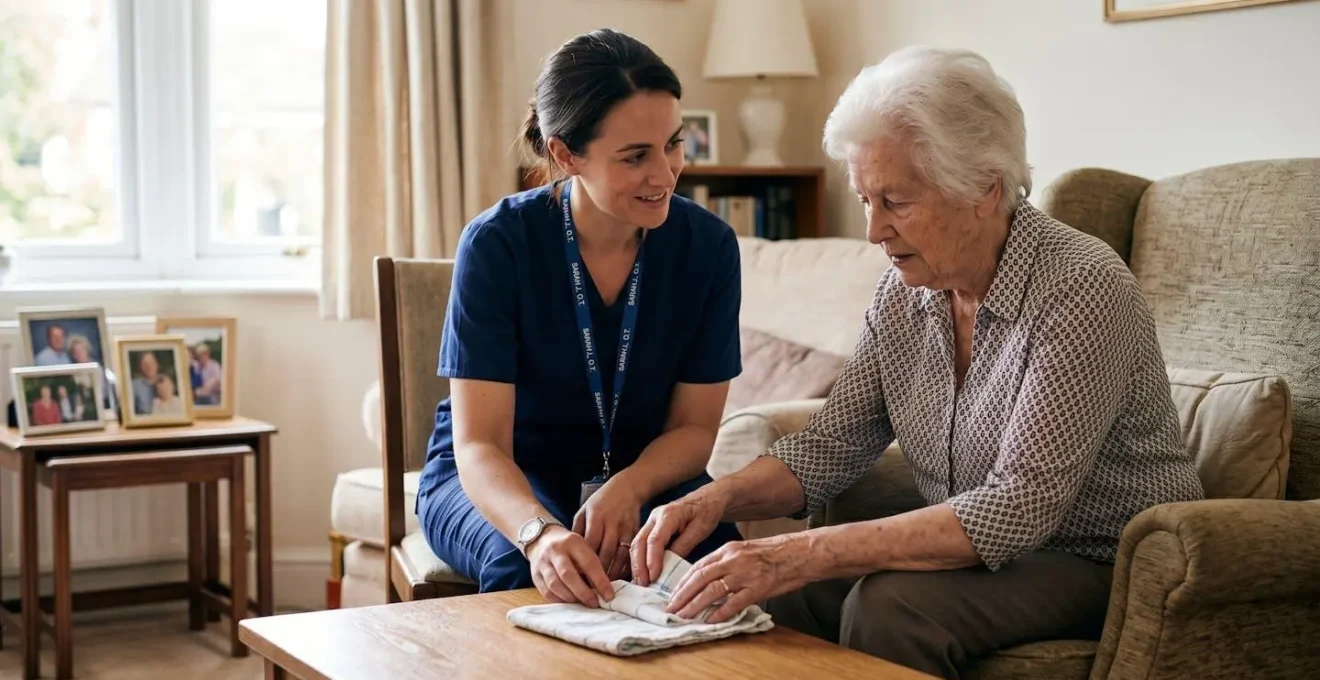
This image perfectly captures the essence of a functional observation. The focus isn’t on a medical test, but on a real-world activity within the person’s own environment. Observing someone making a cup of tea or preparing a simple meal can reveal more about their cognitive sequencing, safety awareness, and physical endurance than a dozen questions. It is in these mundane, everyday “occupations” that autonomy is truly expressed and where the first signs of its loss can be detected.
Your Action Plan: An OT’s Observation Checklist for Daily Living
- Self-Care Activities (Basic ADLs): Observe bathing, dressing, eating, toileting, and mobility. Note not just completion but how long tasks take and any signs of breathlessness, effort, or frustration.
- Instrumental Activities (IADLs): Monitor more complex tasks like cooking, managing finances, shopping, and medication. Watch for sequencing errors, forgotten steps, or safety lapses (e.g., leaving a hob on).
- Cognitive & Executive Function: During any task, note their ability to organise, problem-solve, and exercise safety judgment. Can they adapt if something goes wrong, like a missing ingredient?
- Meaningful Occupation & Social Roles: Track engagement in hobbies, social calls, or community activities. A withdrawal from previously enjoyed occupations is a significant red flag for changes in mood, confidence, or ability.
- Record the ‘How’: Document the qualitative indicators: the time required, the level of effort, emotional responses (anxiety, apathy), and any new adaptive strategies the person uses to compensate for difficulties.
When Does Loss of Autonomy Mean Home Care Is No Longer Enough?
The transition from managing with informal family support to requiring professional care, or from basic home care to a more intensive package, is a significant threshold. There is no single event that signals this point; rather, it is an accumulation of risk factors and an assessment of sustainability for both the parent and the caregivers. From a clinical standpoint, key indicators that home care may be insufficient include escalating safety risks, such as repeated falls or wandering, an inability to manage personal care even with assistance, and a clear decline in health due to factors like poor nutrition or medication errors.
However, one of the most critical—and often overlooked—factors is caregiver strain. A care situation is only sustainable as long as the support system itself is healthy. When a family caregiver’s physical, emotional, and financial resources are depleted, the quality and safety of care inevitably suffer. This is why OTs and social workers pay close attention to the well-being of the entire family unit. A recognised clinical tool for this is the Modified Caregiver Strain Index.
The Modified Caregiver Strain Index (MCSI) is a 13-question tool that measures strain related to care provision across Financial, Physical, Psychological, Social, and Personal domains.
– Hartford Institute for Geriatric Nursing, Modified Caregiver Strain Index Clinical Assessment Tool
This tool highlights that if caregiving is causing sleep deprivation, financial pressure, or social isolation for the caregiver, the situation is becoming untenable. Another stark indicator is the “revolving door” of hospital admissions. When an older person is discharged from hospital without a care package robust enough to meet their needs, readmission is highly likely. In fact, 1 in 6 patients over 75 are readmitted to hospital within 28 days of being discharged in the UK, often because the support at home was inadequate. A cycle of admission, discharge, and readmission is a powerful sign that the current level of home care is failing.
The Well-Meaning Mistake That Speeds Up Autonomy Loss in Elderly Parents
One of the most difficult and counter-intuitive aspects of supporting an ageing parent is resisting the urge to take over. When you see your parent struggling to button a shirt, prepare a meal, or manage their appointments, the most natural, loving response is to step in and do it for them. While this solves the immediate problem, it can, over time, create a much deeper one by fostering a psychological state known as “learned helplessness.”
This is not a sign of weakness; it is a predictable response to a loss of control. When tasks are consistently done for a person, they can internalise the belief that they are no longer capable of doing anything for themselves. This mindset then bleeds into other areas of their life, causing them to stop trying altogether, which accelerates the loss of physical and cognitive skills through disuse. It’s a vicious cycle where help, offered with the best intentions, ultimately undermines the very independence it seeks to protect.
Learned helplessness is the psychological state that results when an individual who is unable to exercise reasonable mastery in one situation incorrectly assumes that he or she is then unable to exercise reasonable control in other situations as well.
– Flannery RB Jr, Treating learned helplessness in the elderly dementia patient: Preliminary inquiry
The clinical antidote to learned helplessness is an approach called reablement. Instead of doing tasks *for* the person, a reablement approach focuses on finding ways to enable them to do tasks *with* the person, or for themselves. This might involve breaking a task into smaller steps, introducing adaptive equipment, or simply allowing more time and offering encouragement. As evidenced by the ReableDEM research network, this approach of supporting participation in meaningful activities shows positive outcomes for people with dementia and is more cost-effective than simply providing replacement care. It is the core philosophy of occupational therapy: to promote health and well-being through occupation, not to remove it.
When Should You Arrange Lasting Power of Attorney Before Autonomy Declines Further?
Arranging a Lasting Power of Attorney (LPA) is a crucial step in planning for the future, but families often struggle with the timing. The critical legal requirement is that the person must have the mental capacity to understand the decision they are making at the time the LPA is created. Waiting too long can mean losing this window of opportunity, leading to a far more complex and costly application to the Court of Protection. From an OT’s perspective, the triggers for arranging an LPA are directly linked to the decline in specific Instrumental Activities of Daily Living (IADLs).
Difficulties with complex IADLs are often the first sign that the executive function required for major legal and financial decisions is becoming compromised. These red flags include:
- Financial Management: Increasing difficulty managing bills, understanding bank statements, or falling victim to scams are clear indicators that a Property & Financial Affairs LPA is becoming urgent.
- Complex Communication: An inability to follow complex conversations, manage correspondence, or use the telephone effectively can signal a reduced capacity to weigh the pros and cons of significant decisions.
- Medication Management: While a Health & Welfare LPA is often considered later, early struggles with managing complex medication schedules can indicate a decline in the reasoning and judgment needed for future healthcare choices.
A key concept in UK law, established by the Mental Capacity Act 2005, is that capacity can fluctuate. A person with dementia, for instance, may have periods of lucidity (often in the morning) and periods of confusion. Capacity is also decision-specific; someone may have the capacity to decide what to have for lunch but not to decide whether to sell their house. The best practice is to act during a “lucid window” to create the LPA, ideally with the support of a GP who can document that the person had capacity at that specific time, ensuring the document is legally robust.
Why Does a “Good” CQC Rating Not Guarantee Quality Care for Your Parent?
When choosing a care home or a home care agency in the UK, the Care Quality Commission (CQC) rating is the first port of call for most families. A ‘Good’ or ‘Outstanding’ rating provides a valuable baseline, confirming that a provider meets fundamental standards for safety, effectiveness, and leadership. However, as an OT, I must caution families against relying on this rating alone. The CQC framework is excellent at assessing safety and process, but it may not capture the more nuanced elements that contribute to a person’s quality of life and autonomy.
A service can be perfectly safe, clean, and well-led, yet still foster an environment of passive dependency. It may excel at preventing falls by restricting movement or ensure good nutrition by serving pureed food to everyone, inadvertently stripping residents of choice and function. True quality of care, from an occupational perspective, is about enabling individuals to live as fully as possible. It is about creating the “just-right challenge” and supporting meaningful occupation, not just providing custodial care. As experts Ruth Usher and Tadhg Stapleton note, a comprehensive evaluation is required.
This image illustrates the difference perfectly. A CQC inspection might confirm the resident is safe and well-fed. But an OT assessment asks a different question: Is this person engaged in activities that are meaningful *to them*? Do they have a role, a purpose, a sense of control over their day? A “Good” rating doesn’t always tell you if the care philosophy is one of reablement and active engagement, or one of passive, risk-averse safety. The best care environments manage to do both, but you often need to look beyond the official report to find them.
Why Does an OT Assessment Cover More Than Just Bathroom Grab Rails?
There is a common misconception that an Occupational Therapy assessment for an older person is primarily about recommending equipment. Families often expect a visit that results in a prescription for a raised toilet seat, a bath board, and some grab rails. While environmental adaptations are certainly a part of our toolkit, they are a single component of a much broader and deeper investigation into a person’s functional ability. To focus only on the equipment is to miss the entire point of the assessment.
The true purpose of an OT assessment is to understand the dynamic interplay between the person, their environment, and their occupations. We are trained to analyse *how* a person performs a task to understand their underlying skills. This includes their physical strength and balance, but more importantly, their functional cognition—the executive functions of the brain that allow us to plan, sequence, problem-solve, and manage risk during an activity. The simplest domestic tasks can be incredibly revealing.
A powerful example is the Assessment of Motor and Process Skills (AMPS), a standardised tool where an OT observes a person performing a familiar kitchen task. When watching someone make a cup of tea, the therapist is assessing dozens of micro-steps. Do they remember all the ingredients? Can they sequence the steps correctly (kettle first, then teabag)? If the sugar bowl is empty, can they problem-solve and find the main bag in the cupboard? How do they handle the boiling water—is their judgment and perception of risk intact? This one activity provides a rich, real-world snapshot of memory, sequencing ability, and safety awareness that a simple questionnaire could never capture. It tells us not just if they *can* make tea, but *how* they do it, and what supports they might need to continue doing so safely.
This close-up view symbolises the heart of our practice: the tactile, intimate connection between a person and their environment. The grab rail isn’t just a piece of plastic; it’s an interface that enables a person to safely navigate their home. Our job is to analyse that interface and a thousand others, from the height of a kitchen counter to the complexity of a medication schedule, to create a holistic plan that supports function in every aspect of life.
Key Takeaways
- Preventable Crises: Ignoring early, subtle signs of functional decline is a primary driver of avoidable emergency hospital admissions among UK seniors.
- The OT Mindset: Assessing autonomy means looking beyond task completion to analyse the ‘how’—the effort, time, and cognitive strategy involved in daily activities (ADLs/IADLs).
- Reablement Over Replacement: Well-meaning help can create ‘learned helplessness’. The clinical goal is reablement—supporting a person to maintain their skills, not doing tasks for them.
How to Find a Reliable Home Care Assistant Through a UK Agency?
Finding the right home care agency is one of the most critical decisions a family will make. Armed with an OT’s perspective, you can move beyond generic questions about cost and availability and probe into the agency’s core philosophy of care. A reliable agency is not just a service that provides a pair of hands; it is a partner that actively works to maintain and promote your parent’s autonomy. Your interview process should be designed to uncover whether they share this reablement-focused approach.
A quality provider will have clear, systematic protocols in place. They should be able to articulate how they train their staff to balance safety with a client’s right to make their own choices. They must also have a formal process for when a carer notices a decline in a client’s ability, ensuring this vital information is escalated to the right healthcare professionals, such as the GP or a community OT. Without this, carers are working in a vacuum and small problems can quickly become crises. The English Longitudinal Study of Ageing data shows that for 20-24% of those with care needs, unmet needs are directly linked to unplanned hospital admissions, highlighting the critical importance of a responsive and proactive care agency.
To help you in this crucial task, use the following checklist of OT-informed questions when speaking to potential agencies. Their answers will reveal the true nature of their service and whether they are genuinely equipped to support your parent’s independence.
Your Action Plan: OT-Informed Questions for Home Care Agencies
- Independence Promotion Philosophy: Ask ‘Can you give a specific example of how your staff promote independence rather than just completing tasks for clients?’ This reveals whether the agency follows reablement principles.
- Decline Detection Protocol: Ask ‘What is your formal procedure when a carer notices a decline in a client’s ability?’ Quality agencies have systematic escalation processes to occupational therapy or medical teams.
- Autonomy vs. Safety Balance: Ask ‘How do you balance safety with a client’s right to make their own choices and take informed risks?’ This tests their understanding of person-centred care under the Mental Capacity Act.
- Specialist Training Evidence: Ask ‘What specific training do your staff receive in dementia care, reablement approaches, or supporting cognitive impairment?’ Request to see training logs or certifications.
- OT Assessment Integration: Ask ‘How do you incorporate recommendations from occupational therapy assessments into daily care plans?’ The best agencies translate OT reports into actionable, skill-maintaining routines for their carers.
By asking these targeted questions, you are not just hiring a service; you are auditing a potential clinical partner. You are seeking an agency that understands that their role is not to replace function, but to skilfully and compassionately support it for as long as possible.
Evaluating your parent’s needs and navigating the UK care system can be a complex and emotional process. The next logical step is to formalise your observations and request a professional care needs assessment from your local council, which will include an occupational therapy evaluation to create a personalised and effective support plan.