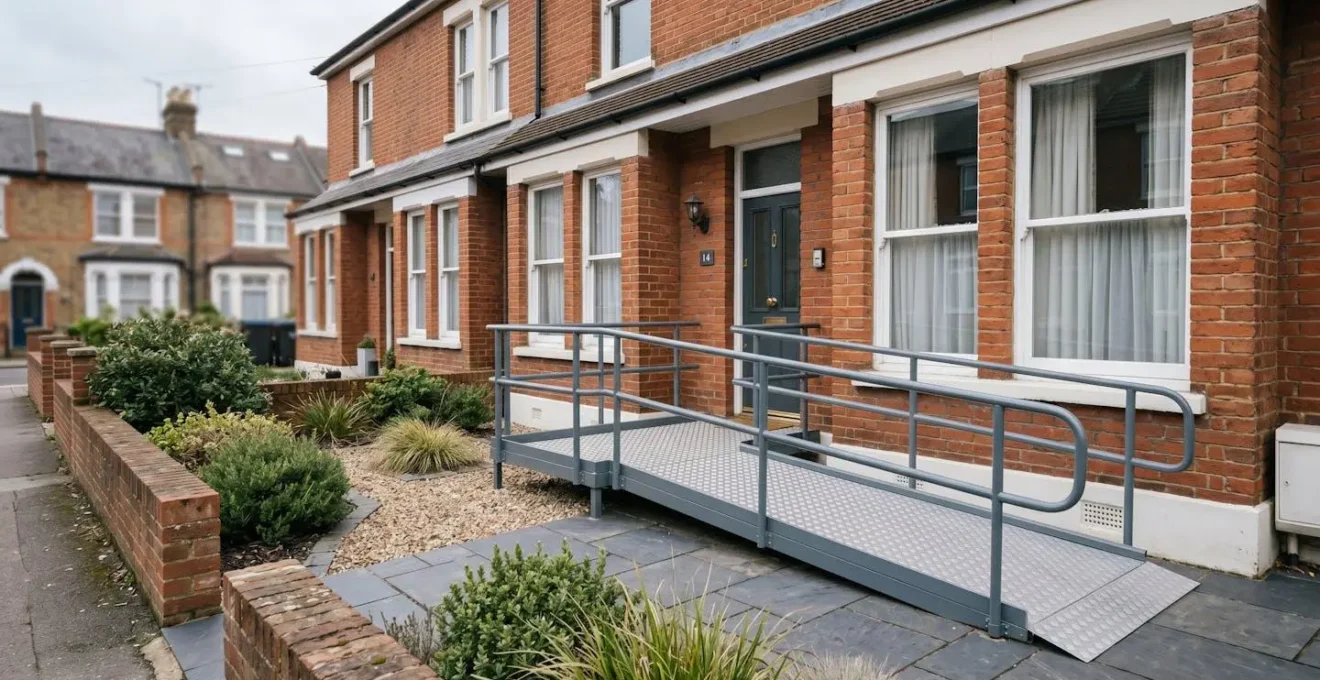
Successfully installing a compliant wheelchair ramp in the UK hinges on a holistic assessment of the user and property, not just on meeting a specific gradient.
- Overlooked details, such as the threshold gap between the ramp and the doorway, are a primary cause of unsafe and impractical installations.
- Proactively applying for a Disabled Facilities Grant (DFG) before hospital discharge is a critical strategic step that can save months and thousands of pounds.
Recommendation: Begin any home adaptation project with an Occupational Therapist’s assessment to define needs before engaging with builders or regulations.
The moment a loved one is due to return home from the hospital with reduced mobility, a simple entrance step can transform into an insurmountable barrier. For many UK homeowners, the immediate reaction is to find a ramp. The internet offers a deluge of advice, most of it revolving around a single, seemingly absolute rule: the 1:12 gradient. This focus on one dimension of Building Regulations Part M, while important, is a dangerous oversimplification. It leads many well-intentioned homeowners down a path of costly mistakes, project delays, and, worst of all, unsafe solutions that fail to meet the user’s actual needs.
The common approach is to treat ramp installation as a simple construction task. You measure the height, calculate the length for the gradient, and build. Yet, this ignores the intricate ecosystem of accessibility. It fails to consider the turning circle of a powerchair, the specific challenges of a modern uPVC door threshold, or the long-term impact of British rain and frost on different materials. It also overlooks the crucial administrative landscape of local council planning permission and Disabled Facilities Grants (DFG), a world where timing is everything.
But what if the key to a successful, safe, and compliant installation wasn’t just adhering to the letter of the law, but understanding its spirit? This guide adopts the perspective of a building surveyor specialising in accessibility. Our angle is that true compliance is not a box-ticking exercise. It is a holistic process of risk assessment and future-proofing. We will demonstrate that the overlooked details—the “critical junction points” where ramp meets home, and where project meets bureaucracy—are the true determinants of a successful adaptation. This article will walk you through the key decisions, from material selection to grant applications, empowering you to ask the right questions and avoid the common, costly oversights.
This comprehensive guide explores the essential considerations for installing a wheelchair ramp in the UK. By navigating through material choices, regulatory requirements, and financial aid processes, you will gain the knowledge to make informed decisions for a safe and durable home adaptation.
Summary: A Surveyor’s Guide to UK Wheelchair Ramps
- How Do Advanced Mobility Solutions Help You Stay Independent After 70 in the UK?
- How to Choose Between a Fixed Concrete Ramp and a Portable Folding Ramp for Your UK Home?
- Aluminium or Wooden Ramp: Which Withstands British Rain and Frost Better?
- The Threshold Gap Mistake That Makes 30% of DIY Ramps Dangerous
- When Should You Apply for a Disabled Facilities Grant Before Hospital Discharge?
- How to Ensure Your Home Extension Meets Part M Accessibility Standards?
- The Planning Permission Oversight That Adds 3 Months to Home Adaptation Projects
- Where Should You Start When Adapting Your Home for Reduced Mobility?
How Do Advanced Mobility Solutions Help You Stay Independent After 70 in the UK?
Maintaining independence in later life is a cornerstone of well-being, and advanced mobility solutions are pivotal in achieving this. Beyond simply providing movement, correctly specified equipment like wheelchairs and home adaptations such as ramps represent a gateway to continued participation in daily life. The UK government acknowledges this critical need, with funding for home adaptations showing significant investment. The announced DFG allocation of £711 million for 2025/26 in England underscores the national strategy to support people to live safely and independently in their own homes for longer.
This support transforms a home from a place of potential obstacles into a safe haven. A properly installed ramp, for example, does more than just bridge a step; it restores autonomy. It means a person can leave their home for a doctor’s appointment, visit neighbours, or simply enjoy their garden without assistance. This empowerment has a profound impact on mental and physical health, reducing social isolation and promoting a sense of self-reliance. As NHS England documents rightly point out, the value is deeply personal and fundamental to quality of life.
As highlighted by NHS England in its documentation for the National Wheelchair Data Collection:
Wheelchairs provide a significant gateway to independence, well-being and quality of life for thousands of adults and children.
– NHS England, National Wheelchair Data Collection documentation
Therefore, viewing these adaptations not as a concession to old age but as a proactive investment in continued independence and dignity is essential. The right solution, whether it’s a lightweight powerchair or a seamlessly integrated ramp, empowers individuals to navigate their own space on their own terms, which is a fundamental aspect of person-centred care after the age of 70.
How to Choose Between a Fixed Concrete Ramp and a Portable Folding Ramp for Your UK Home?
The choice between a permanent, fixed ramp and a temporary, portable one is a foundational decision in any home adaptation project. This is not merely a question of budget but a strategic choice dictated by user needs, property type, and long-term plans. A holistic assessment of the situation is required, moving beyond the immediate problem of surmounting a step.
A fixed concrete ramp is a permanent structural addition. It is durable, can be aesthetically integrated into landscaping, and is ideal for long-term, high-frequency use. However, its permanence is also its primary drawback. It requires significant groundwork, may trigger the need for planning permission, and is a major commitment that can affect property value. This solution is best suited for owner-occupiers who have a permanent mobility requirement and are certain of their long-term residence.
In contrast, portable or modular aluminium ramps offer flexibility. They are lightweight, can be installed quickly with minimal disruption, and can be removed or relocated if needs change or if you move house. This makes them an excellent choice for short-term recovery, rental properties, or situations where a permanent structure is not feasible or desired. For renters or housing association tenants, portable systems are often the only viable option. The key factors in your decision should include:
- User Prognosis: Is the mobility need short-term (e.g., post-surgery recovery) or permanent?
- Property Status: Do you own the property, or are you a tenant requiring a non-permanent solution?
- Space Constraints: Do you have the necessary length for a straight portable ramp, or do you need a fixed ramp with switchbacks to achieve a compliant gradient?
- Total Cost of Ownership: Consider installation, maintenance, and potential removal costs or resale value.
Aluminium or Wooden Ramp: Which Withstands British Rain and Frost Better?
When selecting a ramp material for a UK home, weather resistance is a non-negotiable priority. The persistent cycle of rain, damp, and frost can rapidly degrade unsuitable materials, compromising both safety and longevity. The two most common choices, treated timber and aluminium, have distinctly different performance characteristics in the British climate. While timber can offer a more traditional aesthetic, its long-term durability is entirely dependent on a rigorous maintenance schedule.
Aluminium, particularly with a chequer plate or other textured, non-slip surface, is exceptionally well-suited to UK weather. It is inherently resistant to rust and corrosion (though marine-grade alloys are recommended in coastal areas) and is unaffected by the freeze-thaw cycles that can cause other materials to crack or delaminate. Its primary advantage is its low maintenance requirement, typically needing only periodic cleaning to remain safe and functional for decades. In contrast, treated timber requires, at a minimum, an annual treatment with preservatives to prevent rot and moisture ingress. Failure to maintain this schedule can lead to slippery surfaces (as algae grows) and structural weakness.
The following table, based on an analysis of material properties, provides a direct comparison to inform your decision.
| Material Property | Aluminium (Chequer Plate) | Treated Timber | GRP (Glass Reinforced Plastic) |
|---|---|---|---|
| Slip Resistance (Wet) | Excellent – raised chequer pattern maintains grip | Good with anti-slip strips; requires treatment | Very good – textured surface retains grip |
| Frost Resistance | Excellent – no degradation from freeze-thaw cycles | Moderate – can crack if moisture penetrates | Excellent – non-porous material |
| Coastal Corrosion Risk | Requires marine-grade alloy or coating | High – salt accelerates rot without treatment | Excellent – inherently corrosion resistant |
| Annual Maintenance | Low – periodic cleaning and inspection | High – annual treatment against damp and rot | Low – wash down and check fixings |
| Aesthetic Integration | Modern/industrial – suits contemporary builds | Traditional – complements period/cottage properties | Versatile – available in various finishes |
| Typical Lifespan (UK) | 15-25 years with proper maintenance | 10-15 years with annual treatment | 20-30 years |
While Glass Reinforced Plastic (GRP) offers the best overall performance, particularly in corrosive environments, aluminium represents the most balanced choice for most residential settings, providing an excellent combination of durability, safety, and lifecycle cost effectiveness.
The Threshold Gap Mistake That Makes 30% of DIY Ramps Dangerous
While much focus is placed on the overall gradient of a ramp, the most common point of failure in DIY and poorly specified installations is the critical junction point at the door threshold. Modern UK homes, particularly those with uPVC doors, feature substantial sills (often 60-100mm high) designed for weather and thermal performance. Simply running a ramp up to this sill creates a final, jarring “bump” that is not just inconvenient but genuinely dangerous. This abrupt lip can halt a manual wheelchair, cause an occupant to jolt forward, or, for powerchair users, drain significant battery power through repeated impacts.
Achieving a truly seamless, “level” threshold as required by Part M of the Building Regulations is a task of precision. It often cannot be solved by the main ramp alone. The solution typically involves a combination of an external ramp and a smaller, internal or external threshold ramp or wedge. This dual-system approach bridges the final gap, creating a smooth transition from the ramp surface, over the sill, and onto the internal floor level. The engineering challenge is to do this without obstructing the door’s ability to close and seal properly.
Case Study: uPVC Door Threshold Challenge
Modern UK homes with uPVC door frames typically feature door sills ranging from 60-100mm in height to meet thermal and weather performance standards. A case study from Yorkshire demonstrates the successful implementation of a combination threshold ramp system: an external main ramp achieving the required 1:12 gradient was paired with an internal threshold wedge ramp to eliminate the final step. This dual-approach solution created a seamless transition, eliminating the jarring bump that can drain powerchair batteries by up to 20% over time through repeated impacts. The installation included careful measurement to ensure the internal wedge did not obstruct the door’s full closing arc, maintaining security and weather sealing. Building control approval was obtained by demonstrating the system met Part M requirements for level thresholds while preserving the door’s weatherproofing integrity.
Ignoring this final inch is the mistake that undermines the entire project. It transforms a significant investment into a daily source of frustration and risk. Proper specification requires meticulous measurement and often a bespoke or combination solution to ensure the transition is truly seamless and safe.
When Should You Apply for a Disabled Facilities Grant Before Hospital Discharge?
The answer is unequivocally: as soon as possible. The process of securing a Disabled Facilities Grant (DFG) is not swift, and initiating it early is the most critical strategic action a family can take. A common, heartbreaking scenario involves waiting until a loved one is discharged, only to discover the home is inaccessible and the grant process will take many months. Proactive application is key. The moment hospital staff mention the need for “home adaptations” or involve an Occupational Therapist (OT) in discharge planning, the clock starts ticking.
The DFG is a means-tested grant from your local council to help cover the cost of adaptations. In England, the maximum grant available is a substantial £30,000 for an individual’s DFG, which can cover a significant portion, if not all, of the costs for ramps, stairlifts, and bathroom conversions. However, the process involves assessments, quotes, and approvals that can take an average of 6-9 months from application to completion of works.
Starting the process while the individual is still in the hospital allows several crucial stages to run in parallel with their medical care. The OT assessment, which is the “golden ticket” for the DFG application, can often be arranged by hospital staff. This professional report provides the council with the necessary evidence of need, dramatically accelerating the process. To navigate this effectively, follow a clear timeline:
- Initial Contact: The moment “home adaptation” is mentioned, contact your local council’s Adult Social Care or Housing team to register interest in a DFG.
- Request OT Assessment: Insist on an OT assessment before discharge. This report is the most critical document for your application.
- Submit Preliminary Application: Do not wait for the final OT report. Submit the initial DFG forms with any available medical information to get into the council’s system and start the process.
- Obtain Alternative Quotes: You have a legal right to provide your own contractor quotes. This can be vital for ensuring you get the best quality solution, not just the cheapest one on the council’s list.
- Understand Means Testing: Promptly complete the financial assessment. Remember, the DFG is not means-tested for adaptations for a disabled child or young person under 19.
Delaying the DFG application until after discharge is the single biggest administrative error in home adaptations, often leading to extended stays in unsuitable care settings and immense family stress.
How to Ensure Your Home Extension Meets Part M Accessibility Standards?
When undertaking a home extension, accessibility is often an afterthought, yet integrating it from the design stage is a legal requirement and a moral imperative. All new building work, including extensions, must comply with the Building Regulations, and Part M (Access to and use of buildings) is the relevant document. Compliance goes far beyond simply installing a ramp; it requires a holistic approach to design that ensures a person with reduced mobility can comfortably and safely use the new space.
The shocking reality is that most of our housing stock is not fit for purpose. A 2024 parliamentary committee report found that only 7% of UK homes provide even basic accessibility features. An extension is a golden opportunity to rectify this for your own property, creating a future-proofed environment. Your architect and builder must be briefed on Part M requirements from day one. This isn’t about gold-plating the design; it’s about fundamental usability.
A Building Control Officer will inspect the work to ensure compliance, and failure to meet these standards can result in being forced to undo and redo costly work. Key considerations for a Part M compliant extension, beyond the external ramp, include:
- Flush Thresholds: All door thresholds, especially to the new extension and any garden access, should have a maximum upstand of 15mm.
- Door Widths: All new doorways must have a minimum clear opening width of 775mm to allow for wheelchair passage. This typically requires a door frame of at least 850mm.
- Switches and Sockets: Electrical fittings, including light switches and sockets, must be located in an accessible zone, typically between 450mm and 1200mm from the finished floor level.
- Circulation Space: Corridors must be at least 900mm wide, and crucial areas like hallways and rooms must incorporate clear manoeuvring space for a wheelchair user to turn.
- Accessible WC: If the extension includes a new toilet, or if one is being added on the ground floor as part of the works, it must meet Part M dimensions, including space for grab rails and clear approach routes.
Integrating these features at the blueprint stage is relatively inexpensive. Retrofitting them later is disruptive and far more costly. Ensuring your extension meets Part M is not just about passing an inspection; it’s about building a space that is welcoming and usable for everyone, regardless of mobility.
The Planning Permission Oversight That Adds 3 Months to Home Adaptation Projects
One of the most common and costly oversights in home adaptation projects is the confusion between Building Regulations and Planning Permission. They are not the same thing, and assuming that a compliant ramp doesn’t need planning consent can halt a project for months. While many ramps fall under “Permitted Development” (meaning no planning application is needed), there are crucial exceptions that homeowners ignore at their peril.
Building Regulations (like Part M) are concerned with *how* you build. They dictate the safety and performance standards of the structure: the gradient of the ramp, the height of the handrails, its load-bearing capacity. Your project must always comply with Building Regulations, and you will need approval from your local council’s Building Control department or an approved private inspector.
Planning Permission, on the other hand, is concerned with *whether* you can build. It governs the use of land, the appearance of buildings, and the impact of development on the general environment and neighbours. A ramp, especially a large, permanent structure, can have a significant visual impact. If your project requires planning permission and you build without it, the council can issue an enforcement notice compelling you to remove the structure entirely. Standard planning applications take 8-13 weeks for a decision, so discovering you need permission midway through a project can introduce a debilitating three-to-four-month delay.
Key triggers that almost always require planning permission for a ramp include: being in a Conservation Area, the property being a Listed Building, or the ramp extending very close to a neighbour’s boundary. Failing to make a pre-application enquiry with the local planning authority on a project with any of these characteristics is a significant strategic error. Clarifying this single point at the very start of your project is essential to maintaining your timeline and budget.
Key takeaways
- A holistic Occupational Therapist (OT) assessment is the essential first step, prioritising user needs over simple building measurements.
- The threshold where the ramp meets the door is a critical failure point; a seamless, ‘level’ transition is non-negotiable for safety.
- Proactively applying for a Disabled Facilities Grant (DFG) while the person is still in the hospital is a key strategy to avoid months of delay.
Where Should You Start When Adapting Your Home for Reduced Mobility?
Faced with the urgent need to adapt a home, the instinct is to focus on the physical problem: the steps. Homeowners rush to measure heights, research ramp suppliers, and get quotes from builders. This is, from a surveyor’s perspective, starting the process backwards. The true starting point is not with a tape measure, but with a person. A successful, safe, and cost-effective adaptation begins with a deep, professional understanding of the user’s specific needs, both now and in the future.
Before a single brick is touched or a single pound is spent, the foundation of the entire project must be a holistic needs assessment. This is typically carried out by an Occupational Therapist (OT), a healthcare professional trained to evaluate how a person’s physical condition interacts with their living environment. An OT will assess not just mobility, but strength, balance, cognitive function, daily routines, and the likely progression of their condition. Their subsequent report provides a personalised blueprint for adaptation that is tailored to the individual, not just the building. This document is also the key to unlocking financial support like the DFG.
Only after this human-centric assessment is complete should you move on to the practical and financial steps. This structured approach prevents costly mistakes, such as installing a ramp that is too steep for the user to manage independently or building a permanent structure when the long-term prognosis is uncertain. It transforms the project from a reactive, stressful construction job into a proactive, managed care solution.
Your Action Plan: The Four-Step Foundation
- The Holistic Needs Assessment: Before any measurements, arrange an Occupational Therapist (OT) assessment through your GP or local council. The OT evaluates specific limitations and daily living needs to create a personalised adaptation plan that fits the user, not just the building.
- The Financial Assessment: Immediately contact your local council’s Adult Social Care or Housing team to check Disabled Facilities Grant (DFG) eligibility. Do this before spending any money, as DFG approval can cover up to £30,000.
- The Space & Gradient Audit: Use a tape measure and smartphone spirit level app to measure the step height and available horizontal distance. Calculate the required ramp length (multiply step height by 12 for a 1:12 gradient) to have informed conversations with the OT and contractors.
- The Family Conversation: Organise a discussion about the adaptation as a significant change affecting aesthetics, garden space, and routines. Manage expectations about timelines (DFG can take 6-9 months) and address any anxieties.
By following this foundational sequence, you place the user at the heart of the process, ensuring the final result genuinely enhances their independence and quality of life, which is the ultimate measure of success.
Frequently Asked Questions on How Steep Can a Wheelchair Ramp Be Under UK Building Regulations?
What is the difference between Planning Permission and Building Regulations for wheelchair ramps?
Planning Permission relates to whether you are allowed to build the ramp on your property (considering visual impact, neighbour proximity, conservation area status). Building Regulations relate to how the ramp is built (gradient, width, handrails, load capacity). A ramp can be ‘Permitted Development’ (no planning permission needed) but still require Building Regulations approval to ensure safety and accessibility compliance.
When does a ramp automatically require Planning Permission in the UK?
Planning permission is almost always necessary for properties in Conservation Areas or Listed Buildings, as Permitted Development rights are typically removed. Additionally, ramps that extend beyond the property boundary or come within 1 metre of a neighbour’s boundary usually require planning consent, regardless of size.
How long does Planning Permission typically add to a home adaptation project timeline?
Standard planning applications in England take 8 weeks for a decision, but can extend to 13 weeks for major applications. Including pre-application discussions, plan preparation, and potential revisions if an initial submission is rejected, the planning process commonly adds 3-4 months to project timelines when required but not anticipated early in the process.