The critical difference is intelligence: standard motion lights react to presence, while fall detection systems analyse movement to distinguish between a simple trip to the bathroom and a genuine crisis.
- A basic motion light offers proactive illumination to prevent falls, but its job ends there.
- A fall detection light adds a reactive safety net, capable of identifying a fall and potentially triggering an alert, even if the person is unconscious or unable to call for help.
Recommendation: For a vulnerable person, especially with dementia or high fall risk, a layered system combining proactive, circadian-safe pathway lighting with reactive fall detection technology offers the most comprehensive digital safety net.
For any UK family caring for an elderly relative, ensuring their safety during the night is a primary concern. The fear of a fall in the dark is a constant source of anxiety. Motion-activated lighting has long been the go-to solution, a simple and effective way to illuminate a dark hallway. But as technology evolves, a new category of “smart” lighting has emerged, promising not just to light the way, but to actively detect if a fall has occurred. This raises a crucial question for anyone researching night safety: are all motion-sensing lights the same?
The common approach is to install a few plug-in PIR (Passive Infrared) sensors and consider the job done. This certainly helps prevent falls by lighting a path. However, this is only a single layer of a modern digital safety net. The true innovation isn’t just about detecting movement; it’s about understanding it. What if the system could differentiate between someone walking safely to the bathroom and the sudden, jarring pattern of a fall? This is where the crucial distinction lies.
The fundamental shift is from simple environmental reaction to what we might call environmental intelligence. Instead of a binary “motion/no motion” trigger, advanced systems use sophisticated sensors to analyse behaviour in real-time. This article moves beyond the basic advice of “install night lights.” We will dissect the technology that separates a simple motion light from a life-saving fall detection system, helping you understand how to build a truly proactive and reactive safety environment for your loved one.
To make an informed decision, it is essential to understand the technology, installation requirements, and specific needs of the individual, particularly if they are living with a condition like dementia. This guide will walk you through each critical consideration, providing a clear path to a safer home environment.
Contents: Understanding Smart Lighting for Senior Safety
- Why Do Some Lights Detect Falls While Others Only Sense Movement?
- How to Install a Continuous Light Path from Bedroom to Bathroom?
- Plug-In Motion Lights vs Hardwired Systems: Which Suits a UK Rental Property?
- The Bright Light Mistake That Disorients Dementia Patients at Night
- When Should You Install Night Lighting Before the First Serious Fall Occurs?
- The Dark Hallway Mistake That Doubles Night-Time Fall Risk
- Why Does Your Home Pendant Alarm Not Work Once You Leave the House?
- Which Room in Your Home Contains the Most Hidden Fall Hazards?
Why Do Some Lights Detect Falls While Others Only Sense Movement?
The difference between a light that detects a fall and one that merely senses movement is the difference between simple reaction and intelligent analysis. A standard motion sensor, typically using Passive Infrared (PIR) technology, is a digital tripwire. It detects a change in heat and motion in its field of view and triggers a simple action: turn on the light. This is a proactive safety measure designed to prevent falls by illuminating obstacles. It answers the question, “Is someone there?” but has no capacity to understand what that person is doing.
Fall detection lighting represents a leap into environmental intelligence. These systems don’t just see movement; they analyse it. The most advanced systems use technologies like millimeter-wave (mmWave) radar. Unlike a camera, mmWave is a privacy-respecting technology that can map a room and the people within it in three dimensions. It continuously tracks posture, gait, and velocity. By analysing these data points, the system can distinguish between routine activities like sitting down, bending over to pick something up, and the abrupt, uncontrolled change in velocity and orientation that signifies a fall. One study on a real-time mmWave radar system achieved 96.3% accuracy in distinguishing falls from other statuses without using any cameras.
This analytical capability creates a reactive safety net. If a fall is detected, the system can initiate a pre-programmed response: turning lights to full brightness to aid first responders, sending an alert to a caregiver’s phone, or activating a smart speaker to ask if the person is okay. This is critical because falls are the leading cause of injury-related death among adults aged 65 and older. A standard motion light can’t help if a fall still occurs; a fall detection system is designed for precisely that eventuality.
How to Install a Continuous Light Path from Bedroom to Bathroom?
Creating an effective night-time path from the bedroom to the bathroom is about ensuring a seamless, unbroken chain of light. The goal is to eliminate any “dark zones” where a person moves from one sensor’s range into a moment of darkness before the next one triggers. This “handoff” between lights must be instantaneous and overlapping, providing a consistent, low-level guide.
The ideal setup uses a series of interconnected, low-level lights, such as LED strips along skirting boards or under-bed lighting. These should be positioned to illuminate the floor, showing the path and any potential obstacles without shining directly into the eyes. The key is sensor placement. Rather than one sensor in the middle of a hallway, place sensors at key transition points: one that activates as soon as feet touch the floor beside the bed, another at the bedroom doorway, and a third at the bathroom entrance. Their detection zones should overlap to create that continuous illumination.
When extending this path into the bathroom, UK wiring regulations (BS 7671) become paramount. Bathrooms are divided into zones based on their proximity to water, and any electrical fitting must have an appropriate Ingress Protection (IP) rating for that zone. For example, a light fitting directly above a shower (Zone 1) requires a minimum rating of IP65 for water jet protection, whereas a fitting 0.6m away from the bath (Zone 2) may only need IP44. It is crucial to use a qualified electrician for any hardwired installation in a bathroom to ensure compliance and safety.
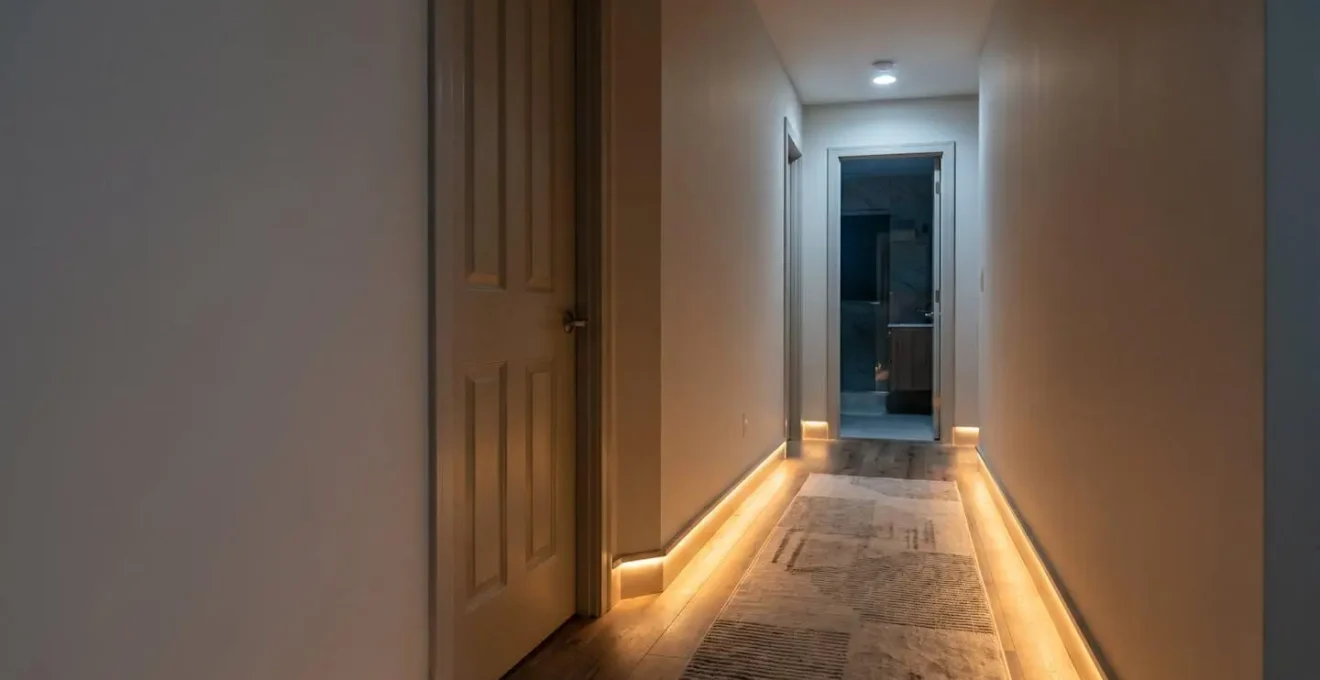
This visual illustrates the concept of overlapping light pools. Notice how the amber glow provides an uninterrupted walkway, with light sources positioned low to the ground. This ensures the floor is clearly visible, guiding the user safely from the moment they leave their bed until they reach the bathroom, completely eliminating the risk of navigating in darkness.
Plug-In Motion Lights vs Hardwired Systems: Which Suits a UK Rental Property?
Choosing the right lighting system for a rental property involves balancing effectiveness with the terms of a tenancy agreement. Landlords are often, and understandably, reluctant to approve modifications that involve drilling, chasing wires into walls, or altering the property’s permanent electrical fixtures. This makes non-invasive, temporary solutions highly attractive for tenants looking to improve safety for an elderly relative.
Plug-in and battery-powered lights are the least invasive options. They require no electrical expertise and can be installed in minutes. Battery-powered “stick-on” puck lights are perfect for inside wardrobes or on the underside of cabinets. Plug-in motion sensors, which often control a separate lamp or light strip, are ideal for hallways and living spaces. Their main drawback is cable management; trailing wires can themselves become a trip hazard and must be carefully secured with cable clips or trunking. While effective for basic pathway lighting, they rarely offer the advanced features of a hardwired system.
Hardwired systems, by contrast, offer a seamless, professional, and more reliable solution. Lights are integrated directly into the home’s electrical circuit, eliminating visible wires and the need to change batteries. This allows for more sophisticated setups, like interconnected LED strip lighting along skirting boards or ceiling-mounted mmWave fall detectors. However, this requires permission from the landlord and the work must be carried out by a qualified electrician, representing a higher upfront cost and a permanent alteration to the property.
The table below provides a clear comparison to help you decide which approach is most suitable for your circumstances.
| Solution Type | Installation Impact | Removal Difficulty | Typical Cost | Best For |
|---|---|---|---|---|
| Battery-Powered Stick-On Lights | Zero (adhesive only) | Easy – no damage | Low | Temporary needs, strict landlords |
| Plug-In Motion Sensors | Low (cable clips) | Easy – removable | Medium | Short-term tenancies, DIY installation |
| Hardwired LED Systems | High (electrical work) | Permanent fixture | High | Long-term tenancies, landlord agreement |
| Smart Bulb Replacements | Zero (standard sockets) | Instant – swap back | Medium | Existing fixtures, tech-savvy users |
A pragmatic middle ground for renters is the use of smart bulbs in existing fixtures. A standard lamp can be transformed into a motion-activated night light by pairing a smart bulb with a wireless motion sensor, offering a degree of smart control without any permanent installation.
The Bright Light Mistake That Disorients Dementia Patients at Night
When installing night lighting, the most common mistake is to focus only on brightness, assuming “brighter is safer.” For a person living with dementia, this can be dangerously counterproductive. The quality of light—specifically its colour temperature—is as important as its presence. A sudden blast of bright, cool-white light in the middle of the night can be profoundly disorienting, increasing confusion, anxiety, and even the risk of a fall.
The reason lies in our biology. The human body’s internal clock, or circadian rhythm, is heavily influenced by light. As research from the Lighting Research Center at Rensselaer Polytechnic Institute demonstrates, short-wavelength blue light (which gives “cool white” light its crisp appearance) suppresses the production of melatonin, the hormone that regulates sleep. Exposing a person to this type of light at night effectively tells their brain it’s time to wake up, disrupting fragile sleep patterns and contributing to the phenomenon of “sundowning.”
The solution is to use circadian-safe lighting. This means using a warm, amber-coloured light with a low colour temperature (around 2700K or less). This type of light has minimal impact on melatonin production, providing enough illumination to see safely without jarring the body’s sleep cycle. The lighting should also be at a low intensity and positioned at a low level, such as along skirting boards or under the bed frame, to illuminate the floor without shining directly in the person’s eyes.
As experts from the Rensselaer Polytechnic Institute Lighting Research Center note in their research on light treatment for dementia patients:
The circadian system responds more favourably to short wavelength (blue) light during daytime, with a peak sensitivity close to 460 nanometres, but this same stimulus at night can worsen sleep disorders in persons with dementia.
– Rensselaer Polytechnic Institute Lighting Research Center, Effect of home-based light treatment on persons with dementia
Therefore, a well-designed system might even use tunable-white LEDs that automatically provide bright, blue-rich light during the day to promote wakefulness and then shift to a soft, warm amber glow after sunset to support a healthy sleep-wake cycle.
When Should You Install Night Lighting Before the First Serious Fall Occurs?
The most dangerous time to address fall risk is after the first serious fall has already happened. The goal of any safety system is prevention, which means acting proactively based on early warning signs, not reacting to a crisis. In the UK, the scale of the problem is staggering; analysis by TakingCare Personal Alarms reveals that an elderly person aged 80 or over falls approximately every 10 seconds. The question isn’t *if* a fall will happen, but when, and the key is to install safety measures like intelligent lighting at the first sign of increasing risk.
Waiting for an obvious cue like a fall is a flawed strategy. Instead, families should watch for subtle but significant changes in behaviour and health that signal a heightened risk. A new medication that causes dizziness, a recent hospital stay that has reduced mobility, or a diagnosis of a condition like osteoporosis are all major red flags. These are clear medical indicators that the individual’s stability is compromised, and their environment needs to be adapted accordingly.
Beyond medical triggers, behavioural signals are often the most telling indicators. The most classic sign is “furniture walking“—when a person begins to use walls, tables, and chairs for support as they move around a room. This is a clear, non-verbal communication that they no longer feel stable on their own. It is a direct indication that their risk of falling between these “support points” has dramatically increased. Another powerful signal is a voiced fear of falling, which can lead to reduced activity and a subsequent loss of muscle strength, creating a vicious cycle of risk.
This image captures the exact moment of “furniture walking.” It’s a quiet, often overlooked behaviour that serves as a critical early warning. Seeing this is the signal to act immediately, implementing safety measures like a continuous lighting path before that reliance on furniture fails.
Your Proactive Fall Prevention Checklist: 5 Triggers to Watch For
- Medical Triggers: Has a new medication been prescribed that lists dizziness as a side effect? Has there been a recent hospital discharge that has impacted strength or mobility?
- Behavioural Observation: Have you noticed the person “furniture walking” – using walls or furniture for support while navigating rooms? This is a critical warning sign of instability.
- Sensory & Mobility Decline: Has there been a new diagnosis affecting balance or vision, such as osteoporosis? In the UK, 3 million residents are at higher fracture risk from this condition.
- Psychological Cues: Is the person expressing anxiety about falling? A fear of falling can lead to reduced mobility, which in turn increases fall risk.
- Environmental Factors: As autumn approaches, do the clocks changing and earlier darkness increase the number of trips to the bathroom in the dark? This seasonal change is a predictable risk factor.
The Dark Hallway Mistake That Doubles Night-Time Fall Risk
The single most common and correctable mistake in home safety for seniors is the unlit path from the bed to the bathroom. A dark hallway is not a minor inconvenience; it’s an obstacle course fraught with peril. In the dead of night, groggy from sleep, a person’s balance and spatial awareness are already compromised. Forcing them to navigate a familiar space in complete darkness, or to fumble for a light switch, dramatically increases the chance of a fall. The consequences are severe, as new data from UK NHS trusts shows there were over 284,280 ambulance callouts for fall-related emergencies among the over-65s in a single year.
The journey to the light switch itself is often the most dangerous part of the trip. The path may be cluttered with shoes, a rug corner may have lifted, or a piece of furniture may be slightly out of place. In daylight, these are minor annoyances; in darkness, they are significant trip hazards. The simple act of installing motion-activated lighting completely removes this initial, high-risk phase of navigation. The moment a person’s feet hit the floor, the path ahead should already be illuminated.
This isn’t about floodlighting the house. It’s about providing a gentle, low-level wash of light that guides the way and clearly defines the walking path and any potential hazards. An intelligent system eliminates the need for guesswork, automatically brightening the room as soon as movement is detected. The journey is no longer from bed to light switch, but simply from bed to bathroom, with the environment adapting to ensure safety at every step. This simple environmental change transforms a high-risk activity into a safe and routine one, significantly mitigating one of the most common causes of falls in the home.
Leaving a hallway dark at night is an unforced error in home safety. It’s a gamble that a person’s memory of the layout is perfect, that their balance is unflinching, and that no temporary obstacles are in the way. It is a risk that is entirely unnecessary when automated lighting solutions can provide a simple, effective, and life-saving alternative.
Why Does Your Home Pendant Alarm Not Work Once You Leave the House?
A common and dangerous misconception surrounds traditional pendant alarms. Many families invest in these devices for peace of mind, believing their loved one has a lifeline in any emergency. While invaluable within a certain range, it is crucial to understand their primary limitation: most standard, home-based pendant alarms are tethered to a base unit and are completely ineffective once the user leaves the property.
The technology is straightforward. The system consists of two parts: the pendant or wrist-worn button, and a base unit that is plugged into the mains and connected to a telephone line or the mobile network. When the button is pressed, it sends a radio signal (similar to a cordless phone) to the base unit. It is the base unit that makes the call to the monitoring centre or a designated family member. The pendant itself has no ability to make a call.
The critical factor is the range of the radio signal between the pendant and the base unit. Typically, this is between 50 and 100 metres in open air. However, inside a house, thick walls, concrete floors, and other electronic devices can significantly reduce this range. This is usually sufficient to cover the house and immediate garden, but the moment the person walks down the street to the shops or to a neighbour’s house, they are out of range. Pressing the button will do nothing because the signal cannot reach the base unit back at home.
This limitation is a key reason for the development of mobile or GPS-enabled pendant alarms. These devices look similar but contain their own SIM card and GPS tracker. They are not tied to a base unit and function like a simple mobile phone. When the button is pressed, the device itself calls the monitoring centre and uses GPS to transmit the user’s exact location, whether they are in the living room, at the local park, or in a different city. Understanding this distinction is vital when building a comprehensive digital safety net for an active senior.
Key Takeaways
- True fall detection relies on intelligent analysis of movement (like mmWave radar), not just the simple presence detection of a standard PIR motion sensor.
- The quality of light is crucial for dementia patients; use low-level, warm amber light (2700K) at night to avoid disrupting circadian rhythms and causing disorientation.
- Install safety lighting proactively based on early warning signs like “furniture walking” or new medications, not reactively after a serious fall has already occurred.
Which Room in Your Home Contains the Most Hidden Fall Hazards?
When asked to identify the most hazardous room in a house, most people point to the bathroom or the kitchen, citing wet floors or sharp corners. While these rooms certainly have their risks, the most insidious and often overlooked fall hazards are not confined to a single room. Instead, they are found in the transitional spaces: the thresholds between rooms, the top and bottom of stairs, and any area where flooring changes from carpet to laminate or tile.
A person’s gait is often adapted to a specific surface. When moving from a soft, high-friction carpet to a hard, low-friction laminate floor, the body must make micro-adjustments to balance and foot pressure. A slight, almost unnoticeable lip on a threshold strip can be enough to catch a toe, especially for someone who shuffles their feet. A single, unexpected step down into a sunken living room, even one that has been navigated a thousand times, can be a major hazard in low light or when distracted. These are the places where falls happen. The cost of such falls is immense, with a recent audit revealing the cost of treating falls in UK hospitals is estimated at £630 million per year.
Therefore, a fall hazard audit should focus less on rooms and more on routes. Trace the most common paths a person takes during the day and, crucially, at night. Is the path from the living room chair to the kitchen clear of loose rugs or trailing cables? Can you walk from the bed to the bedroom door in complete darkness without navigating around any furniture? The hallway, often seen as a simple conduit, is a prime location for temporary hazards like shoes, bags, or post on the floor, which become major trip risks in the dark. In older UK properties, such as Victorian terraces, the steep, narrow staircases are particularly dangerous and require excellent lighting at both the top and bottom, along with secure handrails.
The most dangerous “room” is the one you are transitioning into or out of. By focusing on making these transitional zones as safe as possible—with good lighting, clear pathways, and minimal changes in level or surface—you address the root cause of many household falls.
The next logical step is to conduct a thorough assessment of your home and your relative’s specific needs to determine the right combination of proactive pathway lighting and reactive fall detection technologies.