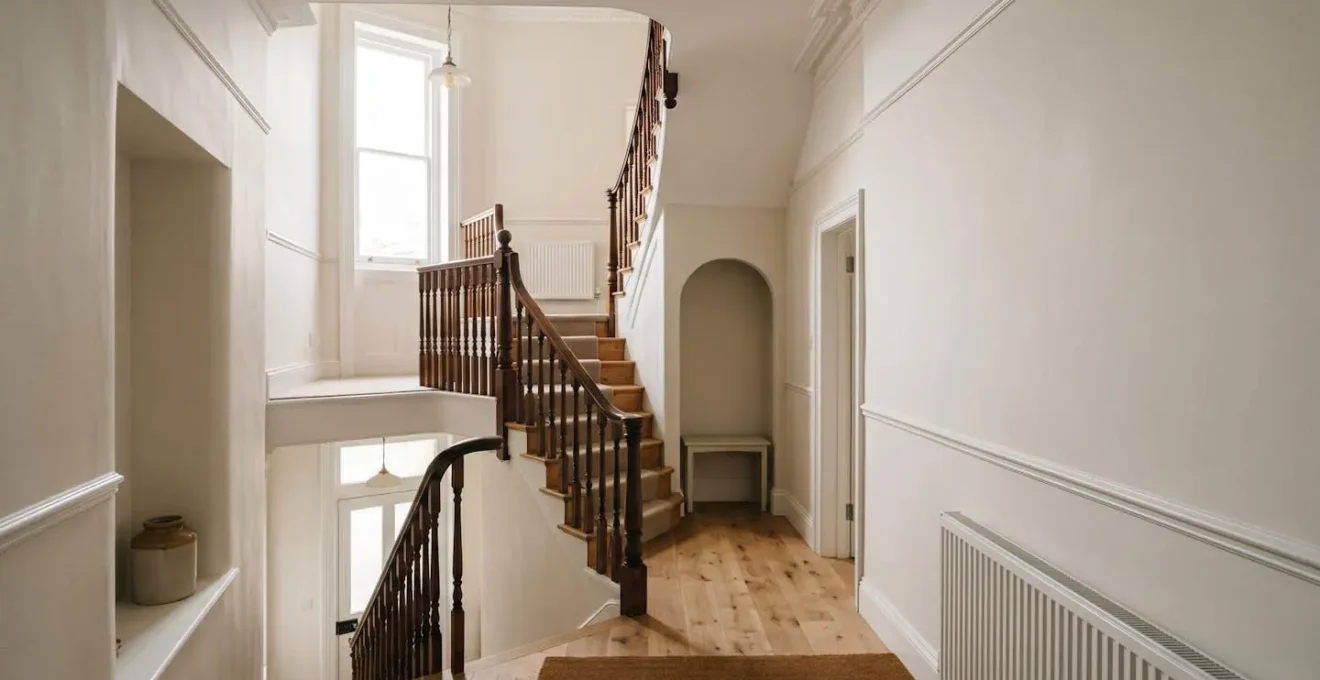
Yes, installing a home lift is entirely feasible in most UK semi-detached houses, but success depends on understanding it as a structural project, not just a product purchase.
- The primary constraints are structural realities like party walls and floor joists, not a lack of space.
- Planning permission is often not required for internal lifts, but Building Regulations approval is always mandatory.
Recommendation: Prioritise a structural survey to determine the optimal lift type and location *before* getting quotes, as the house dictates the lift, not the other way around.
For many homeowners in the UK’s ubiquitous semi-detached houses, the idea of installing a home elevator seems like a luxury reserved for new-build mansions or sprawling detached properties. The prospect of staying in a beloved family home long-term often clashes with the reality of a staircase that becomes a daily obstacle. The default solution is often a stairlift, but for true, unrestricted mobility, a domestic lift offers a far more dignified and practical solution for vertical circulation.
While many brochures focus on the sleek features of the lifts themselves, they often gloss over the core question for a typical 1930s or 1950s semi: “Will this actually work in *my* house?” The answer lies not in the lift’s brochure, but in the structural realities of your home, the bureaucratic hurdles of local planning, and a pragmatic financial assessment. This isn’t just about choosing a product; it’s about managing a minor construction project.
The key is shifting perspective. Instead of asking “Which lift do I want?”, the right question is “Which lift does my house allow?”. This guide moves beyond sales pitches to provide a feasibility-focused framework. We will explore the critical differences between lift types for narrow spaces, the planning permission pitfalls that cause months of delays, the non-negotiable technical requirements that protect your warranty, and the true cost-benefit analysis of adapting your home versus the upheaval of moving to a bungalow.
This article provides a structured path to understanding whether a home elevator is a viable investment for securing your independence. Below is a summary of the key feasibility checks we will explore, guiding you from initial assessment to a confident decision.
Summary: A Homeowner’s Feasibility Guide to Domestic Lifts
- Why Do Some Home Elevators Require Planning Permission While Others Do Not?
- Through-Floor Platform Lift vs Cabin Elevator: Which Suits a Narrow UK Home?
- Pneumatic Vacuum Lift vs Hydraulic: Which Is Quieter for a Residential Setting?
- The Pit Depth Mistake That Voids Home Elevator Warranties
- When Should You Incorporate a Home Elevator into a Whole-House Renovation?
- Stairlift vs Through-Floor Lift: Which Requires More Structural Work to Install?
- The Planning Permission Oversight That Adds 3 Months to Home Adaptation Projects
- Should You Move to a Bungalow or Adapt Your Two-Storey Home for Vertical Circulation?
Why Do Some Home Elevators Require Planning Permission While Others Do Not?
One of the first questions homeowners ask concerns planning permission, and there’s a crucial distinction to make. The good news is that most internal home lift installations qualify as permitted development in the UK. This means for a standard through-floor lift that is entirely contained within the existing footprint of your house, you typically won’t need to apply for planning permission. The work is considered an internal alteration, similar to moving a non-load-bearing wall.
However, the moment the installation affects the external appearance or structure of your property, the rules change. This is where many projects encounter unexpected delays and costs. Planning permission becomes a firm requirement if the installation involves any external structural changes, such as an external shaft, a motor housing on the roof, or if it alters the external footprint or height of the building. Furthermore, if your property is a listed building or located in a conservation area, you will almost certainly need special consent even for internal alterations. Any work on a flat or maisonette will also require freeholder approval.
It is vital to understand that planning permission is entirely separate from another mandatory requirement. As residential lift specialists Swift Lifts UK point out in their guide, “Building Regulations approval is always required regardless of planning permission status.” This process ensures the installation is structurally sound, fire-safe, and accessible, covering aspects like ventilation, structural support, and electrical safety. Ignoring this can lead to enforcement action from the council and invalidate your home insurance.
Key Checklist: When Planning Permission Is Essential
- The property is listed – any alteration requires Listed Building Consent.
- The property is in a conservation area and the lift affects the external appearance.
- The installation involves external structural changes (e.g., an external shaft).
- The lift shaft alters the external footprint or height of the building.
- The property has had its permitted development rights removed via an Article 4 direction.
Through-Floor Platform Lift vs Cabin Elevator: Which Suits a Narrow UK Home?
For a typical UK semi-detached house, where space is at a premium, the choice of lift type is dictated by footprint. The two most common options are the through-floor platform lift and the more traditional cabin elevator. A through-floor lift is a self-contained unit that travels on rails through an aperture cut in the ceiling/floor, often designed to be discreet and park away when not in use. A cabin elevator operates within a dedicated, constructed shaft, feeling more like a commercial lift.
While a cabin elevator offers a more enclosed experience, it generally requires a larger footprint and more significant construction for the shaft. In contrast, modern through-floor lifts are specifically engineered for domestic settings, with remarkably small footprints. However, “small” is relative, and the critical factor is not just the lift’s dimensions but the required manoeuvring space for a wheelchair user at each landing. This is a crucial detail often overlooked at the initial stage.
As the visual concept above suggests, planning for a lift is an exercise in spatial awareness. You must account for the turning circle of a wheelchair and clear access to and from the lift. A compact lift is useless if the user cannot get into it safely. The following table breaks down the typical spatial requirements.
This comparative data on lift dimensions highlights a key trade-off. While a compact cabin lift might have a similar footprint to a through-floor model, the latter is often more practical for wheelchair access in a standard UK home. The through-floor design, without a full shaft, can be more flexibly positioned away from tight hallways, for example, in the corner of a living room travelling up to a bedroom.
| Lift Type | Minimum Footprint | Wheelchair Accessibility |
|---|---|---|
| Through-Floor Platform Lift | 900mm x 1040mm to 1100mm x 1400mm | Single wheelchair (standard width) |
| Compact Cabin Elevator | 840mm x 880mm to 1100mm x 1400mm | Limited – may not accommodate powered wheelchairs |
| Standard Cabin Elevator | 1100mm x 1400mm minimum (residential) | Full wheelchair accessibility including powered models |
Pneumatic Vacuum Lift vs Hydraulic: Which Is Quieter for a Residential Setting?
When installing a lift in a semi-detached house, your neighbour’s peace and quiet becomes a primary consideration, especially if the lift is against the shared party wall. Noise and vibration are therefore critical factors in choosing the drive system. The main contenders are hydraulic systems and the more modern pneumatic vacuum elevators (PVE).
A hydraulic lift uses a pump to push fluid to a piston that raises the car. These systems are known for being smooth and powerful. The pump is typically housed in a separate machine room (or a cabinet), which helps to isolate the noise. However, the system generates noise on both ascent and descent. A pneumatic lift operates using air pressure, with turbines creating a vacuum above the car to lift it. Its main advantage is that descent is almost silent, using gravity and the controlled release of air.
The trade-off is the noise during ascent. While a hydraulic lift might operate at a consistent 55 dB, some sources suggest pneumatic lift turbines can reach up to 85 decibels during upward travel, comparable to a loud vacuum cleaner. This noise, although brief, can be a significant consideration. The key advantage of pneumatic and other modern self-supporting lifts is their reduced structural impact.
Party Wall Act Implications for Semi-Detached Installations
For semi-detached properties, any work affecting the shared ‘party wall’ falls under the Party Wall Act 1996. A hydraulic system that requires fixing structural components into this wall necessitates a formal written agreement with your neighbour before work can begin. A dispute here can freeze a project. In contrast, modern self-supporting through-floor or pneumatic lifts often avoid this entirely as they don’t require load-bearing attachments to the party wall, minimising vibration transfer and legal complexity.
This table compares the noise profiles and vibration risk, which is crucial for a semi-detached setting. While the pump of a hydraulic system can be located away from the party wall, the structural connection may still transmit vibration.
| Lift System | Ascent Noise | Descent Noise | Vibration Transfer Risk |
|---|---|---|---|
| Pneumatic Vacuum Elevator | ~85 dB (vacuum turbine active) | Near silent (gravity descent) | Minimal – self-supporting structure |
| Hydraulic Lift | ~55 dB (pump in separate room) | ~55 dB (controlled descent) | High – structural vibration through party wall if attached |
The Pit Depth Mistake That Voids Home Elevator Warranties
While homeowners focus on the visible cabin and doors, one of the most critical structural elements of a home elevator is unseen: the pit. The pit is the excavated area below the floor level of the lowest landing. Its depth is not arbitrary; it is a precision-engineered space dictated by safety standards, and getting it wrong is a costly mistake that can void your warranty and compromise safety.
Many modern through-floor platform lifts are advertised as “pit-less” or requiring a “shallow pit,” which is a major advantage in existing homes as it minimises construction. However, for more traditional cabin elevators, a pit is non-negotiable. According to UK Building Regulations and BS EN 81 standards, passenger lift pit depths can range from 600mm to 1500mm. An incorrectly constructed pit—too shallow, too deep, or not properly waterproofed (tanked)—can prevent the lift from being commissioned and will likely void the manufacturer’s warranty from day one.
The pit serves several vital functions. It houses the buffers that provide a final, safe stop for the lift car. It allows the lift floor to sit perfectly flush with the home’s flooring for seamless, trip-free access. Crucially, it provides a safe refuge space for engineers during maintenance, a mandatory requirement under safety regulations. Future Lift Services UK, a lift maintenance specialist, warns, “Incorrect pit depth can lead to unintended car movement, non-compliance with safety standards, and expensive reworks during a construction project.” Digging out a concrete floor in a finished home to deepen a pit by a few hundred millimetres is a disruptive and expensive process that can be avoided with proper planning.
This is why the initial technical survey is so important. A lift consultant will assess your ground floor structure, check for services under the floor, and specify the exact pit dimensions required for your chosen lift, ensuring compliance before a single spade of earth is turned.
When Should You Incorporate a Home Elevator into a Whole-House Renovation?
The absolute best time to consider a home elevator is during a major renovation or extension project. Integrating the lift at the design stage, rather than retrofitting it later, offers significant cost savings, better aesthetic integration, and superior structural integrity. The disruption is absorbed into the main project, and decisions can be made when walls and floors are already open.
However, even if you are not ready to install the full lift mechanism, a major renovation offers a unique, one-time opportunity to “future-proof” your home with what is known as a “shaft-ready” strategy. This involves building the empty, structurally sound space for a lift during the main construction work. The cost of building a void with removable flooring is a fraction of the cost and disruption of cutting through finished floors and ceilings years later.
This approach transforms the future installation from a major structural intervention into a simpler, cleaner process of fitting the lift into a prepared space. It’s about thinking ahead, as the close-up, textural view of construction materials suggests. During the renovation, your architect and builder can work with a lift supplier to ensure the shaft dimensions are correct, power is run to the right place, and floor joists are configured to accommodate the future aperture. This forward-planning is the most cost-effective way to ensure your home can adapt to your needs for decades to come.
Your Action Plan: The Shaft-Ready Strategy for Renovations
- Design Integration: Coordinate shaft dimensions with your chosen lift supplier during the architectural design stage.
- Structural Preparation: Build the empty, structurally sound shaft with reinforced floor openings during major construction.
- Electrical Pre-wiring: Run the necessary electrical conduits and power connections before new floors and walls are closed up.
- Temporary Decking: Install removable temporary decking over the floor openings, which can be easily lifted when the lift is ready to be installed.
- Documentation: Keep all architectural plans and builder’s specifications for the prepared shaft to give to the future lift installation team.
Stairlift vs Through-Floor Lift: Which Requires More Structural Work to Install?
At first glance, a stairlift seems like the less disruptive option. It attaches to the stair treads, requires no holes in the ceiling, and can often be installed in a single day. In contrast, a through-floor lift involves cutting a significant aperture through a floor and ceiling. This leads many to assume the stairlift involves minimal structural work, but this is a common and potentially risky oversimplification.
The key difference is the nature of the load. A through-floor lift’s load is static and transferred directly to the floor joists in a planned, reinforced manner. The structural work, while significant, is concentrated on creating and reinforcing the aperture. A reputable installer will use a surveyor to ensure joists are properly cut and supported with new timber (trimming). While this is a clear construction task, the “hidden” work of re-routing pipes and wires within the floor void is often what adds time and cost.
A stairlift, on the other hand, places a continuous, dynamic, and often leveraged load onto the staircase itself. The rail is fixed to the stair treads, and as the chair moves, it pulls and pushes on these points. For a modern, well-built staircase, this is rarely an issue. However, in many older UK semi-detached houses with non-standard, winding, or weakened staircases, this can be a problem. As lift specialists Swift Lifts UK rightly point out, “a stairlift places a continuous dynamic load on the staircase structure itself – a hidden risk for older, non-standard UK staircases.” A proper survey is essential to confirm the staircase can safely bear this repeated load over many years.
The ‘Hidden’ Work of a Through-Floor Lift
While the lift mechanism for a through-floor lift can be installed in 1-3 days, the true project timeline is longer. The primary “hidden” structural work involves dealing with what’s inside the floor/ceiling void. Cutting the aperture frequently requires re-routing central heating pipes, electrical wiring, and sometimes even moving floor joists. Following installation, the “making good” costs for re-plastering, re-carpeting, and re-decorating on two floors are a significant part of the real project cost and effort that must be factored in from the start.
The Planning Permission Oversight That Adds 3 Months to Home Adaptation Projects
Even when a project qualifies as “permitted development” and avoids the main planning permission process, there are several bureaucratic tripwires that can halt a project for months. These oversights often stem from a misunderstanding of how different regulatory bodies and grant processes interact—or fail to interact.
One of the most common and costly mistakes involves the Disabled Facilities Grant (DFG). This is a council grant designed to help with the cost of home adaptations. However, according to UK local authority guidance, the DFG approval process runs separately from and often concurrently with planning and building regulations. A homeowner might get the all-clear from the planning department and, eager to start, instruct builders to begin work. This is a critical error. Starting work before the DFG is formally awarded can make you entirely ineligible for the funding, leaving you to cover costs that could run into tens of thousands of pounds.
Another major delay, particularly for semi-detached homes, is failing to correctly follow the Party Wall Act 1996. If your lift installation requires any structural work on the shared wall, you are legally required to serve notice on your neighbour. If they dissent, it can trigger a dispute resolution process involving surveyors that can freeze your project for months. Assuming your neighbour “won’t mind” is not a valid legal position. These bureaucratic processes, as suggested by the image of patient waiting, demand careful navigation and timing.
Your Checklist: Avoiding Critical Project Delays
- DFG Process: Never start any work before the Disabled Facilities Grant is formally awarded in writing by the council.
- Party Wall Act: For semi-detached homes, always serve the correct notice on your neighbour for any structural work on the shared wall, well in advance.
- Listed Building/Conservation Area: Always assume you need special consent for any alteration, no matter how minor, and verify with the council’s conservation officer first.
- Building Regulations: Do not mistake planning permission (or lack thereof) for Building Regulations approval. They are separate, and both are required.
- Article 4 Directions: Check with your local planning authority to ensure your property’s “Permitted Development” rights have not been removed.
Key Takeaways
- Feasibility in a UK semi-detached home is high, but dependent on structural and regulatory checks.
- The Party Wall Act is a critical consideration for semi-detached properties, influencing the choice of lift system.
- The “true cost” of a lift must include structural work and “making good,” not just the purchase price.
Should You Move to a Bungalow or Adapt Your Two-Storey Home for Vertical Circulation?
This is the ultimate question facing many seniors: invest in adapting the current home or face the significant upheaval and cost of moving to a single-storey property? The decision is both emotional and financial, and a clear-eyed comparison is essential.
The “Adapt” option involves the cost of the lift itself, plus installation. According to 2024 UK domestic lift market analysis, basic domestic lifts in the UK start from £18,000, with premium models ranging up to £30,000. On top of this, you must factor in the cost of any building work, re-decorating, and annual maintenance contracts, which can be around £200-£500. While this seems a large sum, it must be weighed against the true cost of moving.
The “Move” option is rarely just the difference in property price. The list of associated “dead money” costs is extensive and often underestimated. These include Stamp Duty Land Tax, solicitor fees for both selling and buying, estate agent commissions, removal company costs, and survey fees for the new property. In many parts of the UK, the premium paid per square foot for a bungalow can also be significant. When tallied up, these transaction costs can easily exceed the price of a high-end domestic lift installation.
Finally, there’s the question of resale value. A common concern is that a highly adapted home might have a narrower market appeal. However, this can be mitigated. As mobility experts My Mobility UK note, a strategy using a through-floor lift that “can be easily removed and the aperture floored over” allows you to maximise accessibility now without compromising future saleability. The space can be returned to its original state for a relatively low cost, a feature not possible with other major adaptations.
Your Action Plan: Calculating the True Cost of Moving
- Property Price & Stamp Duty: Calculate the bungalow price premium in your area and the corresponding Stamp Duty Land Tax.
- Professional Fees: Add estate agent fees (typically 1-3% of your sale price + VAT) and solicitor fees for both sale and purchase (approx. £1,500-£3,000).
- Moving & Survey Costs: Factor in removal company fees (£500-£2,000) and the cost of a building survey on the new property (£400-£1,500).
- Hidden Financials: Include any potential mortgage early repayment charges and the immediate costs of repairs or updates needed for the new property.
- Emotional Cost: Don’t forget the unquantifiable cost of leaving a familiar community, neighbours, and a home full of memories.
Ultimately, installing a home elevator in a standard UK semi-detached house is a highly achievable project. The key to success is to approach it with a clear understanding of the structural, regulatory, and financial realities. By conducting thorough due diligence and engaging with specialist surveyors and installers from the outset, you can transform your two-storey house into a home for life. The next logical step is to commission a professional site survey to get a definitive assessment of your property’s specific potential and constraints.