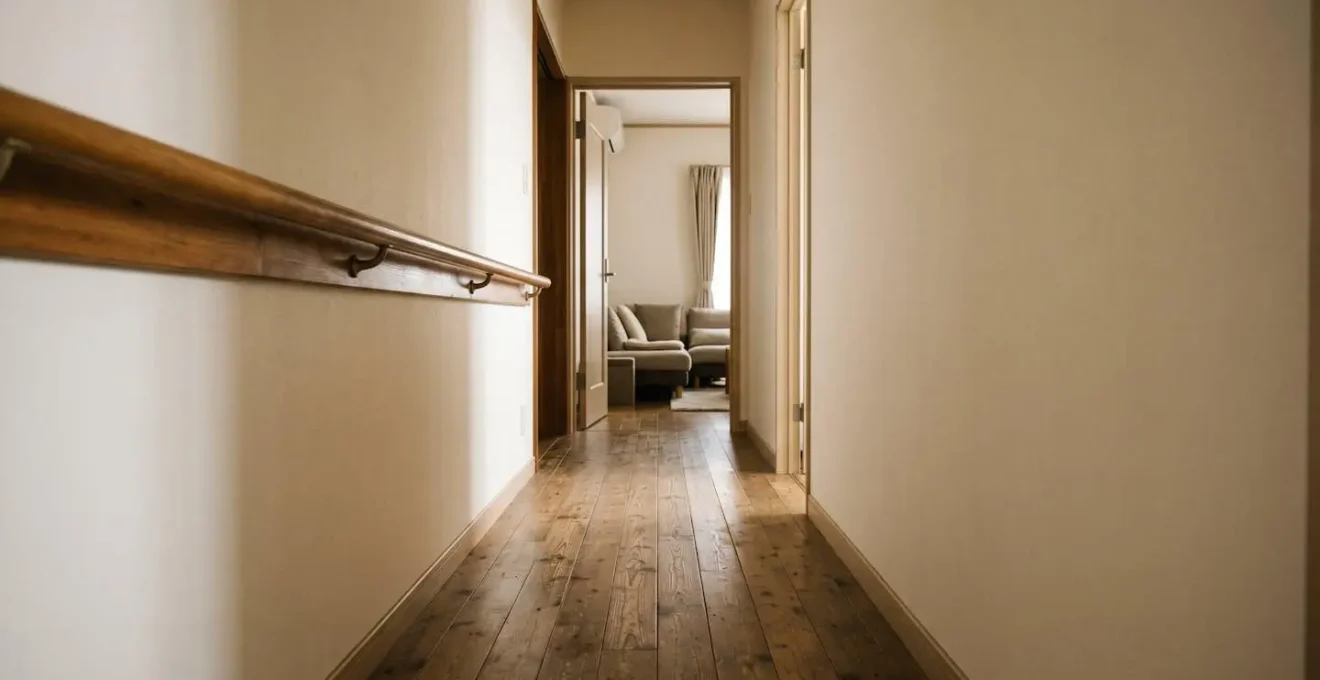
The most dangerous “room” in a senior’s home isn’t the bathroom or kitchen; it’s the invisible pathways they travel every day.
- Most falls happen during routine movements, like walking from the bedroom to the toilet at night.
- Common advice to “remove clutter” is incomplete; you must analyse *why* and *where* a person might stumble.
Recommendation: Instead of using a simple checklist, become a ‘fall detective’ to identify and fix risks within your loved one’s actual daily routines and pathways.
It’s a sound that stops your heart: a sudden shuffle, a muffled cry, and a thud from the other room. For families caring for an elderly parent in the UK, the fear of a fall is a constant, low-level hum of anxiety. You’ve likely heard the standard advice—remove loose rugs, improve the lighting, install a grab bar. While this is a start, it’s like trying to solve a puzzle with only half the pieces.
The truth, from years of working as a community physiotherapist, is that most falls don’t happen because of one single, obvious hazard. They happen within a system of smaller, interconnected risks that are often invisible to those who live with them every day. This is due to ‘familiarity blindness’—we stop seeing the worn carpet edge or the dark corner we navigate daily. But for someone with changing mobility, vision, or balance, these are accidents waiting to happen.
So, what if the most dangerous room isn’t a room at all, but the unlit, unsupported path between them? This guide will shift your perspective. We won’t just give you a checklist. We’ll teach you to become a ‘fall detective’ in your own home. You will learn to see your environment with fresh, critical eyes, identifying the risks hidden within your loved one’s daily process pathways. We’ll investigate the real reasons falls happen and provide actionable strategies to systematically dismantle the danger, one pathway at a time.
This article provides a structured approach to transform your home from a collection of potential hazards into a truly safe environment. The following sections will guide you through the key areas of investigation, giving you the tools to conduct a thorough and effective home safety audit.
Summary: Uncovering the Real Fall Risks in Your Home
- Why Do Loose Rugs Cause 40% of Home Falls Among Over-70s?
- How to Anchor Furniture So It Supports Weight Without Toppling?
- Carpet, Vinyl or Cork: Which Flooring Reduces Fall Injuries Most?
- The Dark Hallway Mistake That Doubles Night-Time Fall Risk
- When Should You Re-Audit Your Home for Fall Risks After a Health Change?
- How to Identify Hidden Fall Hazards in Your Home Before Calling an Occupational Therapist?
- How to Install a Continuous Light Path from Bedroom to Bathroom?
- Where Should You Start When Adapting Your Home for Reduced Mobility?
Why Do Loose Rugs Cause 40% of Home Falls Among Over-70s?
The advice to “get rid of loose rugs” is the first thing on every fall prevention list, but it’s crucial to understand *why* they are so uniquely dangerous. It’s not just about tripping over a curled edge. Rugs represent a perfect storm of hazards: they can slip on a smooth floor, the transition from a hard surface to the rug can catch a foot, and they are often placed in high-traffic areas. This creates a systemic hazard, an object that introduces multiple failure points into a simple act like walking across a room.
A study of rug-related injuries revealed the profound risk they pose in specific contexts. For example, falls are incredibly common at the transition point between carpet and non-carpet flooring. A detailed analysis found that the bathroom is a particular hotspot, with falls often occurring on wet rugs or when a person is hurrying. This highlights a key ‘fall detective’ insight: the danger of an object is magnified by the user’s behaviour (urgency) and the environment (a wet floor).
The real issue is the unpredictable change in surface friction and height. An older adult who may have a shuffling gait or reduced sensation in their feet cannot easily adjust to these sudden changes. A rug that seems perfectly safe can slide just a few inches underfoot, which is more than enough to throw someone off balance. Therefore, removing rugs or securing them with high-quality, full-surface non-slip backing isn’t just about tidiness; it’s about creating a consistent and predictable floor surface throughout a process pathway.
How to Anchor Furniture So It Supports Weight Without Toppling?
As a fall detective, one of the first things you’ll notice is how often people instinctively reach for furniture to steady themselves. A bookshelf, a chest of drawers, or a TV stand becomes an unofficial grab bar along a high-traffic path. The problem is that modern, freestanding furniture is often not designed to take a person’s body weight, especially not a sudden, desperate grab during a stumble. This creates a severe toppling hazard.
Securing furniture to the wall, or ‘anchoring’, transforms a potential hazard into a reliable point of support. It’s a non-negotiable step for key pieces of furniture located along main walkways. The process is straightforward but requires attention to detail to be effective. The goal is to connect the furniture not just to the plasterboard, but to the solid wooden ‘studs’ within the wall structure for maximum strength.
The process of anchoring is a core skill for any home fall detective. This illustration shows the critical connection point.
As seen here, using the right hardware—strong brackets and screws long enough to bite into the wall stud—is essential. Avoid adhesive-only or plastic anchors for heavy items, as they can fail under the sudden load of a fall. The aim is to make the furniture an integral part of the wall, creating a safe and stable environment. Testing the installation by applying firm, gradual pressure ensures it will hold when it’s needed most.
Carpet, Vinyl or Cork: Which Flooring Reduces Fall Injuries Most?
While our primary goal is to prevent falls, a ‘fall detective’ must also consider what happens if a fall does occur. The type of flooring in your home plays a monumental role in determining the severity of an injury. A fall on a hard, unforgiving surface like ceramic tile is far more likely to result in a fracture than the same fall on a more compliant, energy-absorbing floor. This is a critical aspect of risk mitigation.
Hard surfaces like tile, laminate, or stone offer no ‘give’. All the energy of the impact is transferred directly to the body. While thick-pile carpet with high-quality underlay can provide cushioning, it can also pose its own risks, such as making it harder for wheelchair users or people with walkers to move, and its edges can become a trip hazard. The ideal solution lies in a category known as ‘compliant flooring’.
These are modern materials, such as specific types of vinyl, rubber, or cork, engineered to look like traditional flooring but with a crucial difference: they are designed to absorb impact. The data on this is compelling; a Swedish residential care study demonstrated a 59% injury risk reduction for falls on compliant flooring compared to standard floors. While a complete flooring overhaul may seem like a major project, prioritising it for high-risk areas like the bedroom or bathroom can be a life-changing investment in safety. It acts as a permanent safety net, reducing the consequences even when prevention fails.
The Dark Hallway Mistake That Doubles Night-Time Fall Risk
The journey from the bedroom to the bathroom is the most frequent and most perilous nighttime ‘process pathway’. This short trip combines multiple risk factors: disorientation from waking, urgency, and, most critically, darkness. It’s a mistake many families make due to ‘familiarity blindness’—they know the layout by heart. But for a senior with declining night vision or balance, a dark hallway is a minefield of unseen obstacles. The evidence is stark: fall prevention research shows that poor lighting more than doubles a senior’s risk of falling.
The solution isn’t just a bright, jarring overhead light, which can actually worsen disorientation and cause temporary blindness. The key is to create a continuous, low-level ‘path of light’ that guides the way without overwhelming the senses. This means illuminating the floor, not the ceiling. The goal is to clearly define the walking path and highlight any potential obstacles or changes in level.
Modern solutions make this easier and more effective than ever.
As this image demonstrates, low-level, motion-activated LED strips or a series of amber-coloured plug-in nightlights can create a reassuring runway of safety. This continuous illumination transforms a high-risk journey into a secure and guided process. It’s one of the single most effective changes you can make to improve nighttime safety, directly addressing a critical failure point in the home environment.
When Should You Re-Audit Your Home for Fall Risks After a Health Change?
A home safety audit is not a one-time event. A home that is perfectly safe today can become hazardous tomorrow following a change in a person’s health, mobility, or medication. As a ‘fall detective’, you must embrace the concept of proactive re-auditing. The environment must adapt as your loved one’s condition evolves. Waiting for a fall to happen before making changes is a reactive strategy with potentially devastating consequences.
Certain life events should serve as immediate triggers for a full home re-evaluation. A new medication that causes dizziness, a new glasses prescription that alters depth perception, or the introduction of a walking aid all change how a person interacts with their environment. Each of these requires you to re-trace their daily pathways and look for new, emerging risks. For instance, a doorway that was easy to navigate before may now be too narrow for a walker, creating a new bottleneck and potential hazard.
It’s also crucial to remember that you may be the only one looking out for these risks. Many older adults are reluctant to report falls or near-misses for fear of losing their independence. As the Centers for Disease Control and Prevention points out:
more than one out of four older people falls each year, but less than half tell their doctor
– Centers for Disease Control and Prevention, Facts About Falls – Older Adult Fall Prevention
This underreporting is why your role as an observant, proactive detective is so vital. You must look for the signs and conduct a re-audit after any significant health event, a near-miss, or even just at regular six-month intervals to catch gradual changes before they lead to an incident.
How to Identify Hidden Fall Hazards in Your Home Before Calling an Occupational Therapist?
The greatest challenge in making a home safe is overcoming ‘familiarity blindness’. You walk past the same potential hazards every day until they become invisible. The goal of a ‘fall detective’ is to break this spell and see the environment as a stranger—or, more accurately, as an Occupational Therapist—would. It’s about adopting a systematic method of investigation that reveals the dangers hidden in plain sight.
A simple room-by-room checklist is a start, but it often misses the most crucial risks: those that arise from the *process* of living. For instance, fall location data reveals that 55% of fall injuries among older people happen inside the home, often during the most mundane tasks. The hazard isn’t the static room; it’s the interaction between the person, the task, and the environment. Does reaching for a mug in the top cupboard require balancing on a wobbly stool? Does the path to the kettle cross a slippery rug? These are the questions a detective asks.
To do this effectively, you need a new set of tools. You must intentionally look at your home in new ways. This involves tracing the exact paths of daily tasks, observing where a hand reaches for support, and even using your phone’s camera to get a more objective view. By focusing on the actions of daily life, you uncover the specific points of failure in the home’s safety system.
Your 5-Step ‘Fall Detective’ Audit Plan
- Trace the Paths: Follow the most common ‘process pathways’ (e.g., bed to toilet, armchair to kitchen). Note every surface your loved one touches for balance—these are your critical points for assessment.
- Record and Review: Use your phone to film a common task, like making a cup of tea. Watch the video back later. This simple act breaks ‘familiarity blindness’ and reveals awkward reaches, stumbles, and unstable surfaces you’d otherwise miss.
- Test for Stability: Physically test the furniture and walls along these pathways. Does the bookshelf they lean on wobble? Does the wall feel solid? This identifies where ‘unofficial’ grab points are failing.
- Change Your Perspective: Intentionally shuffle your feet or get down to the height of a wheelchair user. This will reveal low-level hazards like raised thresholds, floor vents, and rug edges that are invisible from a standing height.
- Prioritise the Fear: Ask your loved one: “What one daily task worries you the most?” Focus your first and most intensive efforts on making that specific process pathway completely safe. This delivers the biggest impact on their confidence and safety.
How to Install a Continuous Light Path from Bedroom to Bathroom?
We’ve established that the unlit path from bedroom to bathroom is a major danger zone. Now, let’s look at the practical, actionable solutions. Installing a ‘continuous light path’ is a high-impact project that can be scaled to fit any budget or home. The principle is simple: provide an unbroken line of gentle, automatic light from the moment feet touch the floor to the moment they are safely back in bed. This eliminates the need to fumble for switches in the dark.
The importance of this specific pathway cannot be overstated. With some reports suggesting that as many as 80% of senior falls occur in the bathroom, ensuring the journey there is safe is paramount. A continuous light path addresses the primary risk factor for this journey: lack of visibility. Your solution should focus on illuminating the floor, be automatic, and have a time delay long enough for the return trip.
Here is a tiered approach to creating an effective light path:
- GOOD: Strategic Nightlights. The simplest and cheapest option. Install a series of modern, low-profile, amber-coloured plug-in nightlights along the base of the walls. Choose light-sensing models that turn on automatically at dusk. Ensure there are no gaps in coverage, especially around corners or doorways.
- BETTER: Motion-Activated LED Strips. A significant upgrade. These battery-powered or plug-in LED light strips are placed along the skirting boards. A motion sensor near the bed activates them, creating an instant ‘runway’ of light. They provide excellent, continuous coverage right at floor level.
- BEST: Integrated Smart System. The gold standard. This involves a pressure sensor placed under the bed leg or mattress. When the person gets out of bed, it triggers a hard-wired, low-voltage lighting system along the entire path. These systems can have programmable delays and are the most reliable, often with battery backups for power cuts.
Whichever system you choose, the key is continuity. Walk the path yourself in the dark to identify and close any gaps in illumination. This single project can be one of the most effective fall prevention measures you ever implement.
Key takeaways
- Adopt a ‘Fall Detective’ mindset; investigate daily routines rather than just using a generic checklist.
- Focus on securing high-traffic ‘Process Pathways’ (like bed-to-bathroom) where most falls occur during movement.
- Systemic solutions like compliant flooring and continuous, low-level lighting offer a constant layer of protection.
- A home safety audit is not a one-off task; it must be repeated after any change in health, medication, or mobility.
Where Should You Start When Adapting Your Home for Reduced Mobility?
You’ve adopted the ‘fall detective’ mindset and understand the principles. The sheer number of potential improvements can feel overwhelming. Where do you begin? The key is strategic prioritisation. Not all changes are created equal, and focusing your initial energy on the areas with the highest impact will build momentum and deliver the most immediate safety benefits.
Rather than trying to tackle the whole house at once, think in terms of ‘safety zones’ based on essential daily activities. By securing these critical zones first, you address the most frequent and necessary movements, providing a foundation of safety that you can build upon. This targeted approach is more manageable and effective than a scattered, room-by-room effort.
A proven method is to use a three-zone priority system:
- ZONE 1: Rest & Relief. This is the absolute top priority. It includes the bedroom and a clear, secure, well-lit path to the toilet. This pathway is used multiple times a day and night and is often where a person is most vulnerable. Ensure the bed is stable and at a safe height, and the path is free of all hazards.
- ZONE 2: Daily Sustenance. This zone covers the path from the person’s favourite chair (e.g., in the living room) to the kitchen. The focus here is on safe access to food and drink. This involves clearing the path and reorganising the kitchen so that frequently used items (kettle, mug, tea, snacks) are easily reachable between waist and shoulder height, eliminating the need for bending or stretching.
- ZONE 3: World Connection. This is the path to the outside world—typically the front door. Ensure this route is clear, well-lit, and has handrails if there are any steps. This is vital not only for social engagement but for emergency access and exit.
Start with Zone 1. Then, ask your loved one what single task causes them the most worry—the ‘most feared task’—and focus all your efforts on making that process safe. Combining the zone system with this person-centred approach provides a powerful and logical starting point for your entire home adaptation project.
By starting your investigation today with this clear, prioritised plan, you are taking the most important step toward creating a genuinely safe and supportive home environment for your loved one.